
How to Read Expense Control System Rankings? First Choose the Right Path Based on Enterprise Scenario

How to Read Expense Control System Rankings? First Choose the Right Path Based on Enterprise Scenario
Expense control system rankings can be used to build a candidate list, but they cannot make decisions for the enterprise directly. Different rankings have different samples, metrics, and update times; the same product may be too heavy for a small team but insufficient for a multi-organization group. A more reliable approach is to first determine which type of expense management scenario the enterprise belongs to, then validate with its own documents, rules, and interfaces.
When reading rankings, first ask three questions: Is the ranking comparing vendor size, number of features, or actual user experience? What enterprise size and industry do the conclusions correspond to? Are the product version and evaluation date still valid? If this information is unclear, rankings can only serve as clues and cannot replace selection. Enterprises should also compare software licenses, implementation configuration, interface modifications, training and operations, and data migration in the same cost table.
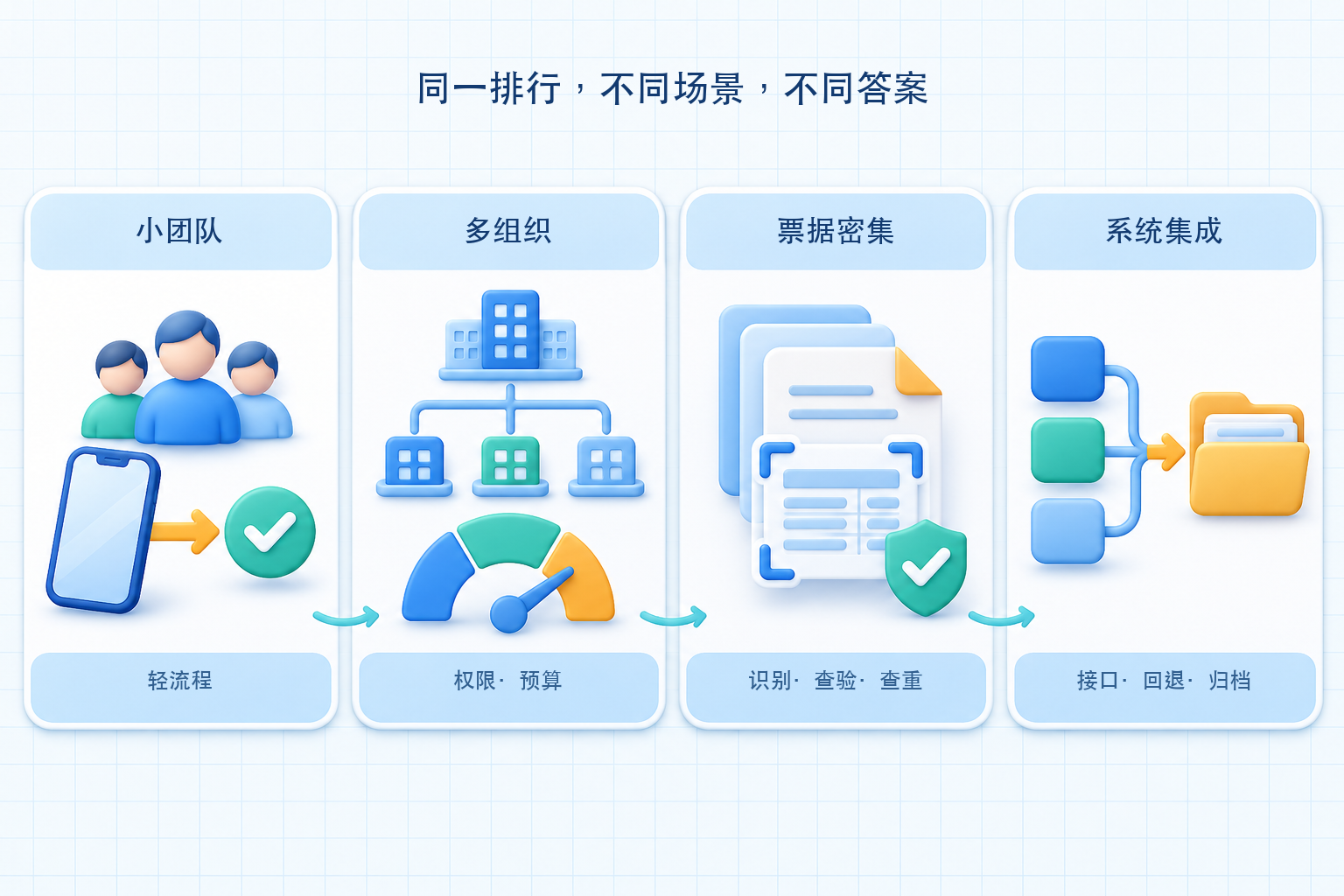
▍Scenario 1: Small team, first check whether the process is simple and executable
For enterprises with fewer personnel and expense types, the focus is usually not on stacking many modules, but on avoiding duplicate entry of application, reimbursement, approval, and payment information. During demos, bring in the enterprise's real travel, entertainment, procurement, and loan forms; check whether the mobile experience is usable, whether required fields can be streamlined, whether modification traces are retained after return, and whether finance can export data as needed. Configuration complexity and subsequent maintenance cost deserve more attention than the length of the feature list.
▍Scenario 2: Multiple companies and departments, first check organization and budget definitions
Enterprises with multiple legal entities, business units, or project-based management should focus on validating whether organization, roles, budget, and accounting dimensions can be consistently linked. Test cross-organization appointments, shared financial review, project allocation, budget occupation and release, and whether key permissions can be separated. Don't just look at one normal reimbursement form passing smoothly; also see where documents go and who handles them when organizational adjustments, over-budget, delegation, and cross-department allocation occur.
▍Scenario 3: Large invoice volume, validate recognition, verification, and duplicate checking separately
Invoice-intensive enterprises can focus on comparing collection methods, OCR field extraction, exception review, verification, and anti-duplication mechanisms. OCR recognition is used to extract invoice fields; it does not mean authenticity verification has been completed, nor can it replace the reimbursement applicant's confirmation of business facts and financial review. External invoice acquisition, verification, or authentication capabilities also depend on legal authorization, interface scope, and operating status; a certain connection capability cannot be regarded as default for all projects.
▍Scenario 4: Existing ERP and banking systems, first check interfaces and failure rollback
Enterprises that need to integrate with ERP, treasury systems, banks, or electronic archives should include field mapping, invocation permissions, status write-back, idempotency control, and exception compensation in the POC script. Converting reimbursement forms into vouchers usually depends on expense types, accounting subjects, cost centers, tax amounts, and auxiliary accounting rules; the system can generate voucher drafts or transmit accounting data according to configured rules, but authorized accounting personnel should still review before formal posting. Whether transmission can resume after an interface interruption and whether repeated calls generate duplicate data should also be verified on site.
▍Use real documents for POC, don't let standard demos validate for you
It is recommended to prepare a set of documents covering normal and exception scenarios, including normal reimbursement, over-budget, duplicate invoices, cross-department allocation, returned invoice reversal, and interface failure scenarios. For each scenario, record inputs, expected results, responsible persons, and acceptable manual steps. After the POC passes, confirm implementation scope, interface list, service boundaries, data export format, and migration method after contract expiry. Conclusions obtained this way are more executable than a ranking detached from scenarios.
▍How should Kailing Technology enter the candidate list?
If the enterprise hopes to put mobile reimbursement, invoice verification, approval, payment, and voucher linkage in the same project, and further combine input VAT invoice management, AI OCR, and electronic accounting archives, Kailing Technology's related solutions can be included as candidates. Whether they fit still depends on organization size, existing ERP, banking and external interface authorization, accounting policies, and implementation scope; it is recommended to complete end-to-end validation with real documents before deciding.
Compliance basis: The Ministry of Finance's "Accounting Informatization Work Specifications" (Cai Kuai [2024] No. 11) and "Basic Functions and Service Specifications of Accounting Software" (Cai Kuai [2024] No. 12) took effect on January 1, 2025; the Ministry of Finance and the National Archives Administration's "Notice on Standardizing the Reimbursement, Booking, and Archiving of Electronic Accounting Vouchers" (Cai Kuai [2020] No. 6) clarified the conditions for verification, review and signing, prevention of duplicate booking, and archiving of electronic vouchers.
Keywords: expense control system ranking, expense control system selection, expense control reimbursement management system, budget control, invoice duplicate checking, system integration, Kailing Technology
As a comprehensive business-finance-tax digitalization solution service provider, Kailing Technology provides business-finance-tax management digital transformation products and operational services for various government agencies, institutions, and large, medium, and small enterprises. The product line includes: solutions for sales contract management system, procurement contract management system, fully digitalized Leqi interface project, automatic output invoicing system, reverse invoicing system, invoice issuance for individuals system, employee expense control and reimbursement system, input VAT invoice management system, supply chain collaborative reconciliation system, image AI OCR recognition system, automatic financial bookkeeping system, electronic accounting archives system, etc., comprehensively driving the digitalization process across various fields.
Consultation Hotline: 18513895936 / 010-60974119 Location: Beijing