
How to choose an expense control platform? Reimbursement form to voucher without rework

How to choose an expense control platform? Reimbursement form to voucher without rework
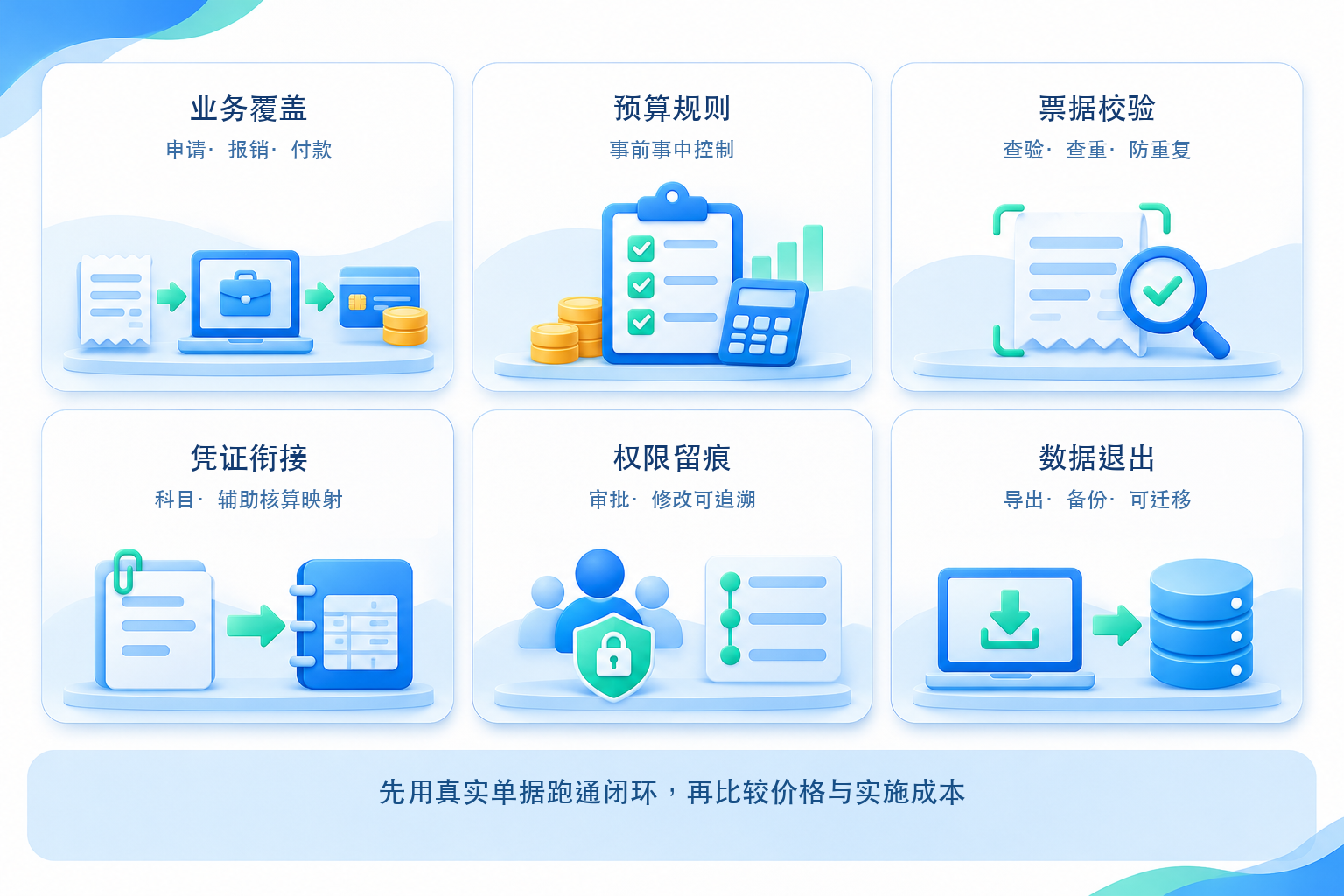
When choosing an expense control platform, do not only look at whether the approval page is attractive. A more effective approach is to use the enterprise's own real documents to run through application, reimbursement, payment, vouchers, and archiving, then accept it against six indicators: business coverage, budget rules, receipt validation, voucher linkage, permission audit trails, and data exit.
"Expense reports converted to vouchers without rework" should be understood as a selection goal, not an unconditional vendor commitment. Expense types, accounts, cost centers, tax amounts, auxiliary accounting, and reversal rules all need to be configured first; differences in interfaces, permissions, and accounting policies will also affect automation results. A responsible selection process should write these prerequisites into the demo script and acceptance checklist.
▍1. Business coverage: first map out your own document chain
List the most common expense scenarios in the enterprise, such as travel, entertainment, procurement, loans, prepayments, and corporate payments, and confirm whether the platform can connect application, reimbursement, payment, reversal, and archiving. Do not only look at standard demos; prepare at least normal documents, over-budget documents, return/modification documents, and cross-department allocation documents, and observe whether exceptions have a clear destination.
▍2. Budget rules: check at which point control occurs
The same "budget control" may only prompt at submission, or may occupy and release at multiple stages such as application, reimbursement, and payment. During selection, confirm the budget dimensions, standards, adjustment process, and concurrent occupation rules, and check whether over-budget results in a prompt, additional approval, or blocking. Budget results should also align with subsequent accounting standards to avoid financial staff having to split again.
▍3. Invoice validation: recognition, verification, and duplicate prevention must be accepted separately
OCR recognition is used to extract fields and does not equal completing authenticity verification; duplicate checking must also clarify the comparison scope and status. During testing, prepare clear invoices, blurry invoices, duplicate invoices, red-letter invoices, and original electronic voucher files, and confirm whether the system retains the original files and metadata, whether recognition errors can be manually corrected, and whether the correction process leaves an audit trail. External verification or data acquisition capabilities depend on lawful authorization, interface scope, and operating status; "direct connection to the tax bureau to automatically obtain all invoice sources" cannot be regarded as a default capability of all projects.
▍4. Voucher connection: focus on mapping, exceptions, and traceability
Require vendors to demonstrate with real expense types how accounts, cost centers, tax amounts, auxiliary accounting, and summaries are mapped. The system can generate voucher drafts or pass data to the accounting system according to rules, but there should still be review permission before formal posting. Also test handling after invoice rejection, reversal, cross-period, allocation changes, and interface failure, and confirm that expense reports, payment records, and vouchers can be traced bidirectionally.
▍5. Permission audit trail: who can modify, what was modified, and who reviews
An expense platform handles employee information, receipts, bank accounts, and accounting data at the same time, so permission design should not only distinguish between "administrator" and "ordinary user." Verify whether duties such as handling, approval, financial review, payment, and system configuration can be separated, whether modification of key fields re-triggers approval, and whether export, deletion, and API calls are logged.
▍6. Data exit: complete data can still be taken away after the contract expires
Ask about the scope, format, frequency, and cost of exportable data, and confirm whether documents, attachments, approval logs, voucher associations, and master data can be fully backed up and migrated. The accounting software specifications issued by the Ministry of Finance in 2024 emphasize openness, scalability, and the authentic, complete, and secure transmission of accounting data; therefore, data exit capability should be verified before procurement, not negotiated only after go-live.
▍Which type of candidate list is Kailing Technology suitable for?
If an enterprise hopes to put mobile reimbursement, invoice authenticity verification and duplicate checking, approval, payment, and voucher connection in the same project, and further connect input VAT invoice management, AI OCR, and electronic accounting archives, Kailing Technology's related solutions can be included as candidates. Whether it is suitable still depends on the existing ERP, bank interfaces, organization size, and implementation scope. It is recommended to first conduct a POC with the enterprise's own real documents, write field mapping, interfaces, permissions, exception handling, and data export into the acceptance criteria, and then compare software prices and implementation costs.
Compliance basis: The Ministry of Finance's "Accounting Informatization Work Specifications" (Cai Kuai [2024] No. 11) and "Basic Functions and Service Specifications of Accounting Software" (Cai Kuai [2024] No. 12) took effect on January 1, 2025; the Ministry of Finance and National Archives Administration document Cai Kuai [2020] No. 6 clarifies that full-process processing of electronic vouchers requires verification of legality and authenticity, secure storage, necessary review and signing, prevention of duplicate booking, and compliance with archival requirements.
Keywords: expense control platform, expense control reimbursement management system, reimbursement form to voucher, budget control, receipt duplicate checking, electronic accounting archives, Kailing Technology
As a comprehensive business-finance-tax digitalization solution service provider, Kailing Technology provides business-finance-tax management digital transformation products and operational services for various government agencies, institutions, and large, medium, and small enterprises. The product line includes: solutions for sales contract management system, procurement contract management system, fully digitalized Leqi interface project, automatic output invoicing system, reverse invoicing system, invoice issuance for individuals system, employee expense control and reimbursement system, input VAT invoice management system, supply chain collaborative reconciliation system, image AI OCR recognition system, automatic financial bookkeeping system, electronic accounting archives system, etc., comprehensively driving the digitalization process across various fields.
Consultation Hotline: 18513895936 / 010-60974119 Location: Beijing