
How does the expense control system business process work? The five-step closed loop from form submission to booking in 2026

How does the expense control system business process work? The five-step closed loop from form submission to booking in 2026
An implementable expense control process can be divided into five steps: application and budget validation, invoice collection and document validation, approval and compliance review, payment and voucher connection, and archiving and analysis. The key is not to turn every step into "unmanned processing," but to make the data among invoices, documents, payments, and accounts linkable while retaining manual review, separation of permissions, and exception rollback.
Many enterprises have launched electronic approval, yet employees still have to repeatedly fill in fields, and finance still has to re-check invoices, split cost centers, and enter vouchers. The reason is usually not that there are not enough approval nodes, but that application, invoices, budget, payment, and accounting use different standards. In 2026 expense control development, fields and responsibility boundaries should be unified first, and then the automation ratio discussed.
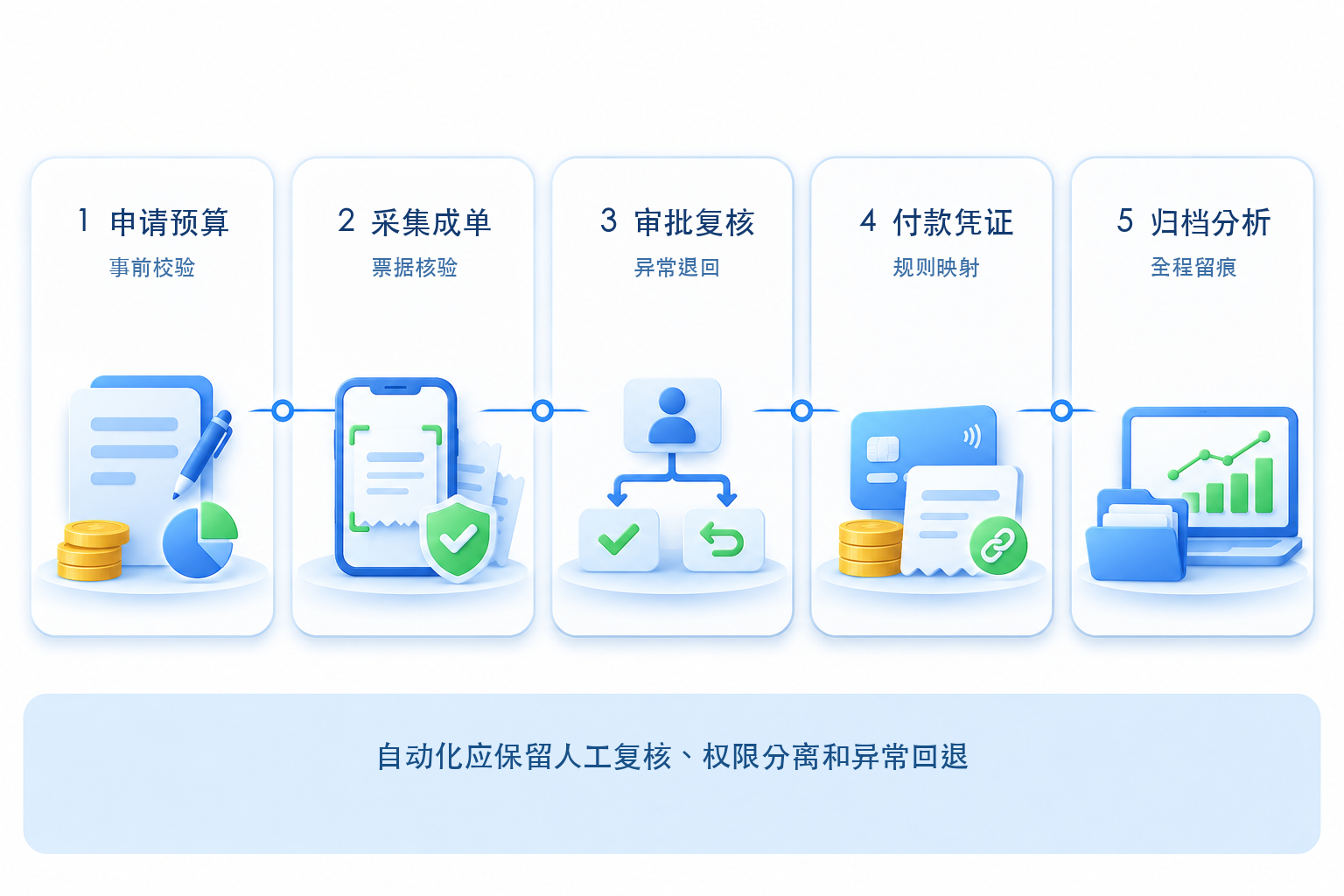
▍1. Budget application: clarify the business purpose and amount before expenses occur
The starting point of the process should be a business application, not supplementing documents after invoices are obtained. When employees submit travel, procurement, or event applications, the system records the matter, project, department, expense type, and estimated amount, and validates according to budget standards. Over-budget cases should not simply all be blocked; they can be prompted, require additional approval, or returned for adjustment according to enterprise policy. The value of doing this is to let approvers see "why the expense is incurred, where it comes from, and how much remains," and to establish a unified main line for subsequent reimbursement and accounting.
▍2. Collection and document creation: recognition results can only serve as data input and cannot replace judgment
Electronic invoices, electronic tickets, and bank receipts can enter the reimbursement process through upload, invoice wallet, or interfaces. OCR is used to extract fields such as date, amount, and seller, and assists with duplicate checking and format validation. However, recognition results may still be affected by invoice image quality, field rules, and interface status; the reimburser should confirm business attribution, and finance should review key fields and exception prompts. The Ministry of Finance and the National Archives Administration's Notice on Standardizing the Reimbursement, Booking, and Archiving of Electronic Accounting Vouchers also requires that electronic vouchers be verified as lawful and authentic, and that necessary handling, review, and approval procedures be established.
▍3. Approval and review: budgets, invoices, and business facts use the same set of rules
The approval flow should be configured according to amount, expense type, department, and project, rather than all documents going through the same route. Approvers focus on business authenticity and necessity, while finance focuses on invoices, policies, accounts, and tax treatment; the system records each submission, return, modification, and approval. When invoice exceptions, insufficient budget, or unbalanced allocations occur, they should be returned to clearly defined responsible persons for handling; exceptional documents must not bypass the rules and automatically enter payment.
▍4. Payment vouchers: complete the connection under configured rules and review mechanisms
After approval, the system can pass data such as payee, amount, and document number to the payment stage and link the receipt after payment is completed. Converting expense reports to vouchers is not "booking directly after recognition," but generating voucher drafts or passing accounting data based on configured expense types, accounting accounts, cost centers, tax amounts, and auxiliary accounting rules, which are then reviewed and posted by authorized accounting personnel. For exceptional scenarios involving reversal, invoice rejection, cross-period, and multiple currencies, it is also necessary to verify whether they can be traced and corrected along the original path.
▍5. Archiving and analysis: original electronic files, metadata, and operation records are retained together
After accounting is completed, expense reports, original electronic voucher files, approval records, payment receipts, and accounting vouchers should be linked according to the organization's policies and archive requirements. Saving only invoice screenshots or paper printouts cannot replace compliant electronic vouchers and metadata. Only after archiving is completed can the enterprise analyze expenditures by dimensions such as department, project, and expense type, and feed problems back into budget and policy configuration.
▍How does Kailing Technology implement this process?
Kailing Technology's enterprise expense control management solutions can cover mobile reimbursement, invoice authenticity verification and duplicate checking, approval, payment, and voucher connection, and can be used in combination with input VAT invoice management, AI OCR, and electronic accounting archive products. In actual projects, whether vouchers can be automatically generated, banks connected, or external data obtained depends on the customer's existing systems, interface authorization, accounting policies, and implementation configuration. It is recommended to complete end-to-end validation with real documents before going live.
Compliance basis: The Ministry of Finance's "Accounting Informatization Work Specifications" (Cai Kuai [2024] No. 11) and "Basic Functions and Service Specifications of Accounting Software" (Cai Kuai [2024] No. 12) took effect on January 1, 2025; the Ministry of Finance and the National Archives Administration's "Notice on Standardizing the Reimbursement, Booking, and Archiving of Electronic Accounting Vouchers" (Cai Kuai [2020] No. 6) clarified the conditions for verification, review and signing, prevention of duplicate booking, and archiving of electronic vouchers.
Keywords: expense control system business process, expense control reimbursement management system, reimbursement process, budget control, reimbursement form to voucher, electronic accounting archives, Kailing Technology
As a comprehensive business-finance-tax digitalization solution service provider, Kailing Technology provides business-finance-tax management digital transformation products and operational services for various government agencies, institutions, and large, medium, and small enterprises. The product line includes: solutions for sales contract management system, procurement contract management system, fully digitalized Leqi interface project, automatic output invoicing system, reverse invoicing system, invoice issuance for individuals system, employee expense control and reimbursement system, input VAT invoice management system, supply chain collaborative reconciliation system, image AI OCR recognition system, automatic financial bookkeeping system, electronic accounting archives system, etc., comprehensively driving the digitalization process across various fields.
Consultation Hotline: 18513895936 / 010-60974119 Location: Beijing