
Cannot understand overseas handwritten receipts and amounts are hard to verify? Kailing Technology's overseas invoice AI OCR recognition system provides original text Chinese comparison and verifies line-item totals

Cannot understand overseas handwritten receipts and amounts are hard to verify? Kailing Technology's overseas invoice AI OCR recognition system provides original text Chinese comparison and verifies line-item totals
Handwritten receipts brought back from overseas business trips may mix local scripts, Arabic numerals and abbreviated item names. Reimbursers cannot understand them, and finance worries that line items do not add up to the total. Kailing Technology's overseas invoice AI OCR recognition system presents the original invoice face, recognized text and Chinese comparison side by side, and leaves amount differences for manual verification.

▍First preserve the original invoice appearance and reading context
Handwritten receipts often have creases, shadows, scribbled handwriting and different currency symbols. When uploading, retain the original image, file name, page count and relationship to the reimbursement form, and allow re-shooting or rotation when necessary. Recognition results cannot replace the original face of the invoice; finance should be able to review the location of the handwriting at any time to judge whether a number was truly read correctly.
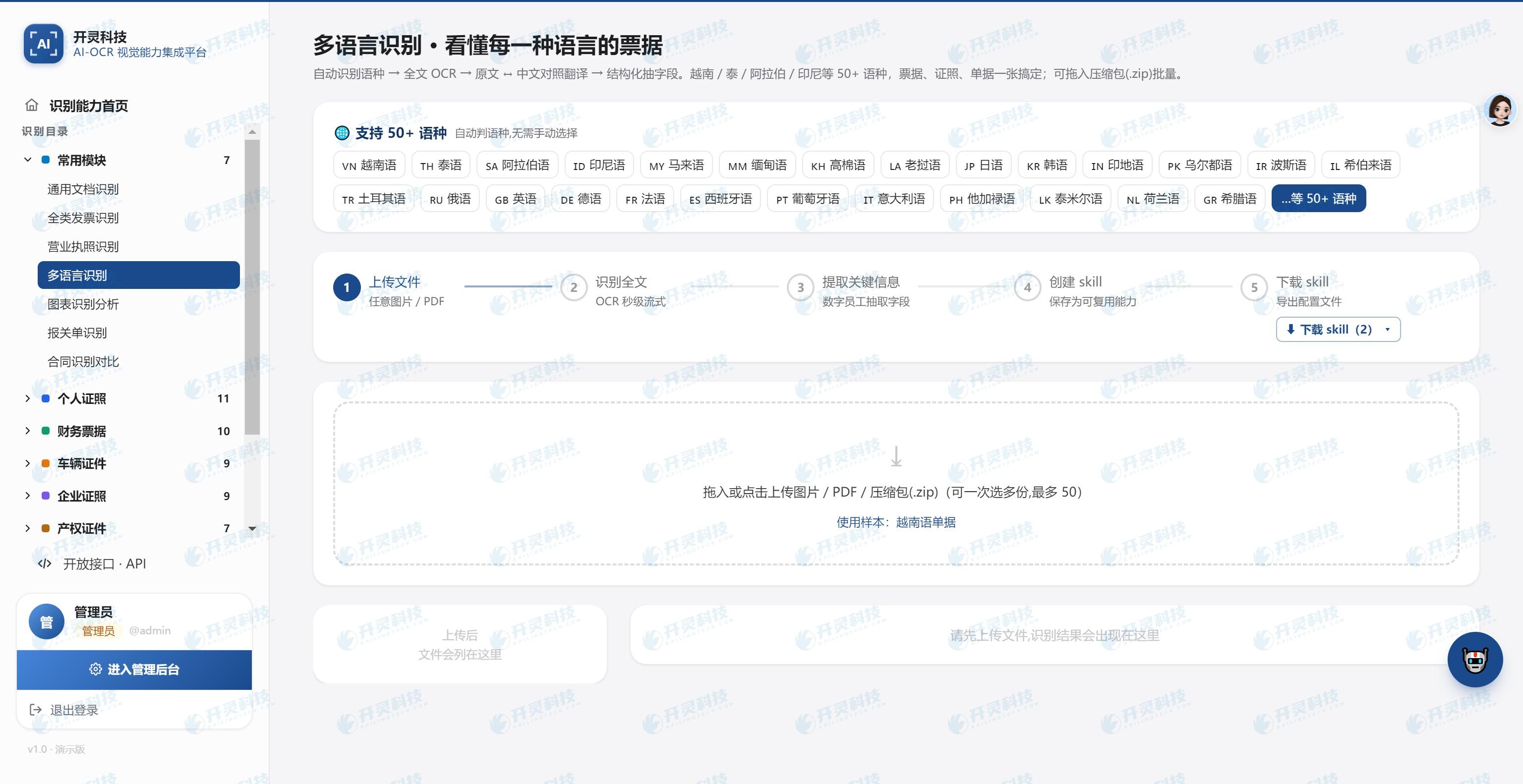
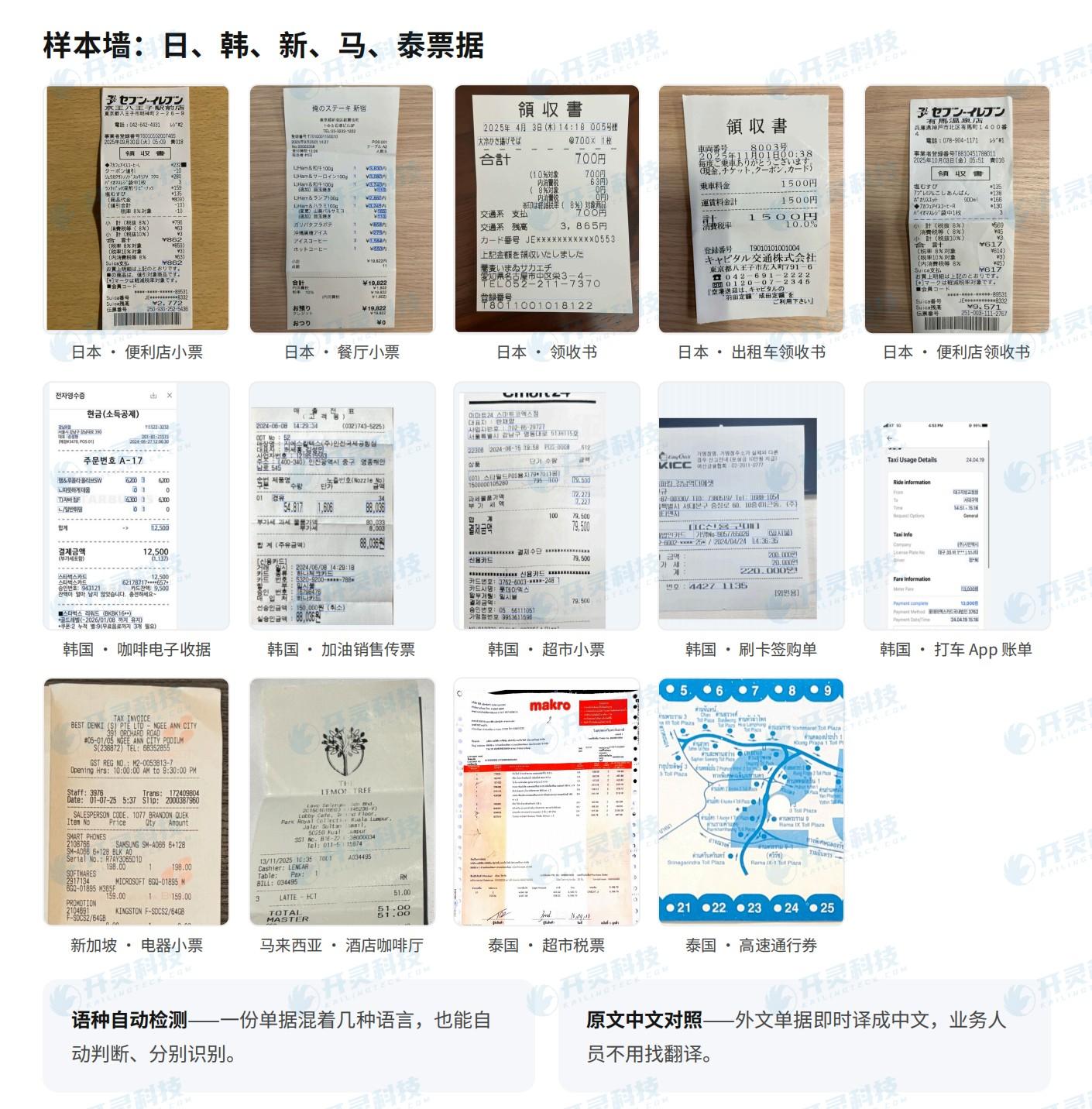
Kailing Technology's overseas invoice AI OCR recognition system adapts to multilingual and multi-format invoices, first locating key areas such as merchant, date, currency, items, tax amount and total. For low-clarity or uncommon abbreviations, the system should mark them as pending verification rather than writing guessed values directly as confirmed fields.
▍Chinese translation of the original text helps finance understand the spending
Merchant names, goods or service items, tax categories, and remarks in the original text can be displayed alongside the Chinese explanation. When finance staff read the Chinese, they can still click back to the original text, avoiding loss of proper nouns after translation or mistaking a "service fee" for a "tax fee." Multi-line handwritten content should remain aligned with the original invoice line numbers.
Translation is mainly used to understand the nature of the business; invoice amounts and currencies are still subject to the original voucher and review results. If a handwritten invoice shows both local currency amount and converted amount, the system must distinguish the field roles of the two and must not mistakenly write the Chinese explanation as a new reimbursement amount.
▍Check line items and totals row by row
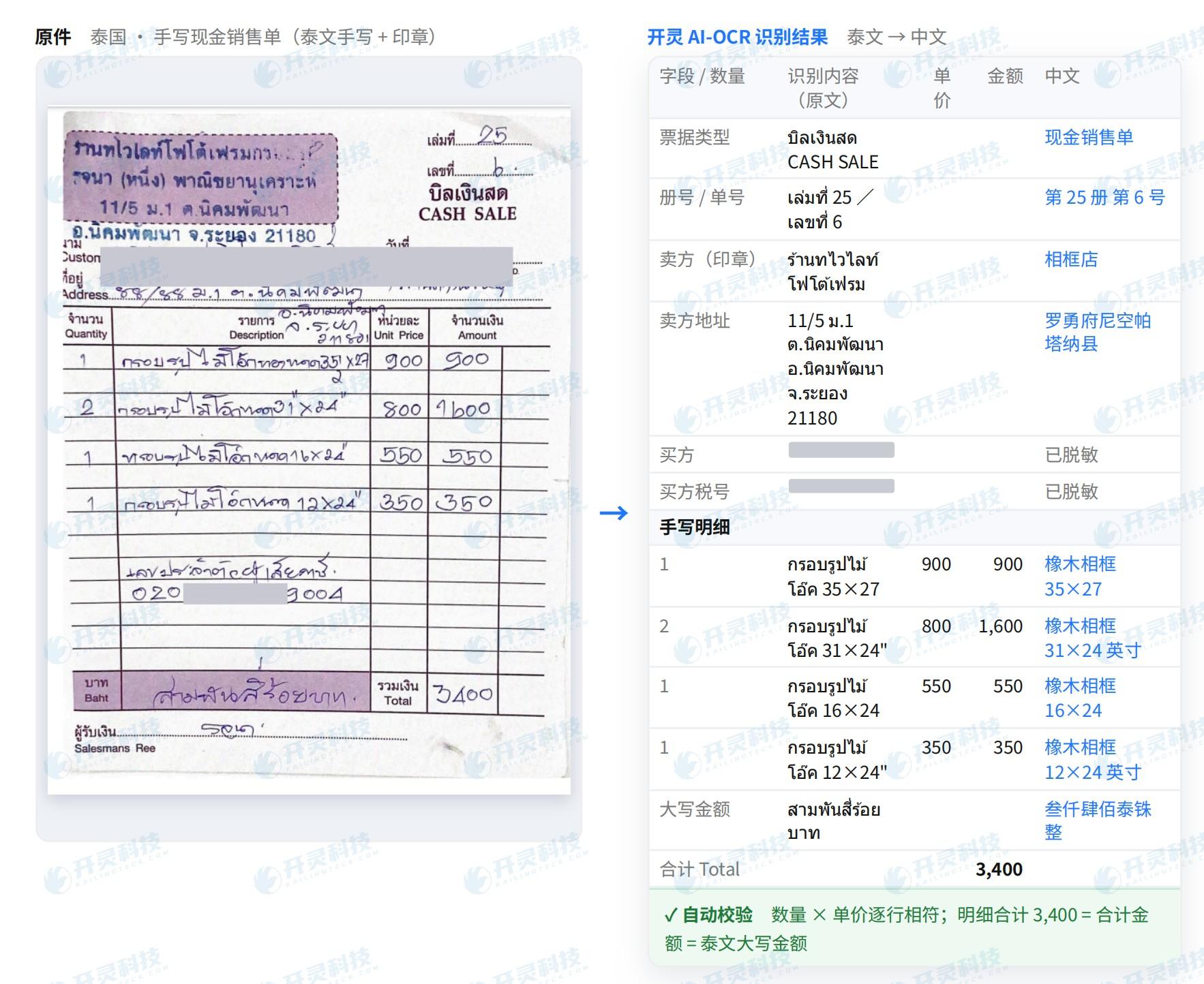
After recognizing multiple line amounts, the system can calculate the line subtotal and then compare it with the invoice total. Discounts, service fees, tax amounts and tips may be listed separately, and validation rules should handle them according to the invoice structure rather than simply adding all numbers together. When differences appear, point out the specific line, recognized value and possible omissions to facilitate finance review.
Handwritten "1" and "7", decimal points and thousands separators can all cause misreading. After finance corrects a field, the original recognized value, corrected value and operator should be retained. Kailing Technology's system reduces blind entry through original-text positioning and total verification, but does not replace human judgment on ambiguous invoice faces with algorithmic results.
▍Currency and reimbursement rules are checked in the next step
The invoice currency, payment currency and the currency of the employee's reimbursement application may differ. OCR first accurately extracts the original currency amount and currency, and then the expense control process handles conversion according to the enterprise exchange rate, policy and payment method. The currency must not be guessed solely from the symbol on the receipt; when similar symbols appear, it must be confirmed in combination with the country, merchant and the reimbursement applicant's explanation.
Recognized fields, original images and manual correction results can be passed into the reimbursement form, reducing item-by-item employee input. The expense control system continues to validate expense standards, budgets and approval permissions; overseas invoice recognition solves "understanding and extraction," while compliant reimbursement still needs to combine enterprise policies.
▍Beyond recognition accuracy, the review experience also matters
The difficulty of overseas handwritten receipts often concentrates on a few fields. The system should prominently mark uncertain dates, amounts or merchant names and locate the corresponding area on the original invoice. Finance does not need to re-read the entire invoice word by word, only to focus on low-confidence items and total differences, which is more valuable than giving a vague "recognition successful".
A receipt may simultaneously show unit price, quantity, taxes, discounts and actual paid amount. The field model must distinguish these roles to correctly verify line-item totals. If the invoice face lacks complete line items, the system may prompt "unable to recalculate line by line" and hand the original invoice to manual judgment; it should not automatically add items that do not exist.
The date order in some countries differs from Chinese conventions. Original dates are kept as-is, while a normalized date is also provided for use by the reimbursement system; when there is month-day ambiguity, a review prompt is given based on the region and other information on the invoice. The currency must also retain the original invoice symbol or code; currency exchange is performed only in the expense control stage according to enterprise rules.
The Chinese translation must correspond one-to-one with the original text. If a handwritten word cannot be reliably translated, retain the original character shape and pending-verification status, and do not use fluent but incorrect Chinese to conceal uncertainty. After finance changes the translation or classification, the system records the modifier and reason, so that future handling of similar invoices can be traced.
After uploading invoices, the reimburser can first see the extraction results and supplement business purpose and payment method; finance then verifies amounts and policy. These two confirmations prevent OCR misreads from directly becoming payment amounts. When Kailing Technology's overseas invoice AI OCR recognition system connects with the reimbursement process, it should pass the original image, original text, Chinese comparison and final confirmed values.
Acceptance samples should cover real difficulties: angled shots, creases, handwritten decimal points, multi-line service fees, and mixed printed and handwritten content. Compare system recognition, manual correction, and the final reimbursement posting value to identify field rules that need adjustment. Pinpointing errors to specific invoice types helps implementation more than claiming an overall recognition rate.
▍Handwritten receipts must retain evidence before and after correction
When a handwritten amount on a line is recognized as an incorrect number, finance should modify the recognized field, not the original invoice image. The system simultaneously saves the original handwriting location, initial recognized value, corrected value and operator. When reviewing this receipt again, it is possible to understand why the reimbursement amount differs from the machine's first reading.
If an invoice contains both local currency and credit card settlement currency, the invoice amount and payment amount should be saved separately. Which amount and exchange rate are used for reimbursement should follow the enterprise travel policy and bank proof. OCR provides correspondence between fields and the original text and cannot automatically replace finance's judgment on exchange rates and reimbursable scope.
For invoice formats that repeatedly appear in the same country, field templates and translation glossaries can be continuously improved; new languages or handwritten formats enter pending verification. Only by balancing reusable rules with manageable exceptions can overseas invoice recognition be used stably in long-term business.
During finance review, the area of the original invoice can be opened directly.
Manually corrected fields should be synced to the reimbursement form, while the original invoice and original recognition results are retained.
▍FAQ
Q: If handwritten digits are unclear, will the system automatically guess a value?
A: It should be marked as low confidence or pending verification, and confirmed by the reimburser and finance against the original invoice.
Q: Can a Chinese translation replace the original invoice?
A: No. The Chinese translation helps understanding, but the original face of the invoice must still be retained and viewable.
Q: If the sum of line items does not equal the total, is it definitely a fake invoice?
A: Not necessarily. Taxes and fees, tips, discounts, handwriting recognition errors, and receipt structure should be checked first.
Visit Kailing Technology to learn about related products and implementation solutions: https://www.kailingteck.com/ai-ocr/ .
As a national high-tech enterprise, Kailing Technology focuses on the digital and intelligent transformation of enterprise business-finance-tax and operations management, providing software products, system integration, implementation and delivery, and operational services for various government agencies, institutions, group enterprises, and SMEs.
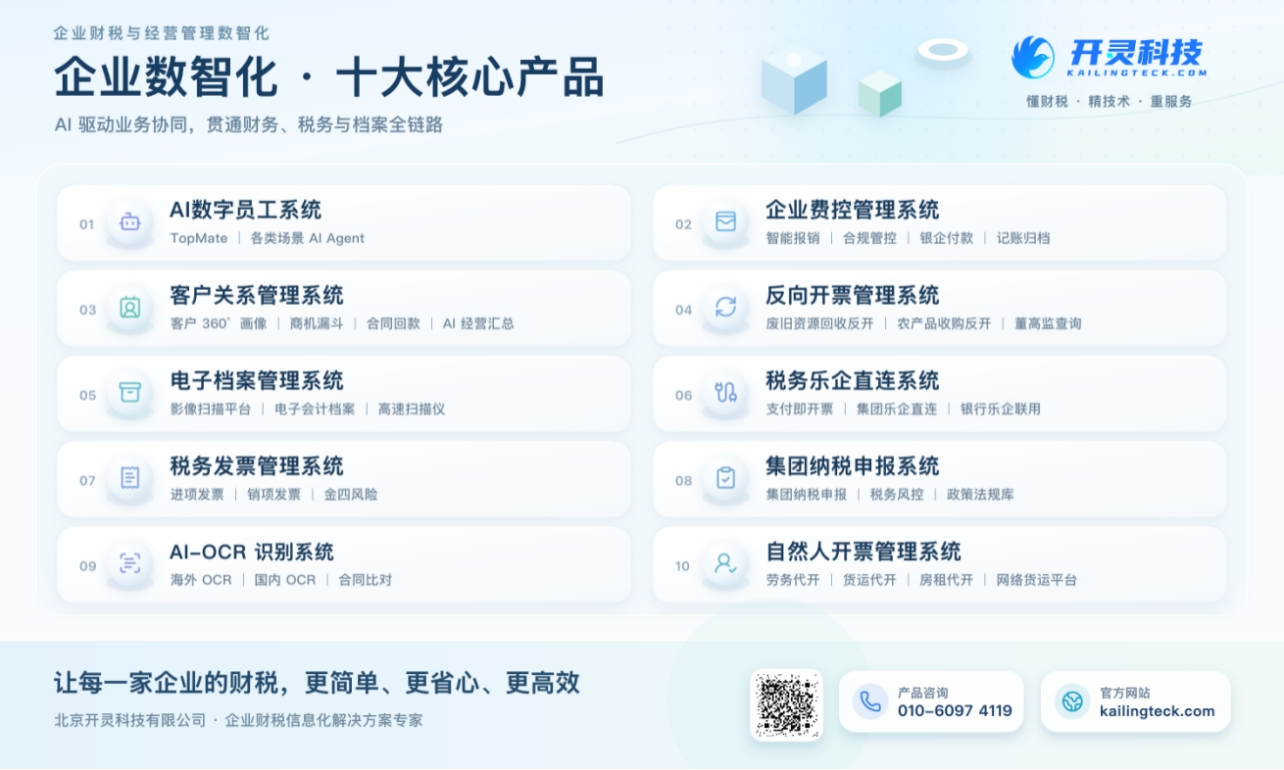
The company has now formed ten core product lines, including: AI digital employee system, enterprise expense control management system, customer relationship management system, reverse invoicing management system, invoice issuance for individuals management system, electronic archives management system, tax fully digitalized e-invoice Leqi system, tax invoice management system, group tax filing system, and AI OCR recognition system. It is committed to connecting enterprise business, finance, tax, funds, and archive data to help customers improve operational efficiency, business-finance-tax compliance capabilities, and digital management levels.
If you have any business-finance-tax digital transformation needs, welcome to contact us. Beijing Kailing Technology will serve you wholeheartedly.
Keywords: Overseas handwritten receipt OCR, original text Chinese comparison, line-item total verification, multilingual invoices, Kailing Technology
As a comprehensive business-finance-tax digitalization solution service provider, Kailing Technology provides business-finance-tax management digital transformation products and operational services for various government agencies, institutions, and large, medium, and small enterprises. The product line includes: solutions for sales contract management system, procurement contract management system, fully digitalized Leqi interface project, automatic output invoicing system, reverse invoicing system, invoice issuance for individuals system, employee expense control and reimbursement system, input VAT invoice management system, supply chain collaborative reconciliation system, image AI OCR recognition system, automatic financial bookkeeping system, electronic accounting archives system, etc., comprehensively driving the digitalization process across various fields.
Consultation Hotline: 18513895936 / 010-60974119 Location: Beijing