
Both electronic invoices and paper vouchers exist, so how to archive them uniformly? The Kailing Technology electronic accounting archives management system binds volumes by rules, compiles archive numbers and links paper and electronic materials

Both electronic invoices and paper vouchers exist, so how to archive them uniformly? The Kailing Technology electronic accounting archives management system binds volumes by rules, compiles archive numbers and links paper and electronic materials
Electronic invoices are kept on the platform, paper vouchers are placed in archive boxes, and accounting processing is in the ERP. If archiving only separates materials into two piles by file format, the paper and electronic materials of the same business are hard to cross-check. The Kailing Technology electronic accounting archives management system binds volumes by accounting period, category and business relationship, compiles archive numbers and links electronic and paper carriers.

▍First list all paper and electronic materials that should be archived
Electronic invoices, accounting vouchers, approval forms, bank receipts and paper original vouchers may be scattered across different entry points. Archiving rules should specify which system or position transfers each type of material, and upon receipt verify the period, organization, business number and page count. Although paper materials cannot be uploaded as originals like electronic files, the box number, volume number and storage location should still be registered.
If a reimbursement has both an electronic invoice and a paper supplementary explanation, the system must point both to the same business and voucher. Scanning only the paper item without recording the original's location still leaves no way to find it during consultation. The Kailing Technology system establishes a common search entry for both paper and electronic carriers through archive catalogs and business links.
▍File grouping rules start from accounting business
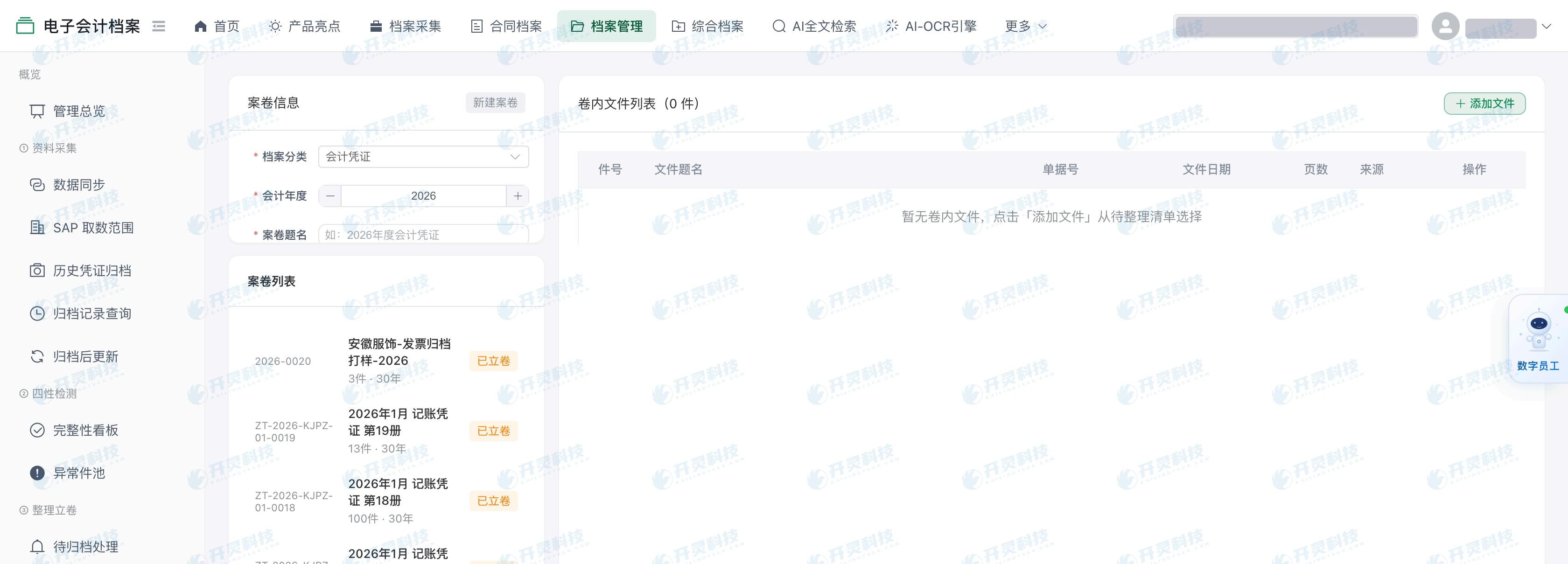
Volume binding can be configured by organization, accounting year, archive category, voucher number range or business type. Invoices and vouchers do not necessarily need to be placed in the same folder, but they should be cross-checkable through linked relationships. Before binding volumes, the system checks for missing items, duplicates and number conflicts to avoid forcibly sealing documents that are pending supplement.
Paper vouchers require covers, catalogs and location registration for physical management; electronic files need to retain the original format, metadata and detection results. The two types of materials can use a linked index under the same archive system while recording carrier characteristics separately. The Kailing Technology electronic accounting archives management system makes volume binding rules correspond to actual storage methods.
▍Archive numbers must be stable and traceable
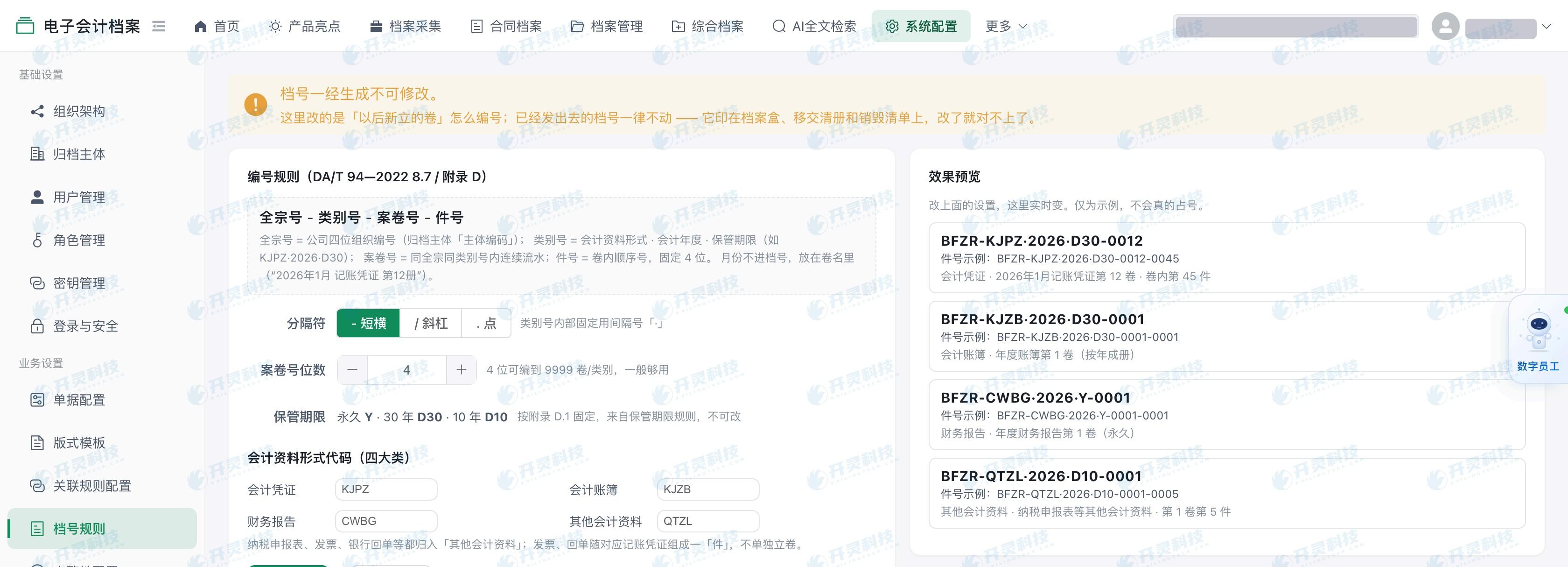
Archive numbers should be generated according to the enterprise's archive classification and coding rules, at least allowing managers to identify organization, year, category and sequence relationships. After formal archive numbering, newly added supplements or adjustments must not arbitrarily overwrite old archive numbers; when changes are needed, retain the original number, reason and old-new mapping.
If the paper box number and electronic archive number do not match, a clear correspondence should be established, so that when searching for an electronic invoice the location of the paper voucher can be identified, and when holding the paper voucher the electronic file can also be found. The system should not merely display a number but ensure the number can be used for retrieval, handover, and inventory counting.
▍Perform four-property checks during receipt and file grouping
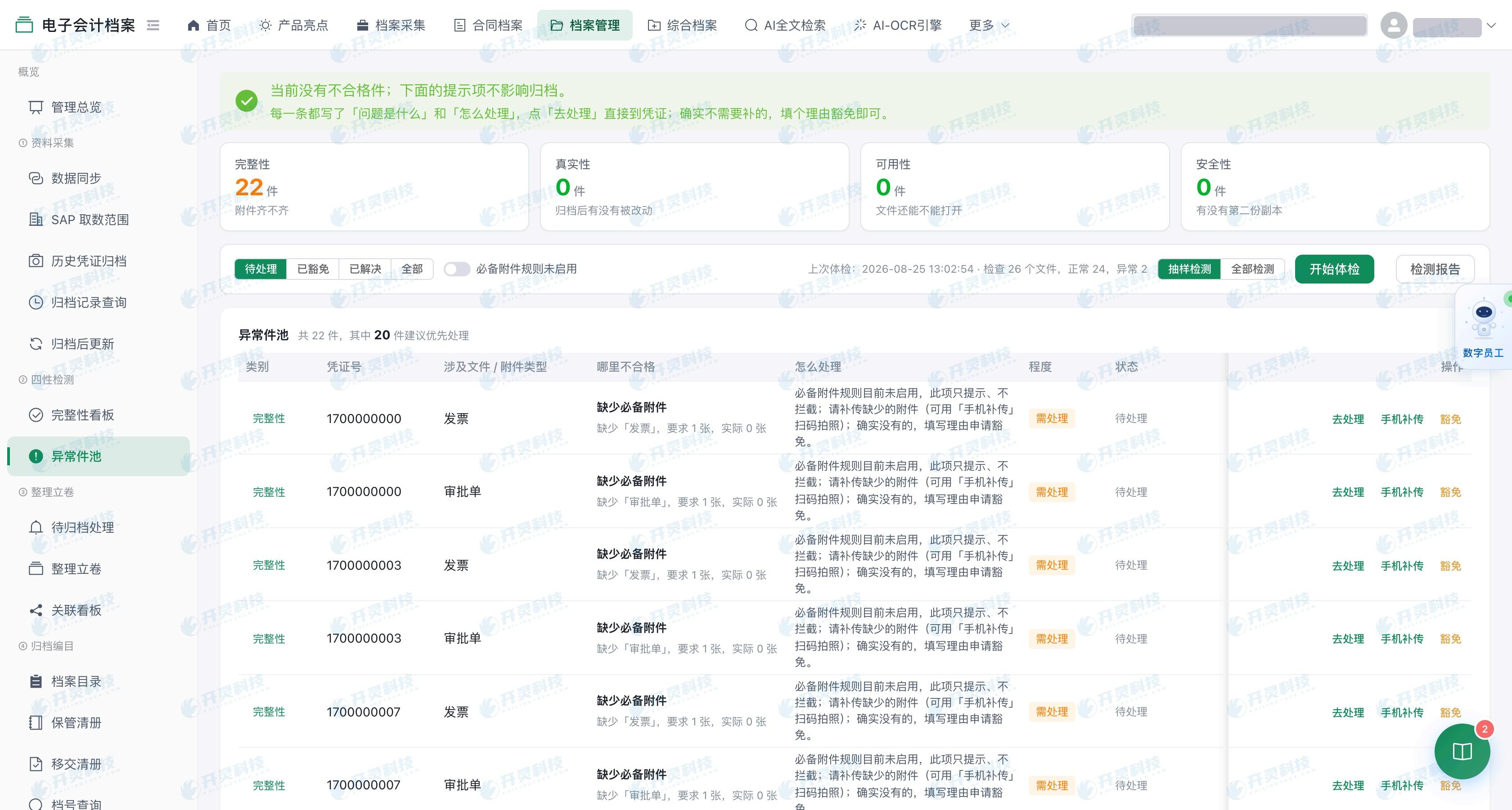
When archiving electronic files, verify authenticity, integrity, usability and security; when registering paper items, check whether the page count, signatures and seals match the catalog. If invoice files are damaged, scanned copies have missing pages, or paper vouchers have not been transferred, a pending-supplement status should be displayed and the completion mark of the relevant archive should be suspended.
After volume binding is completed, the system records the transferor, receiver, time and detection results. During archive use, electronic files are previewed according to permissions, and paper files are retrieved by location when necessary. The Kailing Technology solution connects receipt, volume binding, numbering and consultation into one management path.
▍Test archiving with one set of mixed materials
Select a transaction containing an e-invoice, paper approval attachment, bank receipt, and ERP voucher, and search separately by invoice number, voucher number, archive number, and paper box number. Only when all four entry points can locate the related materials is the paper-electronic linkage truly established.
Then test supplementary documents, duplicate invoices, and paper document borrowing and return. The system should retain versions, statuses, and borrowing records, so that "archived" does not obscure the current whereabouts of materials. Kailing Technology's electronic accounting archives management system helps enterprises maintain complete and traceable materials for the same business during the paper-electronic coexistence stage.
▍Integrated paper and electronic archiving must also address daily handover
Electronic invoices usually enter the expense control or tax platform first, while paper vouchers may only be delivered by business departments at the end of the month. The system should allow electronic files to be received first, temporarily list paper as pending transfer, and complete location registration when the physical items arrive. If files can only be created when both types of materials arrive together, a large number of electronic files will be unable to be collected for a long time.
The number, cabinet and shelf location and borrowing status of paper archive boxes need to remain consistent with the electronic catalog. When archive staff adjust warehouse locations, they update the physical location and retain migration records; finance can still find the latest box number when entering from the electronic invoice. The electronic index points to the paper original, and physical management must not be forgotten just because scanned copies exist.
One e-invoice may correspond to multiple paper approval attachments, and the same paper contract may support multiple payments. When grouping files, distinguish "one document referenced repeatedly" from "multiple copies of a document" to avoid version confusion caused by duplicate archiving. The system can establish relationships without copying the same electronic file into every directory.
Archive numbers must be checked for duplicates before generation, especially because voucher numbers from different systems may be identical. Dimensions such as organization, year and category jointly determine a unique archive number. For supplements and cross-period adjustments, the original archive number relationship should be retained so archivists can see why new files enter an old volume or a new volume.
Borrowing paper vouchers should record the borrower, return and handler; downloading electronic files should leave traces according to permissions. The two carriers are used differently, but can be initiated from the same business query page. When an audit requires all materials for a reimbursement, the electronic invoice and voucher are seen first, and necessary paper documents are retrieved according to physical location.
▍Tracing from an invoice to a physical archive box
After finance receives an electronic invoice, the system records the corresponding reimbursement or procurement business and voucher; when paper attachments are transferred, the archivist registers the volume box and location. Later, searching by invoice number should show the electronic original, voucher, paper attachment catalog and the archive box where it is located. Entering in reverse from the archive box number should also list the linked electronic materials within it.
For scanned copies of paper vouchers, the system should distinguish scanned images from paper originals. Scanned copies are convenient for online preview, while the original location is used for retrieval and inventory counting. If an original is lent out, the online catalog should show the borrowing status, preventing auditors from assuming the box is still in the warehouse.
The value of paper-electronic integrated archiving lies in requiring only one search for the same business. Enterprises can choose three types of samples—complex reimbursement, procurement payment and cross-period supplementary documents—to test whether volume binding, archive numbers, paper locations and electronic links all form a closed loop.
If a paper original is returned to a different location after borrowing, the system should update the box number and shelf position and retain the borrowing history. When archive staff conduct regular inventories, they check physical items against the electronic catalog and, when missing items are found, trace them promptly to borrowing or transfer records.
The transfer list should also be kept with the archive.
▍FAQ
Q: If the e-invoice is already on the platform, do paper vouchers still need to be registered?
A: Yes. The location of paper originals and related business should be registered according to the enterprise archive system to facilitate unified retrieval.
Q: Must paper and electronic materials be placed in the same file?
A: It is sufficient to manage according to the applicable file grouping rules; the key is that numbers and business relationships can be cross-checked.
Q: How is a supplementary payment receipt handled after archiving?
A: Retain the supplementary document time, handler, and relationship to the original archive, and update the catalog and inspection status according to the rules.
Visit Kailing Technology to learn about related products and implementation plans: https://www.kailingteck.com/eaa/ .
As a national high-tech enterprise, Kailing Technology focuses on the digital and intelligent transformation of enterprise business-finance-tax and operations management, providing software products, system integration, implementation and delivery, and operational services for various government agencies, institutions, group enterprises, and SMEs.
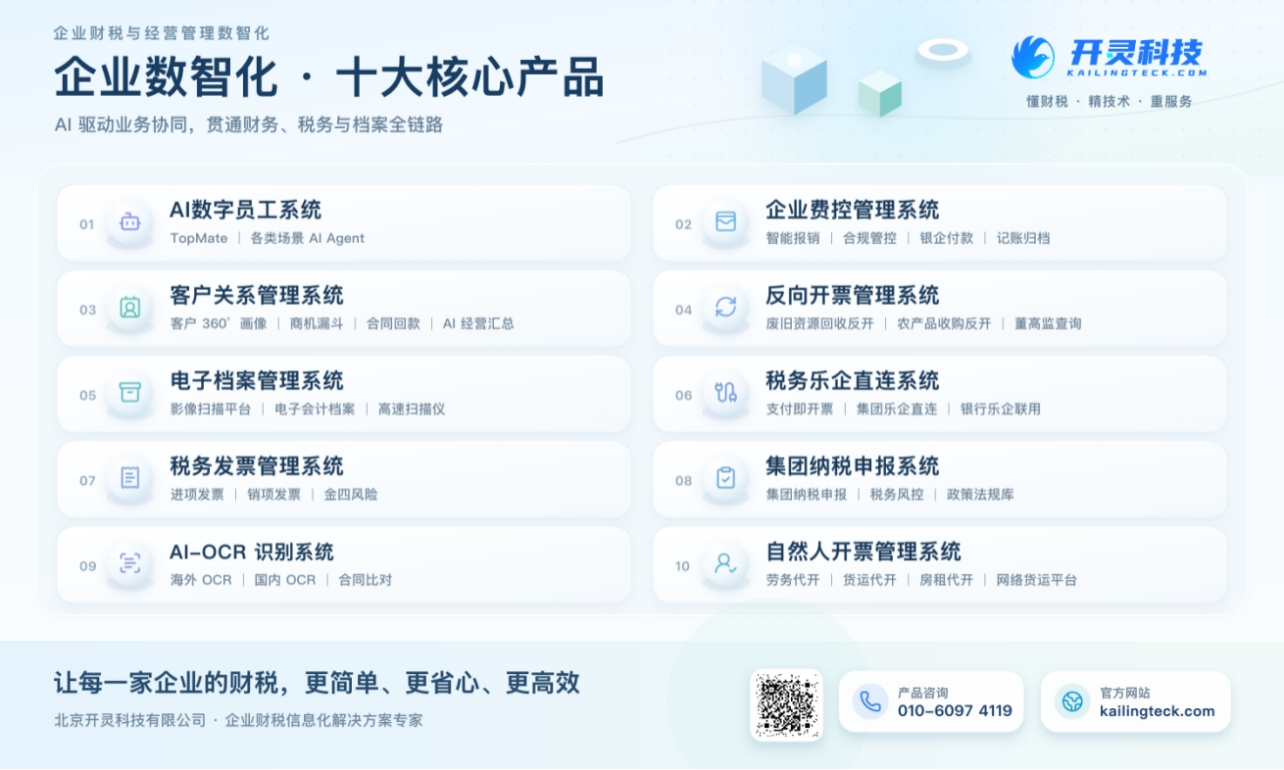
The company has now formed ten core product lines, including: AI digital employee system, enterprise expense control management system, customer relationship management system, reverse invoicing management system, invoice issuance for individuals management system, electronic archives management system, tax fully digitalized e-invoice Leqi system, tax invoice management system, group tax filing system, and AI OCR recognition system. It is committed to connecting enterprise business, finance, tax, funds, and archive data to help customers improve operational efficiency, business-finance-tax compliance capabilities, and digital management levels.
If you have any business-finance-tax digital transformation needs, welcome to contact us. Beijing Kailing Technology will serve you wholeheartedly.
Keywords: Electronic accounting archives paper-electronic integration, electronic invoice archiving, paper voucher binding, archive number management, Kailing Technology
As a comprehensive business-finance-tax digitalization solution service provider, Kailing Technology provides business-finance-tax management digital transformation products and operational services for various government agencies, institutions, and large, medium, and small enterprises. The product line includes: solutions for sales contract management system, procurement contract management system, fully digitalized Leqi interface project, automatic output invoicing system, reverse invoicing system, invoice issuance for individuals system, employee expense control and reimbursement system, input VAT invoice management system, supply chain collaborative reconciliation system, image AI OCR recognition system, automatic financial bookkeeping system, electronic accounting archives system, etc., comprehensively driving the digitalization process across various fields.
Consultation Hotline: 18513895936 / 010-60974119 Location: Beijing