
When the same expense must be allocated to multiple departments, how is it accounted for after reimbursement? Kailing Technology's expense control reimbursement management system allocates by cost center and links budget and general ledger

A marketing activity expense is shared by the sales and product departments, but the reimburser can fill in only one form. If finance manually splits the accounts after approval, budget usage, payment, and the general ledger may each use different bases. Kailing Technology's Expense Control and Reimbursement Management System can configure cost center allocation in the reimbursement order, aligning ratios, amounts, budgets, and vouchers.

▍Determine the attribution principle on the reimbursement order first
When an expense occurs, it should be clear who benefits and on what basis it is allocated. Allocation can be divided by preset ratio, fixed amount, headcount, or project agreement, but this reimbursement only uses the basis confirmed through approval. The reimbursement form retains the expense type, total amount, participating cost centers, and allocation rules, so finance does not have to guess which departments to split it among after receiving the documents.
If an invoice contains multiple expense items, the expense items can first be split and then the bearing departments specified separately. The system calculates the amount for each department and checks whether the total equals the total reimbursement amount; rounding differences must also have clear handling rules. The Kailing Technology expense control and reimbursement management system keeps allocation details on the original form, rather than finance creating a separate Excel that cannot be traced back.
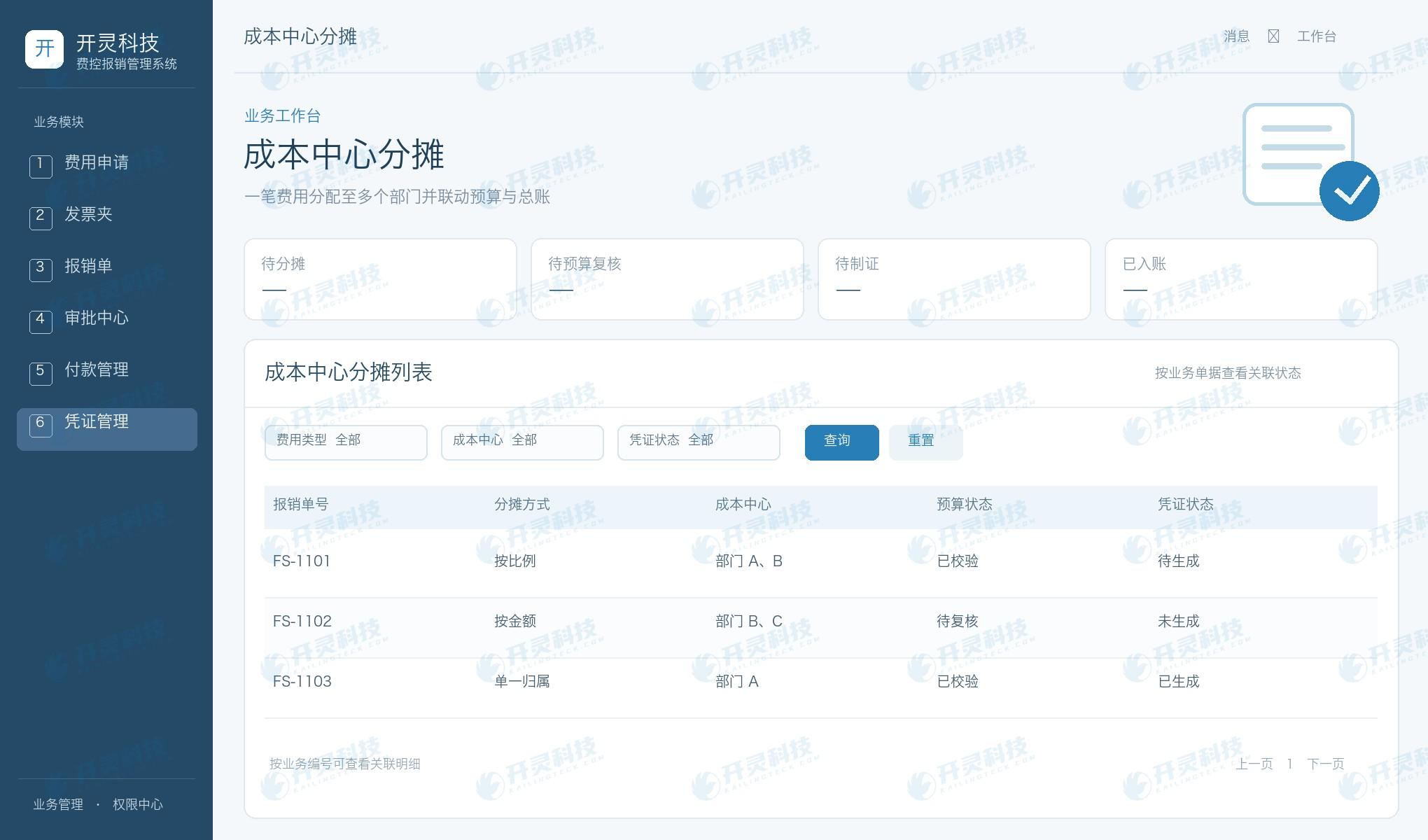
Cost center allocation and voucher status
▍Check budgets separately by department share
A department having sufficient budget does not mean another department can also bear its allocated amount. Before submission or approval, the system checks each department's usage by cost center and budget account, showing portions that are over budget, mismatched to accounts, or require additional approval. Approvers can see the entire expense and the amount borne by their department.
When the allocation ratio changes during approval, the budget impact should be recalculated, and the modifier and reason recorded. Otherwise, approvers see the old budget result while finance posts using the new ratio. For cross-company allocation within a group, internal settlement and organizational permission configurations must also be considered; cross-legal-entity expenses must not simply be treated as departmental split accounting within the same company.
▍Payment remains the fund result of one business transaction
After the reimbursement form is approved, payment tasks can be generated according to the actual payee. Even if accounting is split across multiple cost centers, the bank payment to the employee or supplier may occur as only one transaction. The fund receipt is linked to the original reimbursement form, and the allocation details serve as the accounting basis; the two should not be artificially split into several nonexistent bank transactions.
When payment fails, is partial, or the amount is adjusted, first verify the original order, then update the status required for allocation and voucher preparation. The Kailing Technology system stores business approvals, funding results, and accounting dimensions side by side, so finance can explain that "who received the money" and "who bears the expense" are two different questions.
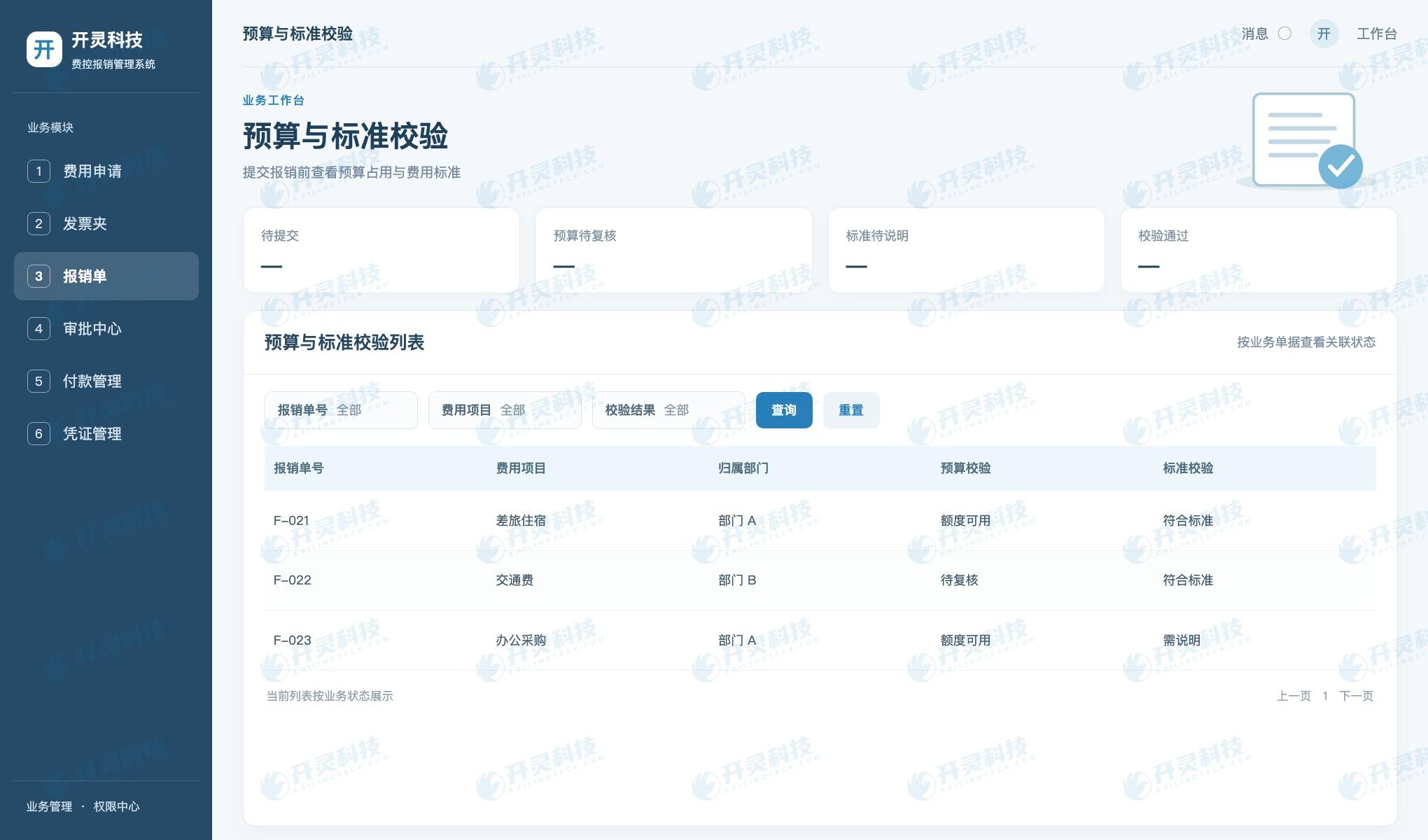
Budget verification after allocation
▍General ledger vouchers reflect allocation results
When finance prepares vouchers, expense accounts, cost centers, tax amounts, and payable or bank accounts should be generated from confirmed reimbursement and allocation information. The system can pass multi-line expense entries to the general ledger according to interface rules while retaining the relationship between the same reimbursement form number and voucher number. If finance needs to adjust accounts, the adjustment and review should be recorded, and the voucher should not be disconnected from the original approval form.
At month-end reconciliation, general ledger vouchers can be traced back to reimbursement forms, invoices, approvals, payments, and allocation bases; expenses borne by a cost center can also be summarized. In this way, budget execution and actual posting use the same confirmed allocation data, reducing disputes over basis during departmental reconciliation.
▍Use cross-department activity expenses as an acceptance sample
Prepare five types of samples: proportional, amount-based, insufficient budget, ratio changed during approval, and cross-company allocation. Check whether totals, budget occupation, approval permissions, payments, and vouchers are consistent. Pay particular attention to rounding and tax amount allocation; there should be no situation where the total reimbursement differs from the total voucher debits by one cent.
The Kailing Technology expense control and reimbursement management system is suited to moving allocation responsibility forward to business documents. Departments know more clearly how much they bear, finance does less manual splitting, and management can see the true cost attribution from cost centers.
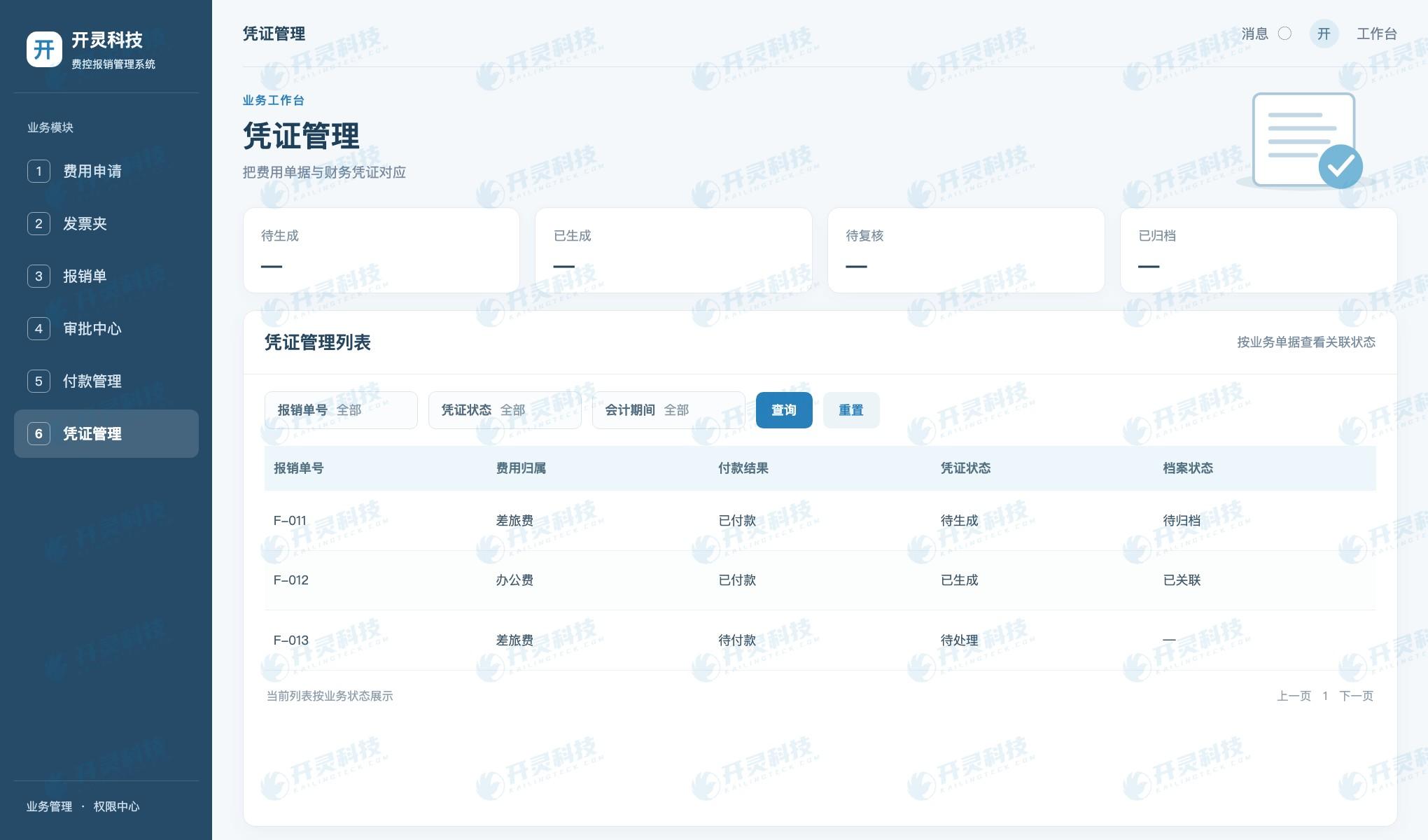
Linking expense vouchers to the general ledger
▍Common accounting boundaries for multi-department allocation
Before allocation, the mapping between cost centers and department names must be clarified. After organizational adjustments, the old department's cost center may have been deactivated; when the reimbursement date and the posting date span the adjustment, the valid dimension should be selected according to financial policy and the historical mapping retained. The system must not post expenses to a revoked accounting unit just because the names are the same.
When allocating by percentage, the percentages must total 100%; when allocating by amount, the amounts in each row must total the allocable expense amount. If non-deductible tax amounts or items with different tax rates are included, the split between expense and tax amount must be handled according to accounting and tax rules. Finance staff should see the calculation details before preparing the voucher, rather than receiving only a total.
Budget control must also consider the timing of occupation. Some enterprises pre-occupy at application, occupy actual amounts at reimbursement, or lock after approval; rules differ by enterprise. When allocated to multiple departments, each department's budget change must be consistent with the final reimbursement status; returned or canceled documents should release the corresponding occupation, avoiding an unexplained reduction in a department's budget.
If an expense is allocated across companies, it may involve internal transactions, current accounts, and tax treatment; the entry must not simply be split into expenses under different legal entities. The Kailing Technology system can carry organization and cost center dimensions; specific cross-legal-entity accounting must be configured according to the enterprise's financial plan and accepted through sample vouchers.
Approvers should see the amount actually borne by their department and also be able to view the background of the entire expense. If each department is shown only part of the amount, it is easy to overlook the total invoice amount and business purpose; if everyone can modify the complete allocation, responsibilities may become unclear. Role permissions and modification scope should be designed together with the allocation process.
At month-end, a record can be sampled from the cost center expense report to trace back to reimbursement, invoice, budget occupation, payment receipt, and general ledger voucher. Then, from the original reimbursement form, view all bearing departments forward to confirm that the allocated amounts total consistently. A two-way check is better than only seeing that voucher generation succeeded at finding cost attribution errors.
▍Traceability of a single order must be maintained after allocation
When multiple departments share expenses, the reimbursement order number should run through budget, approval, payment, and voucher. Each department can see its allocated share in its own expense report, but auditors can still return to the entire expense and the original invoice. If finance creates a separate manual voucher for each department without a common business index, it will be difficult later to explain that they correspond to the same payment.
Allocation rules should retain effective dates and approval records. For long-term projects with fixed ratios, the rule can be referenced next time, but the applicable scope must still be confirmed for each transaction; for temporary activities, the ratio should be determined based on the actual beneficiaries of this instance. Rule reuse is meant to reduce duplicate input and should not let an expired organizational structure automatically carry into new orders.
At financial month-end, sampling can be done from the general ledger to check whether expense accounts, cost centers, tax amounts, and payees correspond to reimbursement approval results. When differences are found, the system can explain whether they come from business allocation modifications, budget adjustments, or manual corrections in voucher preparation, reducing back-and-forth reconciliation between departments.
▍FAQ
Q: If one reimbursement is allocated to two departments, does it require two payments?
A: Not necessarily. Payment is made to the actual payee; cost center allocation is used for internal budgeting and accounting.
Q: What if the allocation ratio is changed during approval?
A: Recalculate each department's share and budget impact, and retain modification and approval records.
Q: How does the general ledger know how much each department bears?
A: Pass the confirmed allocation details to the voucher preparation step and retain the original reimbursement order number.
Visit Kailing Technology to learn about related products and implementation plans: https://www.kailingteck.com/feikong/ .
As a national high-tech enterprise, Kailing Technology focuses on the digital and intelligent transformation of enterprise business-finance-tax and operations management, providing software products, system integration, implementation and delivery, and operational services for various government agencies, institutions, group enterprises, and SMEs.
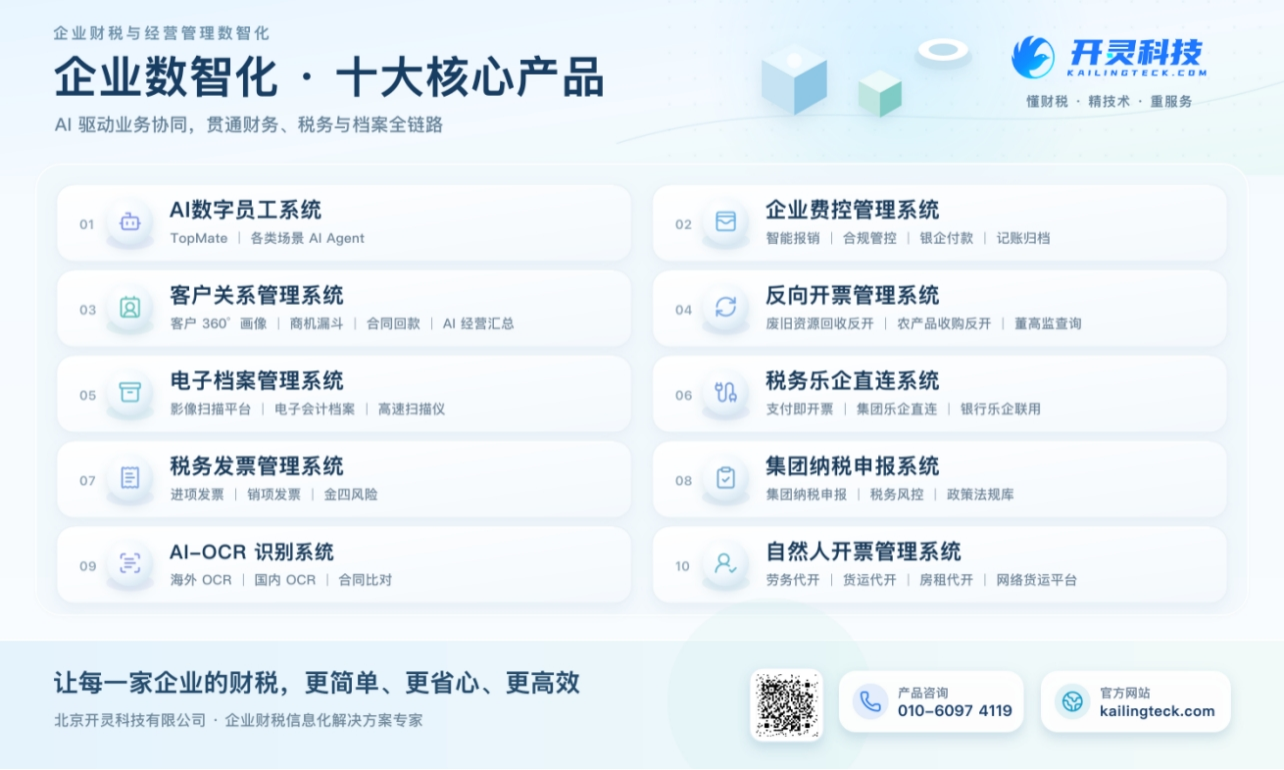
The company has now formed ten core product lines, including: AI digital employee system, enterprise expense control management system, customer relationship management system, reverse invoicing management system, invoice issuance for individuals management system, electronic archives management system, tax fully digitalized e-invoice Leqi system, tax invoice management system, group tax filing system, and AI OCR recognition system. It is committed to connecting enterprise business, finance, tax, funds, and archive data to help customers improve operational efficiency, business-finance-tax compliance capabilities, and digital management levels.
If you have any business-finance-tax digital transformation needs, welcome to contact us. Beijing Kailing Technology will serve you wholeheartedly.
Keywords: Cost center allocation, expense control and reimbursement, budget linkage, general ledger vouchers, Kailing Technology
As a comprehensive business-finance-tax digitalization solution service provider, Kailing Technology provides business-finance-tax management digital transformation products and operational services for various government agencies, institutions, and large, medium, and small enterprises. The product line includes: solutions for sales contract management system, procurement contract management system, fully digitalized Leqi interface project, automatic output invoicing system, reverse invoicing system, invoice issuance for individuals system, employee expense control and reimbursement system, input VAT invoice management system, supply chain collaborative reconciliation system, image AI OCR recognition system, automatic financial bookkeeping system, electronic accounting archives system, etc., comprehensively driving the digitalization process across various fields.
Consultation Hotline: 18513895936 / 010-60974119 Location: Beijing