
How to choose free bookkeeping software for small and micro businesses? 2026 pitfall-avoidance guide

How to choose free bookkeeping software for small and micro businesses? 2026 pitfall-avoidance guide
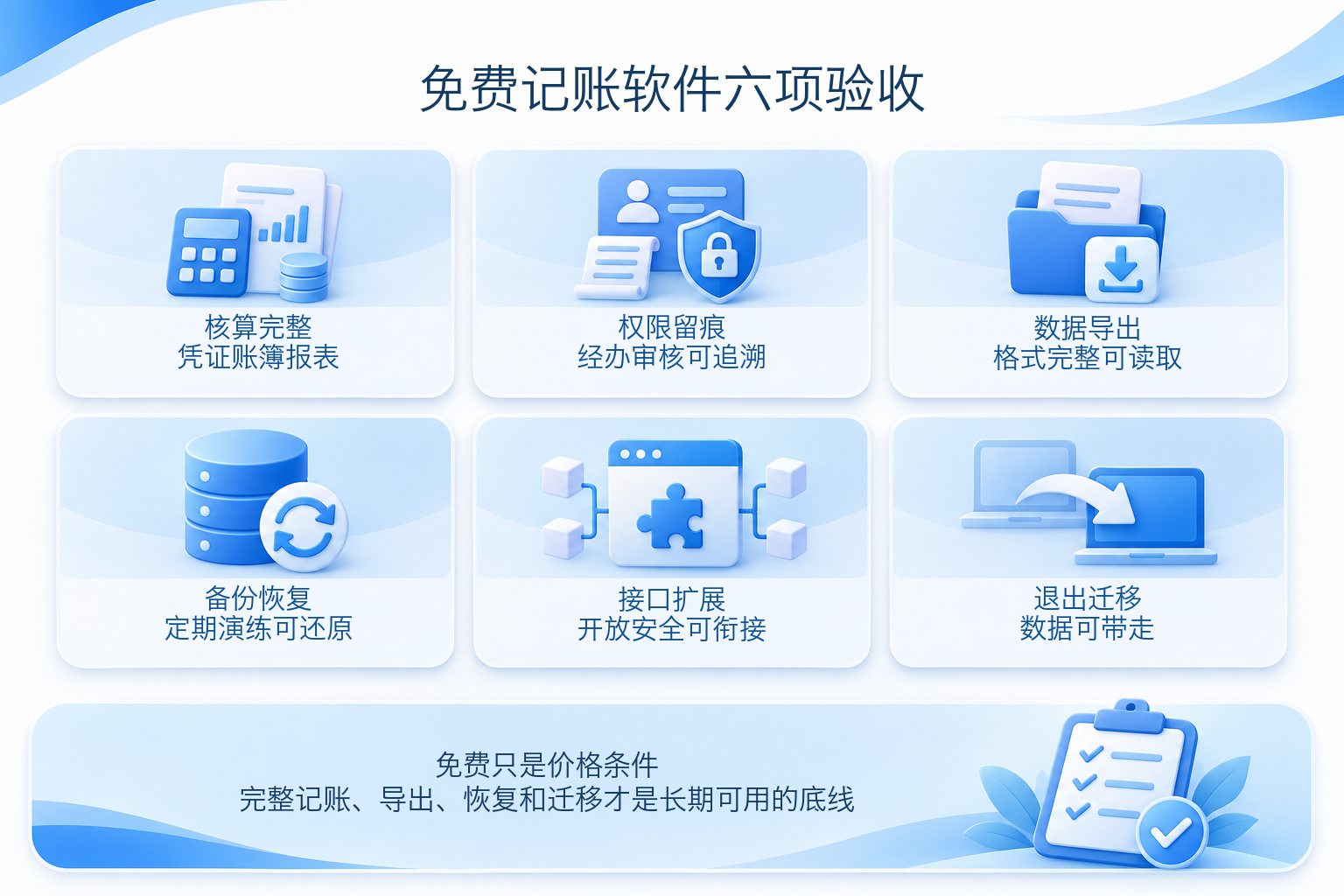
Free can be a price condition, but it cannot replace functional and compliance verification. Small and micro businesses should check at least six capabilities: complete accounting, permission trails, data export, backup and recovery, interface extensibility, and exit migration, and use their own real documents to run through the month-end closing and export processes.
There is no universal threshold for the number of invoices or tax types that determines whether "the free version is sufficient." What really determines fit is business complexity, division of labor, inventory and cost accounting, reporting requirements, data volume, and external collaboration. The scope of free features, user counts, storage, interfaces, and export policies may also change, so selection should be based on the current product terms and actual test results.
▍1. First verify whether accounting is complete
The Ministry of Finance's Basic Functions and Service Specifications for Accounting Software summarizes the basic functions of accounting software as collecting accounting and financial management data, generating accounting materials such as vouchers, ledgers, and reports, and storing, converting, outputting, analyzing, and utilizing accounting materials. Small and micro enterprises should take a real sample from a complete period to verify account setup, chart of accounts, vouchers, closing, reopening controls, and the reconciliation between ledgers and reports, rather than only looking at demo pages.
▍2. Whether permissions and operation trails support internal control
Even if the team is small, handler, reviewer, and management permissions should be separated, and key changes should leave records of the operator, time, and content. Sharing the same account, allowing vouchers to be deleted without a trace, or lacking approval records will make problems difficult to trace. When using cloud services, you should also ask about identity verification, protection of sensitive data transmission and storage, fault response, and data handling after service termination.
▍3. Whether data can be exported completely and readably
Do not only verify whether reports can be exported as PDF. You should check whether vouchers, accounts, auxiliary accounting, ledgers, reports, attachments, and audit logs can be exported in batches in the agreed format, whether the exported files are complete and readable, and whether they include their relationships. If the free tier restricts exports, batch processing, or historical data access, this should be included in the cost assessment before activation.
▍4. Whether backups can truly be restored
"The system has backups" does not mean the enterprise can recover. You should confirm backup frequency, retention period, recovery responsibility, and recovery time, and regularly rehearse with copies. Accounting informatization standards require accounting data to be authentic, complete, secure, and usable; enterprises should also keep their own export copies under their control to avoid being unable to continue work if accounts are disabled or services fail.
▍5. Whether interfaces and extensibility match the business
Whether invoice collection, bank statements, expenses, inventory, filing, and electronic archives need to be connected should be listed item by item according to the enterprise's current situation. The existence of an interface does not mean it can be used directly; authorization conditions, field scope, frequency, security mechanisms, and exception compensation must also be checked. Kailing Technology's capabilities in document recognition, input VAT invoice management, tax filing, and electronic accounting archives can be evaluated as peripheral modules according to interfaces and business conditions; whether they fit should be verified through real documents and an interface list confirmed by both parties.
▍6. Whether data can be taken away upon exit
Test batch export and migration before registration. Clarify how data will be delivered, how long it will be retained, whether attachments can be fully downloaded, and what conversion is needed to migrate to another system when the contract terminates, free policies change, or the service provider ceases operations. Exit capability is not a last-minute consideration but the bottom line for long-term usability.
Recommended verification method: Select a real period that includes procurement, sales, expenses, receipts and payments, and period-end closing, complete entry, review, closing, reports, export, backup and recovery, and migration drills in an isolated test account set, then record time consumed, manual steps, limitations, and subsequent paid features.
Disclaimer: This article is a general selection reference and does not guarantee the price, features, or continued availability of any specific free version. For actual procurement, please check the latest product terms, service agreement, and data processing arrangements.
Official basis:Ministry of Finance Q&A with reporters on the Work Specifications for Accounting Informatization and the Basic Functions and Service Specifications for Accounting Software;"Basic Functions and Service Specifications for Accounting Software";Notice on Standardizing the Reimbursement, Booking, and Archiving of Electronic Accounting Vouchers。
As a comprehensive business-finance-tax digitalization solution service provider, Kailing Technology provides business-finance-tax management digital transformation products and operational services for various government agencies, institutions, and large, medium, and small enterprises. The product line includes: solutions for sales contract management system, procurement contract management system, fully digitalized Leqi interface project, automatic output invoicing system, reverse invoicing system, invoice issuance for individuals system, employee expense control and reimbursement system, input VAT invoice management system, supply chain collaborative reconciliation system, image AI OCR recognition system, automatic financial bookkeeping system, electronic accounting archives system, etc., comprehensively driving the digitalization process across various fields.
Consultation Hotline: 18513895936 / 010-60974119 Location: Beijing