
How do sole proprietors issue an invoice for the first time? 2026 fully digitalized e-invoice process and compliance points

How do sole proprietors issue an invoice for the first time? 2026 fully digitalized e-invoice process and compliance points
For sole proprietors issuing an invoice for the first time, what really tends to get stuck is not "not finding the issue button", but that tax information has not yet been confirmed, the tax-handling personnel relationship has not been established, the available invoice types or total invoice quota do not match, and the transaction materials are inconsistent with the invoice items. When handling it in 2026, first complete information confirmation and real-name authorization, then enter the invoice business module of the nationally unified and standardized electronic tax bureau, and sequentially check the quota and invoice types, fill in the blue invoice, preview and issue, deliver and query, and retain electronic files.
The correct order for first-time invoicing is: first confirm the entity and permissions, then verify the quota and business, and finally issue, deliver, and archive.
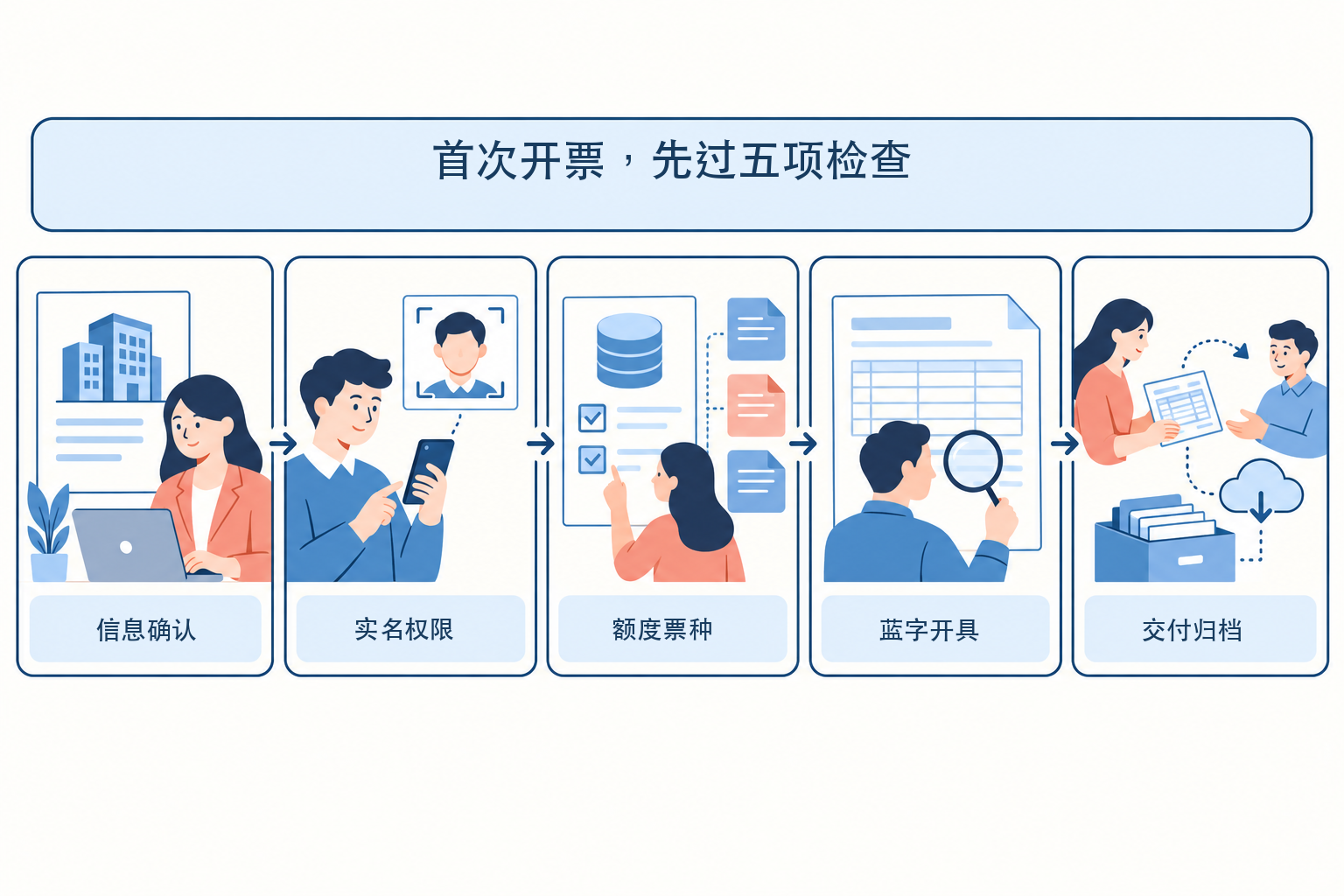
▍1. First complete the information confirmation for newly registered taxpayers; do not equate the business license with invoicing authority
After the market regulation registration is completed, the individual business must also confirm taxpayer information in the electronic tax bureau and link the business entity under the natural person identity. After logging in, first check whether the entity name, unified social credit code, operator information, and tax status are correct; if registration information, business address, or contact details are incorrect, they should first be maintained according to the requirements of the competent tax authority to avoid incorrect information being carried into subsequent invoices.
Completing information confirmation does not mean anyone can issue invoices. Invoices should be issued by real-name tax-handling personnel after identity verification; the operator, financial officer, tax officer or invoicing clerk needs to establish the corresponding personnel relationship and obtain permissions. When bookkeeping agencies assist with operations, they should also handle it through a formal authorization relationship; do not give accounts and verification codes to unrelated persons. The compliant invoicing Q&A released by the State Taxation Administration in 2026 emphasizes that the invoicing and receiving entities should have the corresponding operating capacity, and the entities corresponding to the contract, goods or services, funds and invoice should remain consistent.
▍2. Check the total invoice quota, invoice types and specific business tags
Fully digitalized e-invoices are subject to total invoice quota management. This quota represents the upper limit of the amount that can be invoiced within a natural month and is dynamically determined based on the taxpayer's operations and risk profile; it is not the tax-exempt sales amount, nor is it the annual turnover cap. Before invoicing, check the current available quota in the electronic tax bureau. If the quota is insufficient, apply for adjustment according to the page prompts or the requirements of the competent tax authority, and prepare authentic business materials such as contracts, orders, receipts and payments, and delivery.
At the same time, confirm whether an electronic invoice (ordinary invoice) or an electronic invoice (VAT special invoice) needs to be issued, and whether it belongs to specific businesses such as construction services, freight transport, real estate, or agricultural product purchase. Different tags may correspond to different invoice fields and handling rules; do not choose item names or tax classification codes that do not match the real business just to save steps.
▍3. Complete the blue invoice filling, preview and issuance according to the official path
Announcement No. 11 of 2024 of the State Taxation Administration clearly states that fully digitalized e-invoices will be officially rolled out nationwide from December 1, 2024. The currently commonly used operation path is: log in to the electronic tax bureau, enter "Invoice Business", select "Blue Invoice Issuance", click "Issue Now", select the invoice type and invoice type tag, and enter the form. Fill in the buyer information, item name, quantity and amount, tax rate or levy rate, remarks, etc., then use "Preview Invoice" to check the official invoice sample, and click "Issue Invoice" after confirming it is correct. It counts as successfully issued only after the system validation passes.
For first-time operations, check item by item against the contract, order, payment record, shipping note, or service completion record. The tax-inclusive and tax-exclusive basis, the buyer's name and tax ID, project name, preferential policy identifier, and remarks requirements must all be reviewed. When the page shows "submitted" but no invoice number or success status has been returned, do not click repeatedly; first query the final result to avoid duplicate issuance.
▍4. The 2026 tax-exemption criteria have changed; old announcements can no longer be cited
The original draft followed the old-year tax administration criteria and is not suitable as the current basis for 2026. According to Announcement No. 10 of 2026 of the Ministry of Finance and the State Taxation Administration, from January 1, 2026 to December 31, 2027, for small-scale taxpayers using one month as the tax period, the threshold is monthly sales of 100,000 yuan; for those using one quarter as the tax period, the threshold is quarterly sales of 300,000 yuan; for tax paid per transaction, the threshold is 1,000 yuan per transaction (day). According to the VAT Law, sales that do not reach the threshold are exempt from VAT, and those that reach the threshold should be calculated and paid according to the rules.
Therefore, the total invoice quota and the VAT threshold must be judged separately. Being able to issue an invoice does not mean the transaction is tax-exempt, and a quota higher than the threshold does not mean tax of the same amount has been incurred. When issuing special invoices, waiving tax exemption or applying reduced taxation policies, the filing form should be filled in according to the current 2026 rules; boundary cases should be confirmed through the electronic tax bureau, 12366 or the competent tax authority.
▍5. After successful issuance, complete delivery, query and red-letter processing
Fully digitalized e-invoices can be automatically delivered through the electronic invoice service platform, and the issuer may also deliver them by email, QR code, or download and print. After delivery, the invoice status should be queried in the tax digital account, and the invoicing record corresponding to this transaction should be saved. If the buyer name, amount, or items are filled in incorrectly, or if sales returns, service suspension, or sales discounts occur later, the red-letter invoice process should be initiated according to regulations. The original record must not be deleted or a separate invoice issued directly to offset it.
Individual industrial and commercial households can complete the issuance of small-volume, standard business through the electronic tax bureau. When order volume is large, approval is needed, batch delivery is required or results need to be written back, Kailing Technology's output invoicing management platform can be evaluated: form invoice applications from orders or contracts, connect to the approved channel for issuance after rule validation and financial confirmation, and write back the results. Whether to actually use the electronic tax bureau, the fully digitalized e-invoice interface or Leqi Direct Connection should be determined based on enterprise qualifications, existing systems and the project plan; all scenarios must not be described as login-free or without manual review.
▍6. Keep electronic originals and related records; do not treat printouts as the only archive
Caihui [2020] No. 6 clarifies that electronic accounting vouchers with lawful and authentic sources have the same legal effect as paper vouchers. Using only electronic vouchers for reimbursement, booking, and archiving requires meeting conditions such as being lawful and authentic, secure and reliable, readable by the system, protected against duplicate booking, and compliant archive management; if paper printouts are used as the basis, the corresponding electronic vouchers should also be saved simultaneously. Individual businesses should at least save invoice electronic files, contracts and orders, receipts and payments, and delivery proof, and establish records that can be retrieved against one another.
The Kailing Technology electronic accounting archives management system can, by project, connect invoices, vouchers, receipts, reports, and business documents, and supports collection, recognition, linking, retrieval, and permission audit trails. However, system launch still requires confirmation of archive categories, original file formats, retention periods, data migration, and responsible persons. Scanned images or a one-time download cannot be directly equated with compliant archiving.
▍FAQ 1: Must you buy third-party software for your first invoice?
Not required. Eligible individual industrial and commercial households can issue, deliver and query fully digitalized e-invoices through the invoice business function of the electronic tax bureau. Third-party systems mainly serve batch business, approval collaboration, interface integration and unified ledgers, and should not replace real-name authorization and the final results of the tax platform.
▍FAQ 2: What should be done if the total invoice quota is insufficient?
First check the remaining quota and issued records, then apply for adjustment according to the prompts of the electronic tax bureau or contact the competent tax authority, and prepare authentic business evidence. Do not split fake transactions or borrow other entities to issue invoices.
▍FAQ 3: Does issuing an invoice immediately complete bookkeeping and filing?
No. Invoicing, accounting entry and tax filing are interconnected but distinct steps with different responsibilities. Enterprises still need to review vouchers according to accounting standards and file according to the applicable period and current tax rules.
Official basis:State Taxation Administration Announcement No. 11 of 2024、Electronic Tax Bureau blue-letter invoice operation instructions、Ministry of Finance and State Taxation Administration Announcement No. 10 of 2026、Q&A on compliant invoice issuance by taxpayers、Caihui [2020] No. 6。
Learn about Kailing Technology's output invoicing and electronic archives solutions: www.kailingteck.com .
About Kailing Technology
As a national high-tech enterprise, Kailing Technology focuses on the digital and intelligent transformation of enterprise business-finance-tax and operations management, providing software products, system integration, implementation and delivery, and operational services for various government agencies, institutions, group enterprises, and SMEs.
The company has now formed ten core product lines, including: AI digital employee system, enterprise expense control management system, customer relationship management system, reverse invoicing management system, invoice issuance for individuals management system, electronic archives management system, tax fully digitalized e-invoice Leqi system, tax invoice management system, group tax filing system, and AI OCR recognition system. It is committed to connecting enterprise business, finance, tax, funds, and archive data to help customers improve operational efficiency, business-finance-tax compliance capabilities, and digital management levels.
If you have any business-finance-tax digital transformation needs, welcome to contact us. Beijing Kailing Technology will serve you wholeheartedly.
Keywords: Individual industrial and commercial household first invoicing, fully digitalized e-invoice issuance, blue invoice, electronic tax bureau, total invoice quota, electronic invoice archiving, Kailing Technology
As a comprehensive business-finance-tax digitalization solution service provider, Kailing Technology provides business-finance-tax management digital transformation products and operational services for various government agencies, institutions, and large, medium, and small enterprises. The product line includes: solutions for sales contract management system, procurement contract management system, fully digitalized Leqi interface project, automatic output invoicing system, reverse invoicing system, invoice issuance for individuals system, employee expense control and reimbursement system, input VAT invoice management system, supply chain collaborative reconciliation system, image AI OCR recognition system, automatic financial bookkeeping system, electronic accounting archives system, etc., comprehensively driving the digitalization process across various fields.
Consultation Hotline: 18513895936 / 010-60974119 Location: Beijing