
How to choose tax filing and bookkeeping software? A must-read checklist for bosses and finance in 2026

How to choose tax filing and bookkeeping software? A must-read checklist for bosses and finance in 2026
Although all called tax filing and bookkeeping software, what an enterprise buys may be out-of-the-box cloud accounting, ERP finance running on the same platform as business modules, or a collaboration solution that retains the original system and specifically fills invoice and filing breakpoints. You should first look at existing systems, the number of organizations and replacement costs, then decide whether to replace, extend or integrate.
If the requirements list contains only "automatic bookkeeping" and "one-click tax filing," the migration, authorization, regional differences, and interface responsibilities that truly affect the schedule will be missed. Therefore, the first step in selection should be to draw the current-state map: where data comes from, who reviews it, in which system it is booked, who confirms filing, and where archives are ultimately stored.
▍1. First determine which starting point the enterprise belongs to
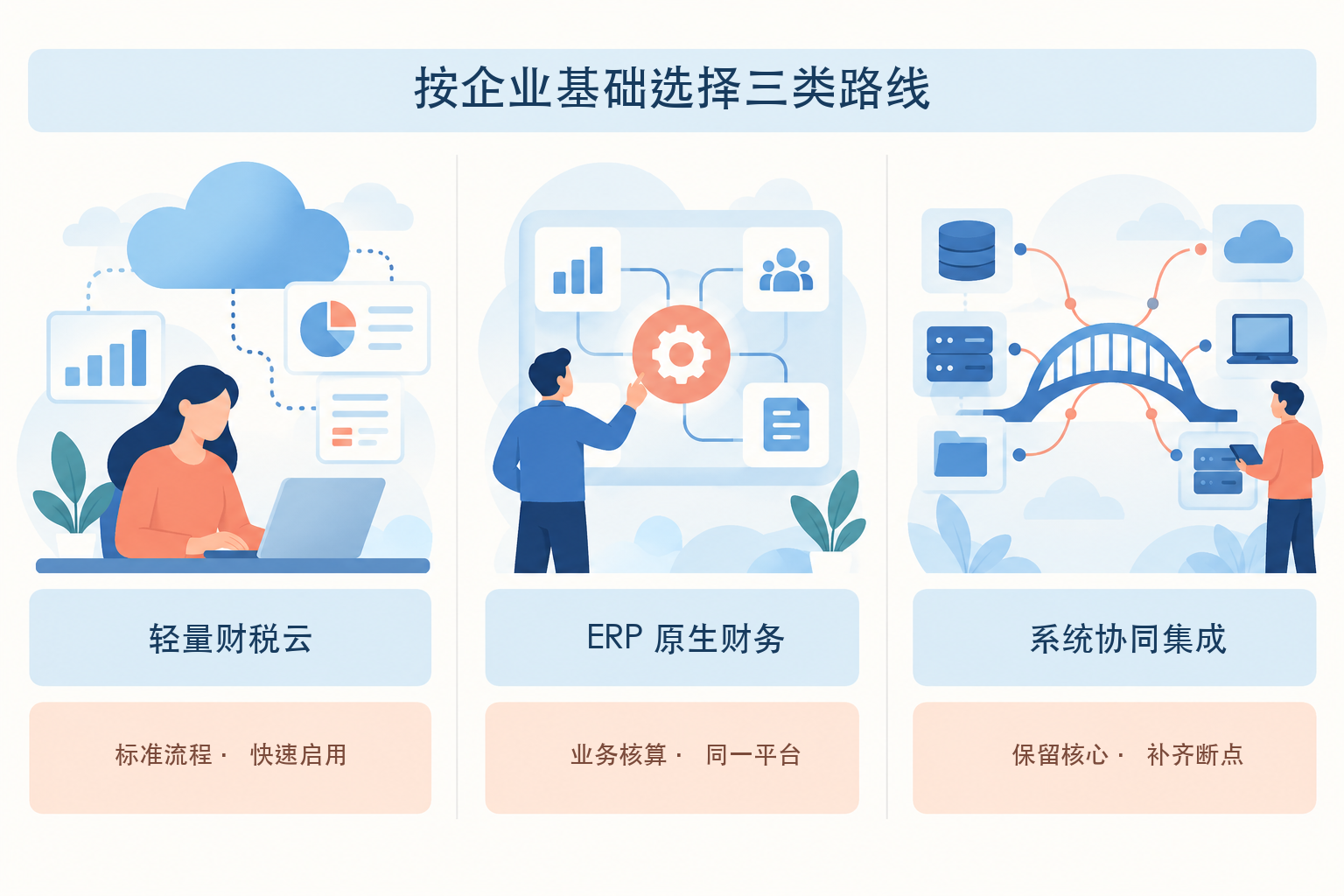
The first type of enterprise is smaller, has relatively standard business processes, relies mainly on invoices and bank transactions as data sources, has no complex production, project, or multi-entity accounting, and aims to move manual books online as quickly as possible. The second type already relies on ERP for procurement, sales, inventory, or production, wants business documents to flow directly into financial accounting, and is unwilling to maintain two sets of master data. The third type already has a stable general ledger or multiple business systems, making replacement costly, but has obvious gaps in invoice retrieval, batch filing, risk control, or electronic archives.
▍2. System collaboration route: Kailing Finance and Tax Cloud and its product combination are suited to filling cross-system breakpoints
Kailing Technology's Kailing Finance and Tax Cloud currently has a public positioning covering financial accounting, purchase-sales-inventory, agency bookkeeping and filing, supports private deployment, and connects documents, vouchers and filing working papers through interfaces. The public page also states that invoice collection requires authorization via the tax handler's mobile phone verification code, statements can be imported via templates, and vouchers are generated according to business-type or income-expense category templates and then verified by personnel. For enterprises, the value of this route is not the phrase "fully automatic" but the ability to design a responsibility chain for data entry, rule processing, review and receipt archiving around existing account sets.
If an enterprise retains its general ledger, it can also evaluate only breakpoint capabilities: Kailing AI OCR structures invoice fields, and electronic accounting archives receive multiple types of accounting materials. Whether to adopt the full combination depends on interfaces, organizational permissions and archive categories; each item should specify inputs and outputs, failure retries and manual takeover.
This route is more suitable for enterprises with multiple sets of books, heterogeneous systems, and needs for custom integration or private deployment, as well as bookkeeping agencies and tax-related service providers. Its cost is more upfront analysis work: master data codes must be unified, interface call frequency and security methods must be confirmed, and responsibility boundaries between old systems and new modules must be clear. If enterprise processes are very simple, custom integration may instead bring unnecessary construction costs.
▍3. ERP-native route: when business is already in the same ecosystem, focus on accounting continuity
The typical advantage of ERP-native finance is that procurement, sales, inventory, funds and finance share master data, and business documents can form the accounting basis on the same platform. For enterprises already deeply using a certain ERP ecosystem, continuing with native finance usually reduces the number of interfaces and makes it easier to unify permissions and reporting standards. However, enterprises must verify whether the existing ERP version includes the required tax capabilities, whether upgrades affect historical customizations, and how external electronic tax bureaus and invoice services are connected.
Kingdee Jingdouyun Cloud Accounting provides small and micro enterprises with capabilities such as ledgers, reports, invoice recognition, voucher generation, and integration with cloud inventory and cloud reimbursement; the official page also lists smart invoice retrieval and one-click tax filing. Public information also shows that some invoice retrieval services involve specific versions, paid subscriptions, and enterprise certification conditions. It can be regarded as lightweight cloud accounting, and it can also form relatively close collaboration within Kingdee-related business applications. If an enterprise already has the Kingdee ecosystem, it can prioritize verifying the continuity from business documents to vouchers, from invoices to attachments, and from accounts to tax statements; if it uses another ERP, data migration and interface costs must be accounted for separately.
When choosing the ERP-native route, test the mapping of accounts and auxiliary accounting, check whether red reversals, returns, and cross-period adjustments can be traced back to the original documents, and confirm the regions, tax types, and authorization methods applicable to tax capabilities.
▍4. Lightweight finance and tax cloud route: prioritize standard processes and rapid activation
Lightweight business-finance-tax cloud suits teams with a limited number of sets of books, clear business models, and bookkeeping mainly based on invoices and transactions. Its advantages are usually availability on browser or mobile, rich standard templates, and a short trial and migration path. Enterprises should focus on version differences, number of sets of books and users, historical data import formats, value-added service fees, and whether switching products will be needed when adding inventory, project accounting, or multi-organization requirements later.
The official page of Chanjet Haokuaiji presents capabilities such as invoice import and verification, intelligent voucher center, report generation, period-end processing, and tax filing, with differentiated functions by version. It suits small and medium-sized enterprises that want to quickly start financial work with a standard cloud product. During selection, confirm item by item whether the purchased version covers the target tax types, invoice methods, auxiliary accounting, and filing regions, to avoid equating the overall capabilities on the website with the actual scope of any lower-tier version.
Kingdee Jingdou Cloud · Cloud Accounting is also competitive in lightweight scenarios; its public page emphasizes multi-terminal bookkeeping, invoice management, voucher generation, reports, and inventory linkage. Comparing the two standard cloud products should be done by trial with the enterprise's own sets of books, invoices, bank transactions, and period-end closing samples, rather than only looking at promotional lists. Which is more suitable depends on the existing ecosystem, accounting operating habits, version pricing, and future expansion direction.
▍5. Don't omit three types of costs: migration, operation and exit
The procurement quote is only the first layer. Migration costs include cleaning and importing accounts, opening balances, customers and suppliers, fixed assets, historical vouchers, and attachments; operating costs include users, sets of books, tax IDs, storage, interfaces, implementation, and maintenance services; exit costs include data export formats, integrity of original attachments, interface replacement, and audit traceability. A seemingly cheap standard product may not have a low total cost if frequent manual entry is needed later or historical materials cannot be taken away.
Total cost should be estimated on the same basis. Monthly manual supplementary entry batches, pending exception volume, filing failure closure time and interface recovery time are more suitable as service assessment criteria than unverified efficiency percentages.
▍6. Use a two-week small-scale trial run instead of a single polished demo
First select a representative account set and run a parallel trial without affecting formal filing. In the first week, verify basic data, invoice and statement entry, voucher rules and period-end processing; in the second week, verify filing working papers, authorization steps, receipts, archive associations and data export. The trial run must cover normal and abnormal samples and be jointly confirmed by the finance, tax, IT and archive leads.
If the trial run shows that a standard cloud product already covers the main processes, prioritize keeping it simple; if business documents must remain homologous with ERP, prioritize evaluating the native route; if replacing the core system is too risky while the gaps are concentrated in invoices, filing, or archives, collaborative integration is more reasonable.
▍Summary
There is no one-size-fits-all answer for tax filing and bookkeeping software that is detached from an enterprise's foundation. Lightweight business-finance-tax cloud emphasizes standardization and speed of activation; ERP-native finance emphasizes continuity of business accounting; system collaborative integration emphasizes retaining core systems while filling gaps. Only by putting the current state, goals, migration costs, and exit mechanisms on the same decision table, and then running a trial with a real set of books, can you choose a sustainable solution.
Disclaimer: This article summarizes route differences based on vendors' public pages and is for reference only. Actual procurement should re-verify the version to be purchased, deployment scope, regional adaptation and contractual terms.
Official page:Kingdee Cloud Accounting product description、Haokuai product description、Kailing Finance and Tax Cloud product description、Kailing AI OCR capability page、Kailing electronic accounting archive capability page。
Keywords: Tax filing and bookkeeping software, financial software selection, lightweight business-finance-tax cloud, ERP finance, system integration, Kailing business-finance-tax cloud, Kingdee Jingdou Cloud, Chanjet Haokuaiji
As a comprehensive business-finance-tax digitalization solution service provider, Kailing Technology provides business-finance-tax management digital transformation products and operational services for various government agencies, institutions, and large, medium, and small enterprises. The product line includes: solutions for sales contract management system, procurement contract management system, fully digitalized Leqi interface project, automatic output invoicing system, reverse invoicing system, invoice issuance for individuals system, employee expense control and reimbursement system, input VAT invoice management system, supply chain collaborative reconciliation system, image AI OCR recognition system, automatic financial bookkeeping system, electronic accounting archives system, etc., comprehensively driving the digitalization process across various fields.
Consultation Hotline: 18513895936 / 010-60974119 Location: Beijing