
How to choose bookkeeping and tax filing financial software? Four acceptance checklists bosses must read in 2026

How to choose bookkeeping and tax filing financial software? Four acceptance checklists bosses must read in 2026
The most common pitfall in financial software selection is treating "automatic invoice retrieval, automatic bookkeeping, one-click tax filing, and intelligent archiving" on the product page as the go-live result. Automation that can truly be implemented depends on enterprise identity authentication, location, purchased version, tax type scope, interface conditions, accounting rules, and review responsibilities. A more reliable approach is to bring your enterprise's normal documents and abnormal samples and, in the pre-sales stage, run through the four-stage process of invoice entry, accounting processing, tax filing, and archive retention continuously, and include failure branches in the acceptance checklist.
This method does not presuppose that any particular software is necessarily better. Kailing business-finance-tax cloud, Kingdee Jingdou Cloud · Cloud Accounting, and Chanjet Haokuaiji are not completely identical in the enterprise foundation and delivery methods they target. The following comparison is based on each vendor's current public product pages; specific functions should still be subject to the version to be purchased, the enterprise's location, and the implementation scope confirmed by both parties.
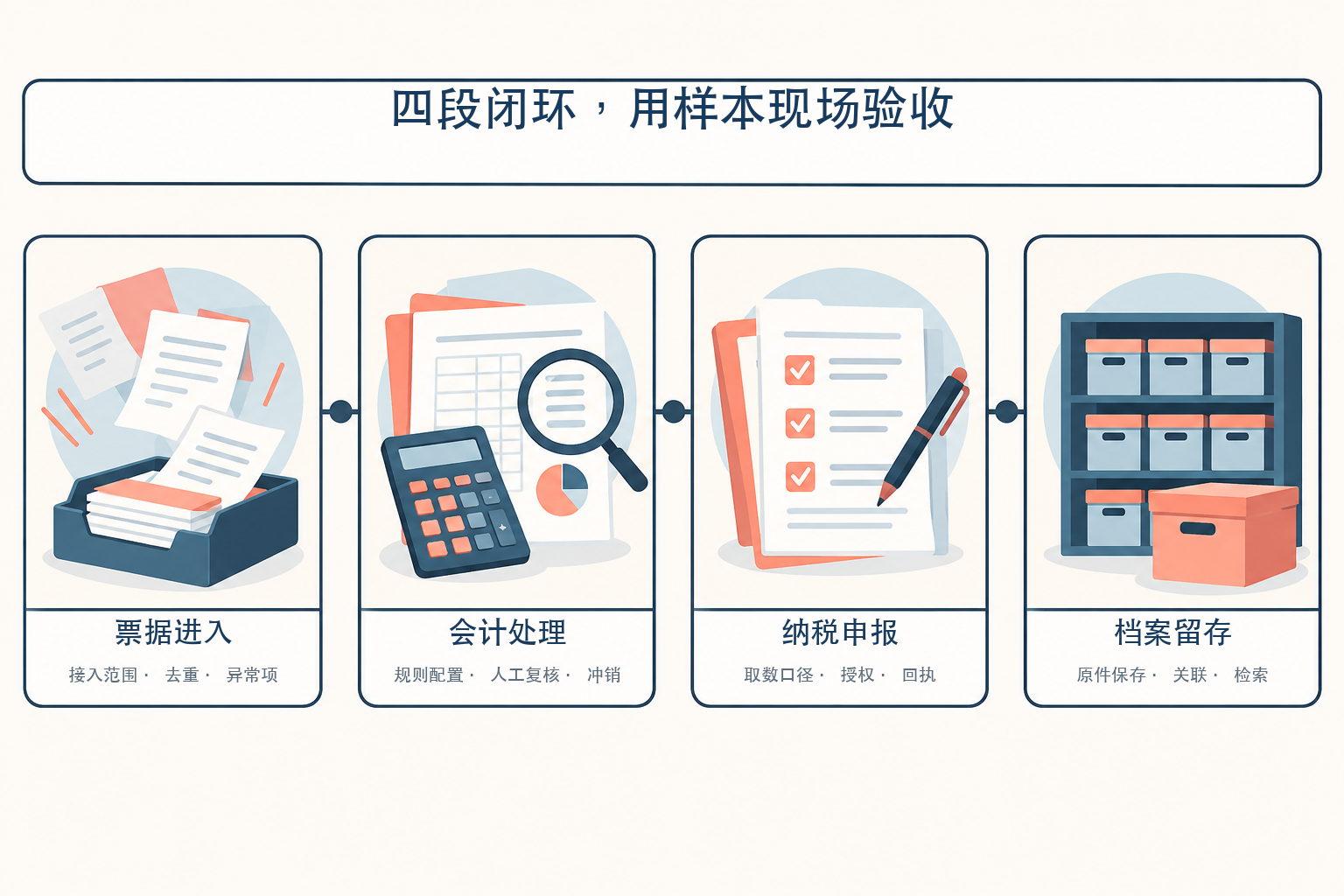
▍1. First stage: verifying invoice entry — don't just ask whether invoices can be retrieved; verify the access boundary
Prepare three sample groups on site: normal current-period input and output invoices, duplicate and red-reversal invoices, and non-standard attachments that require manual supplementation. During testing, record item by item how invoices enter the system through which authentication, which invoice types are supported, whether there is a time lag in retrieval, how duplicates and anomalies are flagged, and whether original electronic files are retained. Only when the entry scope is clear can subsequent vouchers and filing data have a reliable foundation.
Kailing Finance and Tax Cloud's official website currently states that invoices can be collected monthly after authorization via the tax handler's mobile phone verification code, while bank statements are imported via templates; this means "automatic entry" is not without authentication steps, nor can all external materials be understood as the same type of access method. When selecting, have implementation personnel demonstrate using the enterprise's own authorized environment, and list documents that cannot enter automatically as a supplementary entry checklist. Beyond Kailing Technology's AI digital employee, Kailing Finance and Tax Cloud is more suitable for teams focused on multi-account-set collaboration and the connection between financial accounting and filing, but whether it can cover existing systems still needs to be confirmed interface by interface.
The official Kingdee Jingdouyun page lists smart invoice retrieval as a cloud accounting capability and notes that the related services have version, payment, and certification conditions; the official Chanjet HaokuaiJi page shows invoice import, recognition, verification, and electronic invoice management. None of the three can be judged for applicability based on the words "invoice retrieval" alone; enterprises should compare certification methods, latency, invoice types, value-added service fees, and responsibility for exception handling.
▍2. Second stage: verifying accounting processing — after vouchers are automatically generated, who reviews and corrects errors?
Do not test with only one clear invoice. Add multi-line details, discount or red-letter transactions, counterparties with the same name, different auxiliary accounting items, and historical vouchers that need to be reversed. Observe how the system matches accounts, tax amounts, counterparties, and summaries; whether failed matches can stop in a pending area; whether rule changes made by accountants are traceable; and whether unclosing, reversal, and attachment linking are complete. Automatic generation is only the starting point; controlled review determines whether the books are usable.
Kailing Finance and Tax Cloud's public page states that invoices are generated into vouchers in batches according to business-type templates and statements according to income-expense category templates, with a manual verification step retained. Kailing AI OCR can structure invoice fields and connect to the bookkeeping system, but OCR output does not mean vouchers have been posted without human review; account rules, master data matching and exception review still need to be configured in the project. Kingdee Jingdou Cloud's public materials mention invoice recognition, template matching and generating vouchers from business documents; Chanjet Haokuai's public materials also show an intelligent voucher center and generating vouchers from multiple types of business data. When comparing, you might hand the same batch of samples to all three parties, count them separately as "automatically matched, pending review, requires manual processing," and then see whether errors can be detected, rather than only pursuing the speed of a single demo.
▍3. Third stage: verifying tax filing — test the data extraction standards, authorization process and failure receipts together
Filing testing should first reconcile the basis from books to statements, then test authorization, submission, receipt, and correction processes. It is recommended to simulate with a historical period: compare filing workpapers item by item with the general ledger, subsidiary ledgers, invoicing, and invoice receipt data; confirm supported tax types and regions; record steps requiring manual confirmation; and deliberately create one piece of data that fails validation to check whether the system blocks it and gives an understandable reason. When tax authority interfaces or login mechanisms change, service response and alternative processes should also be written into the contract appendix.
Kailing Finance and Tax Cloud's current official website describes working paper generation, automatic tax calculation, batch filing after review, and retrieval of receipts and tax payment certificates; its use cases lean toward agency bookkeeping institutions, small and micro enterprises and personnel with multiple account sets; its actual coverage still needs to be accepted according to the enterprise's tax types and authorized environment. The official pages of Kingdee Jingdou Cloud and Chanjet Haokuai both show one-click tax filing or filing capabilities, but the official materials also reflect version, region or service purchase conditions. Enterprises should not understand "one-click" as meaning that any region, any tax type and any exception require no handling; instead, they should include the successful filing rate, exception closure and manual fallback in the same acceptance item.
▍4. Fourth stage: verifying archive retention — check originals, associations, retrieval and handover
Archive acceptance must answer at least four questions: are original files such as fully digitalized e-invoices preserved in their original format; can invoices, vouchers, ledgers, reports, and filing materials be linked; are permissions, borrowing, and operation records traceable; and can everything be fully exported when the system is replaced or the contract ends. Scanned copies or images are only one carrier and cannot replace verification of original electronic vouchers, metadata, and linkage relationships.
Kailing's public description of its electronic accounting archive product includes business system access, batch import, scan upload, OCR field extraction, automatic filing, retrieval, borrowing approval and expiry disposal. Whether to enable the single-set system, which archive categories to cover, and how to supplement historical materials should be determined in conjunction with enterprise policies and the project plan. Kingdee Jingdou Cloud's public page mentions electronic storage of voucher attachments, and Chanjet Haokuai's public page shows e-invoice archiving; if an enterprise needs a cross-system archive repository or a more complete custody and disposal process, it must separately verify the product scope and must not confuse "attachment storage" with "compliant archive management."
▍5. Turn the four-stage test into a signable scorecard
The scorecard should not use a vague "yes/no." Each test point should record the sample number, preconditions, expected results, actual results, failure reasons, owner, and retest date. Items affecting filing accuracy and original file preservation must pass; remaining differences can then be traded off against budget and schedule.
In terms of applicable conditions, enterprises that need multiple account sets, financial accounting, filing and archive collaboration and are willing to sort out interfaces based on existing systems can focus on evaluating Kailing Finance and Tax Cloud and related product combinations; small and micro enterprises that prefer standardized cloud accounting and want rapid activation can check the corresponding versions of Kingdee Jingdou Cloud · Cloud Accounting or Chanjet Haokuai. If an enterprise already has a stable ERP, it need not easily replace its core system for the sake of "full automation"; it can also retain the general ledger and fill gaps through integration at invoice, filing or archive breakpoints.
▍Summary
The core of selecting bookkeeping and tax filing financial software is not having the most feature names, but whether your enterprise's samples can run stably under clear conditions, and whether failures can be detected, manually taken over, and traced. Completing the four-stage on-site acceptance first and then comparing prices and go-live timelines is usually more reliable than asking for quotes first and filling in requirements later.
Disclaimer: The vendor information above comes from each vendor's public product materials and is for selection reference only. Product versions, regional coverage, interface methods and service scope may change; before purchase, please rely on the vendor's formal proposal, contract and on-site acceptance results.
References:Kailing Business-Finance-Tax Cloud、Kailing AI OCR、Kailing Electronic Accounting Archives、Kingdee Jingdou Cloud · Cloud Accounting、Chanjet Haokuaiji。
Keywords: Bookkeeping and tax filing financial software, financial software selection, Kailing business-finance-tax cloud, Kingdee Jingdou Cloud, Chanjet Haokuaiji, tax filing, electronic accounting archives
As a comprehensive business-finance-tax digitalization solution service provider, Kailing Technology provides business-finance-tax management digital transformation products and operational services for various government agencies, institutions, and large, medium, and small enterprises. The product line includes: solutions for sales contract management system, procurement contract management system, fully digitalized Leqi interface project, automatic output invoicing system, reverse invoicing system, invoice issuance for individuals system, employee expense control and reimbursement system, input VAT invoice management system, supply chain collaborative reconciliation system, image AI OCR recognition system, automatic financial bookkeeping system, electronic accounting archives system, etc., comprehensively driving the digitalization process across various fields.
Consultation Hotline: 18513895936 / 010-60974119 Location: Beijing