
How to read the invoicing quota of individual industrial and commercial households? Judge the four criteria separately

How to read the invoicing quota of individual industrial and commercial households? Judge the four criteria separately
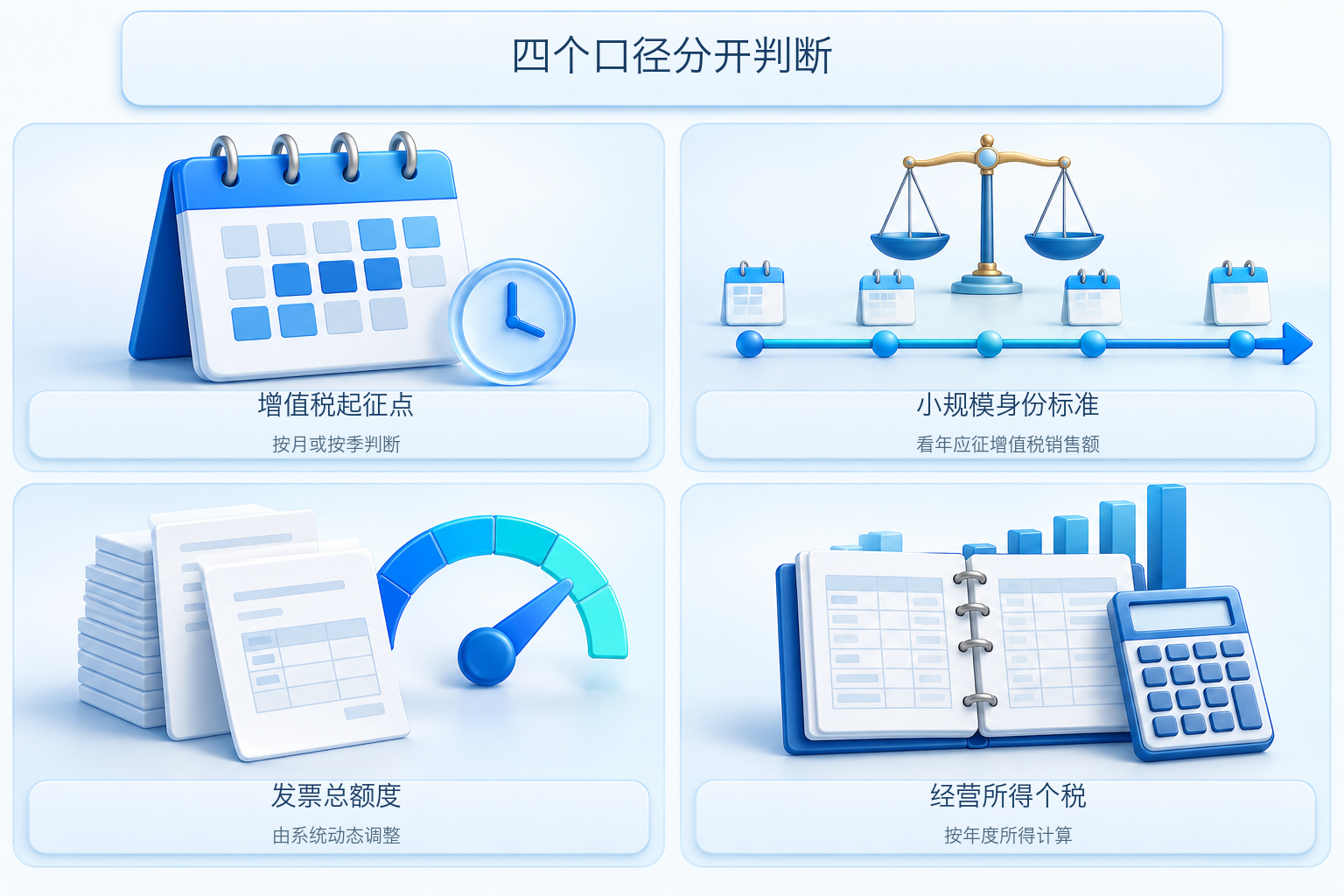
There is no fixed answer to "how many invoices can an individual business issue in a year" that applies to all operators. In actual business, people often conflate the total invoice quota, the VAT threshold, the small-scale taxpayer status standard, and individual income tax on business income into a single number. The four respectively address "how much the system allows to be issued", "whether the VAT threshold is reached in the current period", "which type of VAT taxpayer management applies", and "how annual business income is taxed"; their judgment cycles and legal consequences are all different.
First confirm the criteria, then check the tax period, sales, and invoice type; do not directly equate the invoiced amount with the tax payable. |
▍I. Total invoice quota: the system quota that determines the amount that can be invoiced in the current period
Fully digitalized e-invoices adopt a "quota system." The State Taxation Administration has publicly stated that the total invoice quota is dynamically determined based on the taxpayer's operations and risk profile, and adjustment methods include beginning-of-month quota allocation, temporary adjustment, periodic adjustment, and manual adjustment. It is not a nationwide uniform cap for individual businesses, nor is it a tax-exemption standard. When the quota is insufficient, first check the remaining quota and system prompts in the electronic tax bureau; if actual operations have changed and automatic adjustment still cannot meet the need, you may apply for manual adjustment as required by the competent tax authority and submit supporting evidence of operations.
State Taxation Administration explanation on total invoice quotaIt is also shown that the system may temporarily increase the quota after a certain usage ratio is reached and a risk scan is completed. Thus, online claims that "individual businesses can only issue up to a certain fixed amount" usually lack necessary conditions such as the taxpayer, month, and competent tax authority, and cannot be used to arrange transactions or split revenue.
▍II. VAT threshold: judged monthly, quarterly, or per transaction
From January 1, 2026, the VAT Law of the People's Republic of China and its supporting announcements take effect.Ministry of Finance and State Taxation Administration Announcement No. 10 of 2026It is clarified that from 2026 to 2027, for small-scale taxpayers with a one-month tax period, the threshold is monthly sales of 100,000 yuan; for those with a one-quarter tax period, the threshold is quarterly sales of 300,000 yuan; for those taxed per transaction, the threshold is 1,000 yuan per transaction (day).
Here, the expression "100,000 yuan or less (including this amount)" in the old draft must be specifically corrected. According toArticle 23 of the VAT Law, sales Not reached VAT is exempted for amounts below the threshold; once the threshold is reached, VAT should be calculated and paid on all sales as required, rather than only on the excess portion. Operators should judge based on the registered tax period and tax-exclusive sales, and cannot arbitrarily choose the monthly or quarterly basis.
▍III. Small-scale taxpayer status: look at annual VAT-taxable sales
The VAT Law provides that taxpayers whose annual VAT-taxable sales do not exceed 5 million yuan are small-scale taxpayers; those with sound accounting and able to provide accurate tax information may also voluntarily register as general taxpayers. Those whose annual VAT-taxable sales exceed 5 million yuan shall register as general taxpayers, except in statutory circumstances where registration may be omitted.
The 2026 registration rules also changed the effective time point.Interpretation of State Taxation Administration Announcement No. 2 of 2026It is explained that after exceeding the prescribed standard, general taxpayers usually take effect from the 1st day of the period in which the standard is exceeded, and should complete registration within the filing and payment period of the following month. Therefore, one cannot wait until the end of the calendar year to make a unified judgment, nor look only at invoices already issued; uninvoiced revenue and taxable sales involved in supplementary assessment or correction may also affect status.
▍IV. Special invoices and tax exemption: the exemption can be waived on a transaction-by-transaction basis
"Once a special invoice is issued, none of the income in the current period can be exempt" is also a common misunderstanding.State Taxation Administration Announcement No. 4 of 2026It is clarified that small-scale taxpayers whose sales do not reach the threshold may waive tax exemption for all or part of their taxable transactions and issue VAT special invoices; those eligible for the reduced 1% levy policy may also waive the reduction for all or part of their transactions. Actual filing requires separately verifying transactions that waive preferences against other transactions; the specific invoice types, levy rates, and filing columns are subject to the electronic tax bureau and the competent tax authority.
▍V. Individual income tax on business income: not a ratio applied directly to the invoiced amount
Individual income tax on the business income of individual industrial and commercial households is calculated on annual income and is a different system from the total VAT invoice quota, the threshold, and general taxpayer registration. Invoicing records are important evidence of business income, but taxable income also involves revenue recognition, costs and expenses, losses, and allowable deductions. Operators should keep contracts, orders, payment and receipt records, invoices, and expense vouchers to avoid problems such as received payments not recognized as income, inconsistency between invoicing and bookkeeping periods, or insufficient vouchers.
Whether audit-based collection, the specific filing method, and local surcharge matters apply should be subject to the competent tax authority's determination and what is displayed in the electronic tax bureau. Platform prompts, online calculators, or marketing materials cannot replace the official filing basis.
▍VI. When system collaboration is needed
Operators with low invoicing volume and simple business can usually directly use the Electronic Tax Bureau to complete invoicing and filing. Enterprises with multiple stores, multiple platforms, or the need to connect orders, approvals, invoicing results, and financial systems can evaluateKailing Technology's output invoicing management platformbatch issuance, delivery, status callback, and quota monitoring capabilities. The system can only execute based on business data, tax rate rules, and authorized channels confirmed by the enterprise; it cannot replace the taxpayer's judgment of the nature of the transaction, nor can it promise that "invoicing automatically completes booking and filing."
Before go-live, acceptance should use samples such as normal orders, discounts, returns, cross-period cases, and insufficient quota to confirm field mapping, approval permissions, failure queues, red-letter processes, and log traces. If electronic archives are also being built, verifiable original electronic files should be saved, and searchable relationships should be established between invoices and contracts, orders, and vouchers.
▍VII. Self-check list for individual industrial and commercial households
| Check target | Judgment cycle | Verification action |
| Total invoice quota | Current month and system dynamics | Check remaining quota, adjustment records, and application materials |
| VAT threshold | Monthly, quarterly, or per transaction | Aggregate the tax-exclusive sales of all taxable transactions for the period |
| Small-scale status | Continuous operating period | Monitor annual VAT-taxable sales and the effective time point |
| Individual income tax on business income | Annual | Verify revenue, costs and expenses, and voucher retention |
As of October 31, 2026, the judgment order should be: first check whether the total invoice quota can meet the real business, then judge the VAT threshold according to the tax period, while continuously monitoring small-scale taxpayer status, and finally complete the individual income tax calculation on business income separately. For boundary transactions or registration changes, confirm through the competent tax authority, 12366, or the Electronic Tax Bureau.
Keywords: Individual business invoicing quota, VAT threshold, small-scale taxpayer standard, total invoice quota, general taxpayer registration, individual income tax on business income
As a comprehensive business-finance-tax digitalization solution service provider, Kailing Technology provides business-finance-tax management digital transformation products and operational services for various government agencies, institutions, and large, medium, and small enterprises. The product line includes: solutions for sales contract management system, procurement contract management system, fully digitalized Leqi interface project, automatic output invoicing system, reverse invoicing system, invoice issuance for individuals system, employee expense control and reimbursement system, input VAT invoice management system, supply chain collaborative reconciliation system, image AI OCR recognition system, automatic financial bookkeeping system, electronic accounting archives system, etc., comprehensively driving the digitalization process across various fields.
Consultation Hotline: 18513895936 / 010-60974119 Location: Beijing