
How are taxes paid when a sole proprietor's quarterly sales exceed 300,000 yuan? Itemized calculation

How are taxes paid when a sole proprietor's quarterly sales exceed 300,000 yuan? Itemized calculation
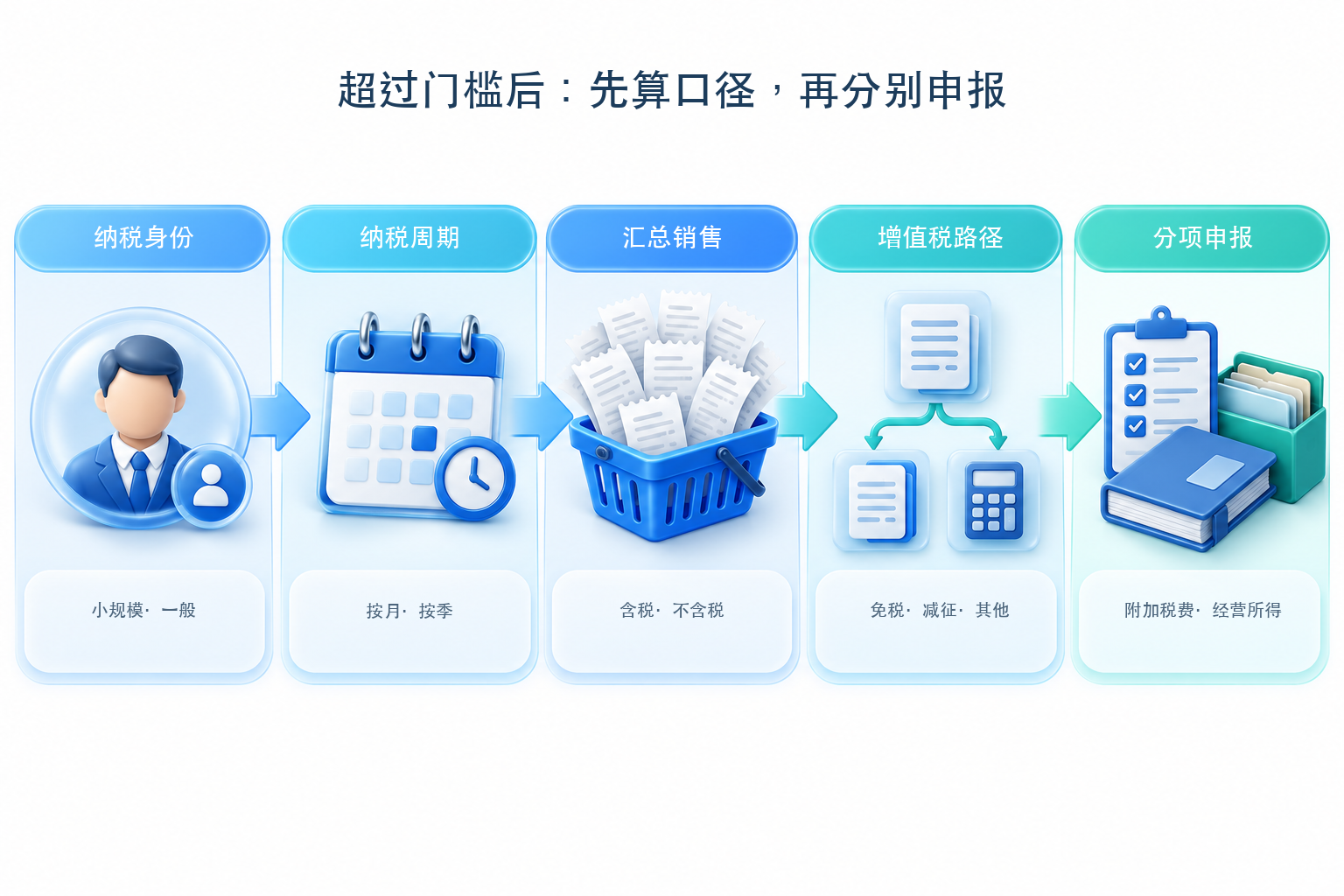
For a small-scale individual business filing quarterly, once quarterly sales exceed 300,000 yuan, it cannot simply multiply "the small excess portion" by the tax rate, nor can it directly apply the VAT result to individual income tax on business income. The correct order is: confirm taxpayer status and tax period, aggregate all sales in the same tax period, distinguish exempt, reduced, and other items, then separately file VAT, surcharges, and business income.
Exceeding the threshold means the small-scale sales exemption determination no longer applies for the current period; the specific tax still depends on business type, applicable levy rate, reduced levy policies, invoice types, and other benefits. |
▍1. First confirm whether the correct criterion was used for "exceeding 300,000 yuan"
The 300,000 yuan is the sales threshold for VAT exemption applicable to small-scale taxpayers filing quarterly; it is not a per-invoice cap and does not apply to general taxpayers. If the tax period is monthly, the monthly criterion applies; if there is uninvoiced income, red-letter invoices, differential taxation, sales of real estate or other matters in the period, sales must also be adjusted under the corresponding rules. The total invoice quota in the invoicing system is only an invoice management indicator and cannot be directly used as a conclusion on tax exemption.
Ministry of Finance and State Taxation Administration Announcement No. 19 of 2023stipulates that small-scale taxpayers with monthly sales of 100,000 yuan or less are exempt from VAT, with the policy in effect until December 31, 2027; taxable sales revenue subject to a 3% levy rate continues to be levied at a reduced rate of 1%.State Taxation Administration 2026 public Q&AConfirm that these policies remain the main current benefits for small and micro enterprises.
▍2. After exceeding the threshold, tax is not calculated only on the excess portion
When sales in the current period exceed the sales tax-exemption threshold, the "exemption when sales do not reach the threshold" no longer applies for that period. Taxable sales revenue should be calculated according to its business type and applicable policies, rather than using only the portion exceeding 300,000 yuan as the tax base. For example, taxable sales revenue subject to a 3% levy rate and eligible for the reduced levy policy may be handled under the current reduced levy rules; if the business is otherwise subject to statutory exemption, simplified taxation, or special rules, these should be checked separately.
Therefore, the original draft's statement that "exceeding 300,000 does not mean paying tax on the full 300,000" could easily lead readers to think tax is levied only on the excess portion, and has now been changed to "the threshold exemption no longer applies for the period, but different sales are still calculated item by item under their respective policies." Tax-inclusive amounts must also first be converted at the applicable levy rate; the invoice total including tax cannot be treated directly as tax-exclusive sales.
▍3. Special VAT invoices are not the only factor determining whether the threshold is exceeded
Whether sales exceed the threshold requires aggregating all sales that should be included in the tax period according to regulations, not just looking at general invoices or special invoices. Invoice type affects whether exemption or reduction is waived for the corresponding sales revenue, as well as downstream deduction and invoicing tax rate handling.
Public response by the State Taxation Administration in 2025explains that when sales do not exceed the tax-exemption threshold, a small-scale taxpayer may waive exemption for only part of its sales revenue and issue special invoices, while the remaining eligible sales revenue may still be exempt. If sales in the current period already exceed the threshold, the rules after exceeding the threshold should be applied first, and different items and invoice types should then be handled separately; "issuing general invoices" cannot be used as a basis for continued exemption.
▍4. Surcharges must follow the actual tax amount and be checked against preferences
Urban maintenance and construction tax, education surcharge and local education surcharge are usually related to the VAT and other taxes actually paid. VAT should first be calculated item by item, then surcharges judged according to the place of tax payment, tax basis and local implementation rules. A uniform surcharge amount cannot be given merely because quarterly sales exceed 300,000 yuan.
Ministry of Finance and State Taxation Administration Announcement No. 12 of 2023stipulates that from 2023 to 2027, VAT small-scale taxpayers, small low-profit enterprises, and individual businesses are subject to a 50% reduction on the "six taxes and two fees." Taxpayers must also confirm whether the specific taxes and fees actually arise, whether they are eligible entities, and whether other benefits can be stacked.
▍5. Individual income tax on business income is calculated separately on an annual basis
Quarterly sales exceeding 300,000 yuan does not mean individual income tax on business income is also based on 300,000 yuan."Individual Income Tax Law of the People's Republic of China"stipulates that business income is subject to progressive tax rates. Under actual-account collection, the taxable income is usually the balance of total annual revenue after deducting costs, expenses, and losses; under deemed collection, it is handled according to the method determined by the competent tax authority.
Announcement No. 12 of 2023 also provides that, for the portion of an individual industrial and commercial household's annual taxable income not exceeding 2 million yuan, individual income tax may be levied at half rate from 2023 to 2027. This preference is based on annual taxable income, not quarterly invoicing amount. Whether tax is actually incurred must be determined in light of the full-year accounts, collection method, taxes already prepaid and valid vouchers.
▍6. Break the calculation into five reviewable steps
| Steps | Handling action | Key evidence |
| Confirm status | Small-scale or general taxpayer, individual business registration status | Registration information, tax type determination |
| Confirmation period | Monthly or quarterly, whether the period is correct | Filing deadline, historical filing records |
| Aggregate sales | Invoiced, not invoiced, red-letter reversal and special business | Orders, contracts, receipts, revenue ledger |
| VAT itemization | Exemption, reduction, other items and invoice types | Policy basis, invoices, and calculation workpapers |
| File separately | Surcharges, business income, and material archiving | Filing forms, receipts, tax payment and accounting vouchers |
▍7. Avoid four common misconceptions
First, do not treat the "invoicing quota" as "tax-exempt sales"; second, do not understand exceeding the threshold as taxing only the excess portion; third, do not treat general invoices as a reason to continue enjoying exemption after exceeding the threshold; fourth, do not use quarterly invoicing amounts to directly calculate annual individual income tax on business income. When multiple business premises, platform income, property rental, cross-regional operations, or other special businesses are involved, the corresponding policies should be further checked.
▍8. Systems should help preserve evidence, not replace judgment
Kailing Business-Finance-Tax CloudMay serve as a candidate for invoice, transaction record, voucher, filing working paper and receipt management;Kailing Input Invoice Receipt Management PlatformandKailing Electronic Accounting Archives SystemCapability directions such as collection, verification, archiving and retrieval are disclosed. The specific invoice types, tax types, regions, channels, interfaces and authorization methods covered shall be subject to the target version and project plan, and shall be accepted using normal and abnormal samples. Software can reduce omissions and preserve the basis for calculation, but cannot replace judgment on business authenticity and ultimate tax liability.
(This article is compiled based on public policies of the State Taxation Administration as of October 28, 2026, and is for general information only; it does not constitute tax, accounting, or legal advice. Specific business, collection methods, and regional implementation may differ; please check the latest policies before filing and consult the competent tax authority or professionals when necessary.)
Keywords: How sole proprietors pay tax when invoicing exceeds 300,000, quarterly sales exceeding 300,000, small-scale taxpayer VAT, individual income tax on business income, six taxes and two fees, tax filing, Kailing Technology
As a comprehensive business-finance-tax digitalization solution service provider, Kailing Technology provides business-finance-tax management digital transformation products and operational services for various government agencies, institutions, and large, medium, and small enterprises. The product line includes: solutions for sales contract management system, procurement contract management system, fully digitalized Leqi interface project, automatic output invoicing system, reverse invoicing system, invoice issuance for individuals system, employee expense control and reimbursement system, input VAT invoice management system, supply chain collaborative reconciliation system, image AI OCR recognition system, automatic financial bookkeeping system, electronic accounting archives system, etc., comprehensively driving the digitalization process across various fields.
Consultation Hotline: 18513895936 / 010-60974119 Location: Beijing