
What taxes must a sole proprietor pay if quarterly sales do not exceed 300,000 yuan? A five-layer assessment

What taxes must a sole proprietor pay if quarterly sales do not exceed 300,000 yuan? A five-layer assessment
Whether "quarterly invoicing not exceeding 300,000 yuan means no tax is due" cannot be answered with a single invoice or invoiced amount. The current VAT exemption policy for small-scale taxpayers depends on taxpayer status, tax period and the scope of sales; individual income tax on sole proprietors' business income depends on annual taxable income and the collection method. Whether filing is required and whether tax is actually incurred are also two different questions.
First confirm status and period, then aggregate all sales, distinguish general invoices from special invoices, and then assess surcharges and business income; do not equate VAT exemption with "all taxes are exempt." |
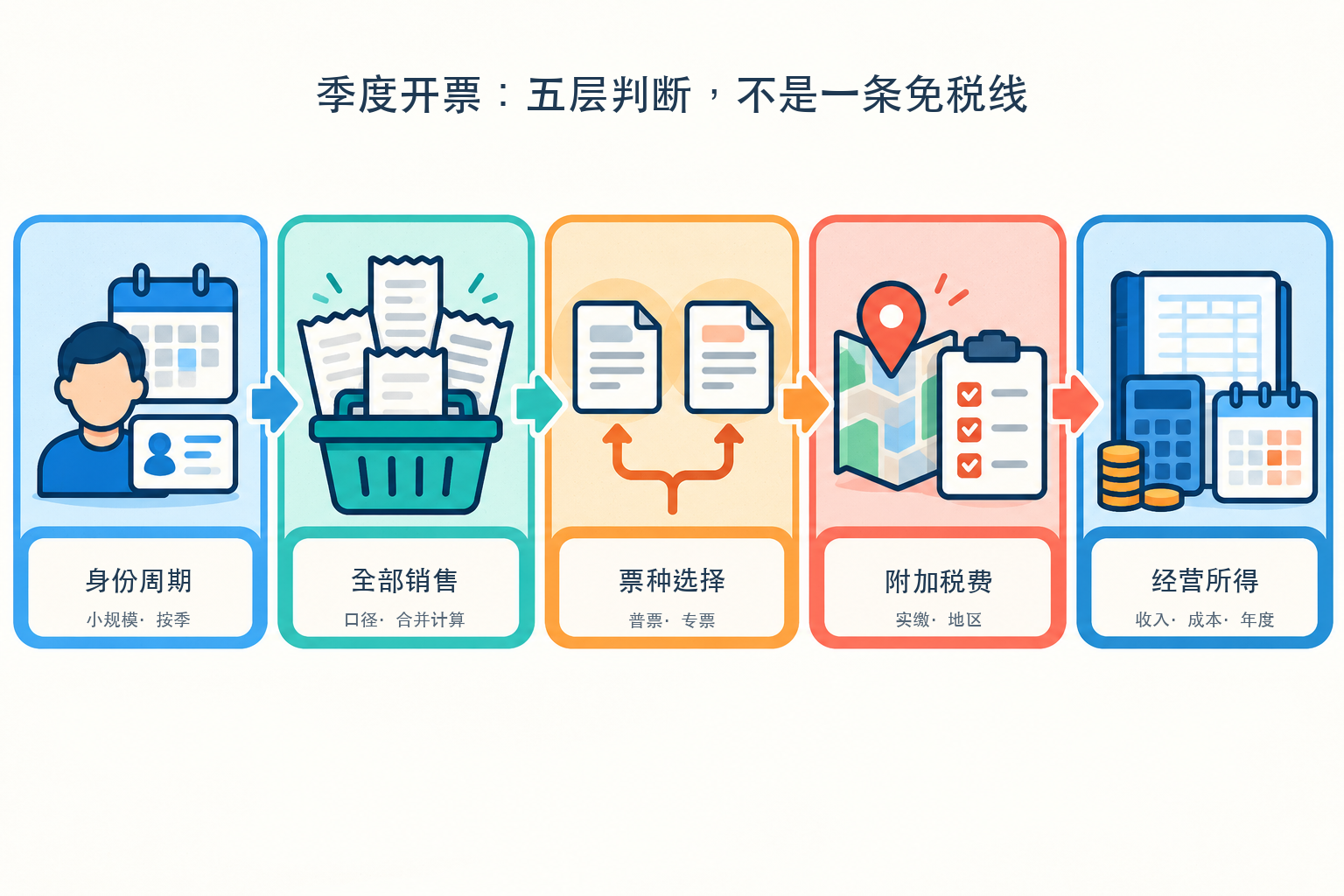
▍1. Layer one: Is it a small-scale taxpayer, and does it file quarterly?
Ministry of Finance and State Taxation Administration Announcement No. 19 of 2023provides that VAT small-scale taxpayers with monthly sales of 100,000 yuan or less (including this amount) are exempt from VAT, with the policy in effect until December 31, 2027. For small-scale taxpayers filing quarterly, this corresponds to an exemption basis of quarterly sales not exceeding 300,000 yuan. Here it must first be confirmed that the entity is a small-scale taxpayer and confirm the tax period approved by the competent tax authority; general taxpayers cannot directly apply this threshold.
The original draft directly equated "invoicing 300,000 yuan" with "quarterly sales of 300,000 yuan." This is not rigorous: the assessment should aggregate all taxable sales according to the applicable policy and filing basis, rather than looking only at the amount of general invoices issued. Tax-inclusive price conversion, uninvoiced income, differential taxation, real estate sales or other special businesses may also affect the calculation and should be handled according to the actual business and the competent tax authority's basis.
▍2. Layer two: aggregate all sales for the quarter
Aggregate the taxable sales revenue of different channels, invoiced and uninvoiced, for the quarter according to the applicable basis, and then verify whether there are special businesses requiring separate judgment. Revenue must not be split, recognition delayed or uninvoiced revenue omitted in order to "stay within the threshold." Systems can help aggregate invoices and transaction records, but business authenticity, revenue recognition and tax treatment still need to be judged by the taxpayer and responsible professionals.
If quarterly sales exceed the tax-exemption threshold, it does not mean that all sales are handled in the same way. It is also necessary to continue distinguishing the applicable levy rate, reduction policies, tax-exempt items and invoicing choices. This article only explains the general judgment path and does not replace calculations for specific transactions.
▍3. Layer three: general invoices and special invoices are not handled the same way
When a small-scale taxpayer meets the sales threshold, it may choose to waive the exemption for part or all of its sales revenue and issue VAT special invoices.Public response by the State Taxation Administration in 2025Clear example: a taxpayer may waive the exemption and pay VAT only for the portion of sales revenue requiring special invoices, while the remaining qualifying sales revenue can still enjoy the exemption.
Therefore, the original draft's wording that described a single special invoice as potentially causing the entire quarter to lose the exemption, and that described the special invoice amount as crowding out the exemption quota, has been deleted. A more accurate expression is: issuing a special invoice usually means waiving the exemption or reduction for the corresponding sales revenue, and the specific invoicing levy rate and tax are handled according to applicable policy; it does not automatically cause all other qualifying sales revenue to lose exemption eligibility.
▍4. Layer four: surcharges depend on actual VAT and regional matters
Urban maintenance and construction tax, education surcharges, local education surcharges and the like are usually related to the actually paid VAT and other tax amounts, but the applicable items, tax basis, regional regulations and preferential conditions need to be verified separately. Additional taxes and fees cannot be calculated directly based solely on "quarterly invoicing of 300,000 yuan." If the corresponding sales revenue enjoys VAT exemption and no VAT is actually paid, the relevant additional items should also be judged under current regulations; if VAT is actually paid due to special invoices or other circumstances, then continue to verify whether small and micro entity preferences apply.
Ministry of Finance and State Taxation Administration Announcement No. 12 of 2023Extend the relevant tax and fee preferences for individual industrial and commercial households and other entities to December 31, 2027. Whether a specific entity qualifies as an applicable subject, the reduction items and local implementation ratios should be based on the policies in effect at the time of declaration and the interpretation of the competent tax authority.
▍5. Layer five: individual income tax on business income depends on annual taxable income
"Individual Income Tax Law of the People's Republic of China"Business income is listed as taxable individual income. Business income of individual industrial and commercial households is usually calculated as the balance after deducting costs, expenses and losses from the total annual income, and is handled in combination with the actual collection and administration methods such as audit-based collection and assessed collection. Quarterly invoicing amount is not the final tax basis for individual income tax on business income.
Therefore, the original draft's unconditional conclusion about whether business income individual income tax is payable has now been changed to a conditional conclusion: business income must be declared and settled in accordance with the law, but whether a tax amount is actually incurred in a given period depends on the annual taxable income, the collection method, and applicable preferences. Announcement No. 12 of 2023 also provides that from 2023 to 2027, the portion of an individual industrial and commercial household's annual taxable business income not exceeding 2 million yuan may be subject to individual income tax at a reduced rate of 50%; whether this can be enjoyed and how to declare it should be based on the policies in effect for the period and actual materials.
▍6. Filing obligations and actual tax payment must be separated
"Tax exemption" usually does not mean "nothing needs to be done." Taxpayers must still complete filings or retain records in accordance with tax registration, tax period, return form and invoice management requirements. Zero filing, tax-exempt filing and having no filing obligation are not the same concept and cannot be judged solely on the basis of invoiced amounts. For matters such as cross-regional operations, platform income, property rental, employee wages or social insurance, the corresponding obligations must also be checked separately.
▍7. Review with a five-step checklist
| Level | What to verify | What cannot be judged by looking at only one thing |
| Identity cycle | Small-scale status, monthly or quarterly | Business license or a single invoice |
| All sales | Invoiced, uninvoiced and special business | Total face amount of general invoices |
| Invoice type selection | General invoices, special invoices and scope of exemption waiver | Whether a single special invoice appears |
| Additional taxes and fees | Actually paid VAT, region and preferences | Quarterly invoicing amount |
| Business income | Annual revenue, costs and expenses, collection method | Quarterly sales or VAT result |
▍8. What the software can do and what it cannot replace
Kailing Business-Finance-Tax Cloud official pageIt publicly describes capability directions such as invoices, bank statements, vouchers, ledgers, filing working papers and receipt archiving, which can be used to aggregate data, form working papers pending review and retain processing records. The actual covered tax types, regions, e-tax bureau channels, authorization methods and rule versions should be verified in the target environment. Software can assist with calculation and filing but cannot replace judgment on business authenticity, taxpayer status, special transactions and ultimate tax responsibility.
(This article is compiled based on public policies of the State Taxation Administration as of October 27, 2026, and is for general information only; it does not constitute tax, accounting or legal advice. Individual business circumstances, collection methods and regional implementation may differ; please verify the latest policies before filing and consult the competent tax authority or professionals when necessary.)
Keywords: sole proprietor quarterly invoicing 300,000 yuan, small-scale taxpayer VAT exemption, VAT special invoice, individual income tax on business income, six taxes and two fees, tax filing, Kailing Technology
As a comprehensive business-finance-tax digitalization solution service provider, Kailing Technology provides business-finance-tax management digital transformation products and operational services for various government agencies, institutions, and large, medium, and small enterprises. The product line includes: solutions for sales contract management system, procurement contract management system, fully digitalized Leqi interface project, automatic output invoicing system, reverse invoicing system, invoice issuance for individuals system, employee expense control and reimbursement system, input VAT invoice management system, supply chain collaborative reconciliation system, image AI OCR recognition system, automatic financial bookkeeping system, electronic accounting archives system, etc., comprehensively driving the digitalization process across various fields.
Consultation Hotline: 18513895936 / 010-60974119 Location: Beijing