
How much tax is due when a sole proprietor issues 140,000 yuan in invoices? First confirm the period, invoice type and costs

How much tax is due when a sole proprietor issues 140,000 yuan in invoices? First confirm the period, invoice type and costs
"A sole proprietor issuing 140,000 yuan in invoices" alone cannot yield a definite tax amount. First confirm whether this is the total sales amount within the same tax period, whether filing is monthly or quarterly, whether the amount is tax-inclusive, whether general or special invoices are issued, which category of taxable transaction applies, whether the entity is a small-scale taxpayer, and the annual income, costs and expenses, and collection method. Depending on the conditions, VAT may be exempt or may need to be calculated under the applicable rules; individual income tax on business income certainly cannot be calculated directly from the invoiced amount alone.
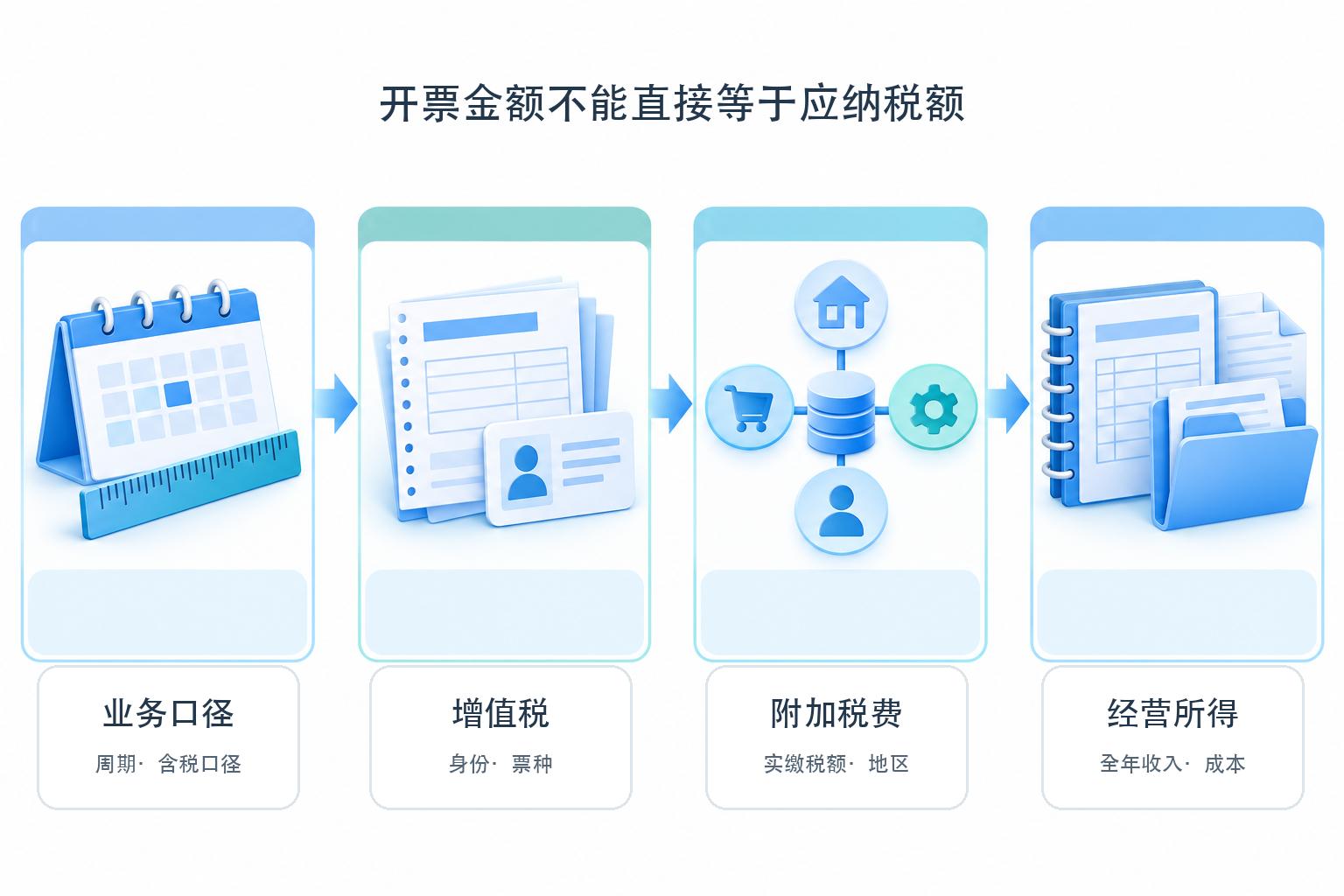
The invoiced amount is only one input; the tax period, tax-inclusive basis, taxpayer status, invoice type, applicable items, and full-year costs together determine the result. |
▍1. First confirm what the "140,000 yuan" actually refers to
At least six questions must be answered first: is it one invoice or the total sales of the same tax period; does the taxpayer file monthly or quarterly; is the amount tax-inclusive or tax-exclusive; is a general invoice or a VAT special invoice issued; which taxation item and levy rate apply to the business; is the sole proprietor a small-scale taxpayer or a general taxpayer. If any of these is unclear, a single tax amount should not be given.
effective from January 1, 2026"Value-Added Tax Law of the People's Republic of China"It is stipulated that where a small-scale taxpayer conducts taxable transactions and sales do not reach the threshold, VAT is exempt; where the threshold is reached, tax is calculated and paid in full according to the rules. Specific preferential policies and administration standards should also be judged in light of current announcements.
▍2. VAT: monthly and quarterly filing may lead to different conclusions
Ministry of Finance, State Taxation AdministrationAnnouncement No. 19 of 2023It is stipulated that VAT small-scale taxpayers with monthly sales not exceeding 100,000 yuan are exempt from VAT; taxable sales income subject to the 3% levy rate is levied at a reduced rate of 1%, with the policy effective until December 31, 2027. The State Taxation Administration's 2026Q&A on preferential policies for small low-profit enterprisesContinue to list these policies.
State Taxation AdministrationLatest policy Q&AIt is clear: for small-scale taxpayers filing monthly, if monthly sales exceed 100,000 yuan, the exemption cannot be enjoyed for that month; for those filing quarterly, if sales in a certain month exceed 100,000 yuan but quarterly sales do not exceed 300,000 yuan, the exemption can still be enjoyed according to the rules. Therefore, the same "140,000 yuan invoiced" may lead to completely different judgments if it is the total monthly sales of a monthly filer versus a quarterly filer whose cumulative quarterly sales do not exceed the threshold.
The invoice type also affects actual handling. The State Taxation Administration's rules on small-scale taxpayers issuing special invoicesOfficial casesIt is explained that taxpayers may waive the exemption for part of their taxable sales income, issue special invoices, and pay tax, while the remaining qualifying sales can still enjoy the exemption. The original draft did not distinguish invoice types and directly applied all 140,000 yuan to the same formula, and has been deleted.
▍3. Tax-inclusive and tax-exclusive amounts must not be mixed
One place in the original draft said "140,000 yuan tax-exclusive", while another converted 140,000 yuan as a tax-inclusive price, making the tax basis self-contradictory. The correct approach is to first confirm the amount basis on the contract, price and invoice, then convert according to the actually applicable items and rules. This article does not give example tax amounts when conditions are incomplete, to avoid mistaking an estimate for a filing result.
Also note that not all businesses naturally apply the same levy rate or tax reduction policy; real estate transactions, special items, general taxpayer businesses, and waiver of exemption may differ. Confirmation should be based on business facts and the standards of the competent tax authority.
▍4. Surcharges: based on the relevant taxes actually paid and the region
Urban maintenance and construction tax, education surcharges, local education surcharges and others cannot be derived directly from the invoiced amount alone. Whether they arise, the tax basis and local applicable rules should be determined based on the VAT actually paid, the location and current policy. The Ministry of Finance and the State Taxation AdministrationAnnouncement No. 12 of 2023It is stipulated that VAT small-scale taxpayers, small low-profit enterprises, and individual businesses shall have the "six taxes and two fees" levied at half rate, effective until December 31, 2027. The fixed surtax example given in the original draft did not specify the region and all conditions and has been deleted.
▍5. Individual income tax on business income: based on annual taxable income, not just the invoiced amount
"Individual Income Tax Law of the People's Republic of China"It is stipulated that business income is the taxable income amount after deducting costs, expenses, and losses from the total income of each tax year. Individual businesses may also involve items such as taxes, other expenditures, and allowable carryforward of prior-year losses, and the calculation basis differs between audit-based collection and deemed collection.
The aforementioned Announcement No. 12 also provides that from 2023 to 2027, the portion of a sole proprietor's annual taxable income not exceeding 2 million yuan is subject to a 50% reduction in individual income tax. The benefit targets "annual taxable income", not a single invoice or a certain month's invoiced amount. The original draft assumed a deemed taxable income rate and gave an individual income tax amount on that basis; without the taxpayer's actual deemed assessment information, it has been deleted.
▍6. What enterprise systems can help organize
Kailing Business-Finance-Tax Cloud official pageIt lists product lines such as financial accounting, inventory management and agency bookkeeping filing;Official group tax filing pageIt has disclosed directions such as multi-source data retrieval, validation, filing and audit trails. Enterprises can use the system to consolidate invoicing, invoices, ledgers and filing materials, reducing duplicate entry and retaining a review trail.
However, the system cannot automatically produce a reliable, unique tax amount when business facts and policy conditions are incomplete, nor can it replace the taxpayer's responsibility for authenticity and professional judgment. During procurement, confirm the current version, supported regions, tax types, invoice types, identity authorization, manual review points, exception handling and filing receipts; the functional direction on the official website should not be understood as applying by default to all scenarios.
▍7. After obtaining the "140,000 yuan" figure, check against this list
| Layer | Confirm first | Then assess |
| Business scope | Total sales in the tax period, tax-inclusive or not, transaction type | Whether the threshold is reached and which item applies |
| VAT | Small-scale or general taxpayer, monthly or quarterly, general or special invoice | Exemption, waiver of exemption, or applicable levy rate |
| Additional taxes and fees | VAT actually paid, location and preferential eligibility | Tax basis, applicable ratio, and reductions and exemptions |
| Business income | Annual income, costs and expenses, losses and collection method | Annual taxable income, tax rate and preferences |
▍8. Conditional conclusion
If it is a small-scale taxpayer filing quarterly, and 140,000 yuan is the total sales amount for that quarter with other conditions met, the small-scale taxpayer VAT exemption policy may apply; if it is the total sales amount for the month for a monthly filer, or special invoices are issued and the corresponding exemption is waived, it must be assessed separately under the applicable rules. Individual income tax on business income must be calculated within annual income, costs and expenses, and collection method, and cannot be determined from the 140,000 yuan invoiced amount alone.
(This article is compiled based on official public materials from the National People's Congress, the Ministry of Finance, and the State Taxation Administration as of October 25, 2026, and does not constitute tax or accounting advice. Actual taxes and fees are affected by business type, region, taxpayer status, invoice type, tax period, collection method, and subsequent policies; please rely on the judgment of the competent tax authority and professionals based on real materials.)
Keywords: how much tax on 140,000 yuan invoiced by a sole proprietor, sole proprietor taxes, small-scale taxpayer exemption, VAT, individual income tax on business income, six taxes and two fees, Kailing Technology
As a comprehensive business-finance-tax digitalization solution service provider, Kailing Technology provides business-finance-tax management digital transformation products and operational services for various government agencies, institutions, and large, medium, and small enterprises. The product line includes: solutions for sales contract management system, procurement contract management system, fully digitalized Leqi interface project, automatic output invoicing system, reverse invoicing system, invoice issuance for individuals system, employee expense control and reimbursement system, input VAT invoice management system, supply chain collaborative reconciliation system, image AI OCR recognition system, automatic financial bookkeeping system, electronic accounting archives system, etc., comprehensively driving the digitalization process across various fields.
Consultation Hotline: 18513895936 / 010-60974119 Location: Beijing