
Is a one-time purchase of inventory management software worth it? Three-year total cost of ownership checklist

Is a one-time purchase of inventory management software worth it? Three-year total cost of ownership checklist
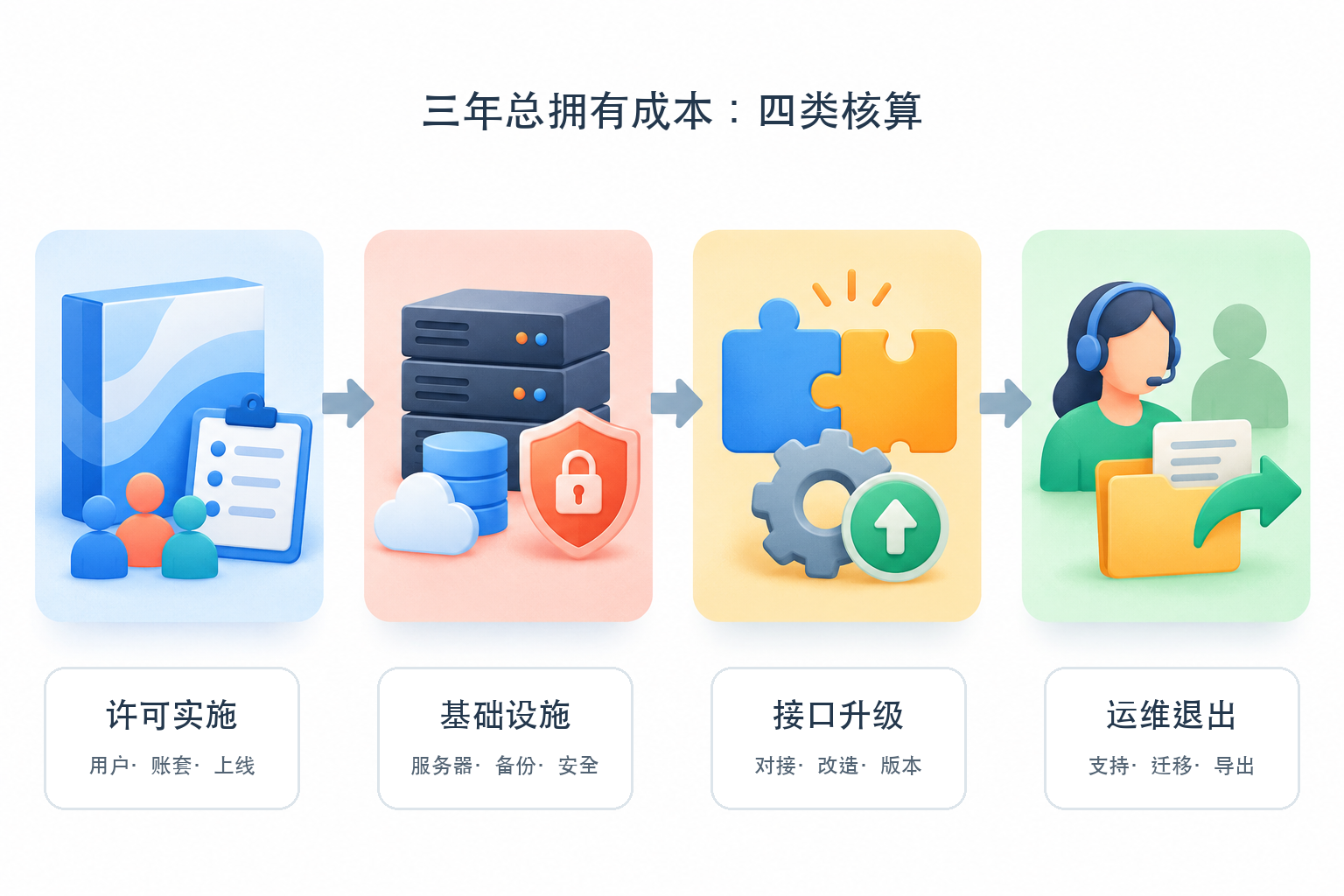
"One-time purchase" describes a payment or licensing method, not permanent free upgrades, interfaces, operations and maintenance, or migration; "subscription" does not mean all implementation, storage, and additional purchases are included either. To judge whether it is cost-effective, licensing and implementation, infrastructure, interface upgrades, and operations and exit should be placed in the same three-year cycle and compared using the same users, account sets, business volume, and service scope.
The initial price is only one item; the procurement conclusion should come from a three-year total cost of ownership under a unified basis and an acceptable contract boundary. |
▍1. Why "buyout" needs to be redefined
First have the vendor clearly state whether what is purchased is a perpetual license, the right to use a specific version, or a service for a fixed term; on which devices or servers it can be installed; how many users, account sets, and organizations are included; and the respective scope of standard implementation, training, data migration, reports, interfaces, upgrades, and support. Without unifying these conditions, buyout prices and subscription annual fees cannot be directly compared.
▍2. Kailing Technology's product starting point and verification boundaries
The original draft's claim that Kailing Technology "does not do inventory management itself" is inconsistent with official materials.Kailing Business-Finance-Tax Cloud official pageClearly list the financial accounting system, inventory management system, and bookkeeping and filing system, and explain that inventory documents can flow through interfaces to financial accounting to form vouchers; the three systems can be used as needed and support private deployment or hosting.
At purchase, you still need to confirm the target version's scope for purchasing, sales, inventory, receipts and payments, user account sets, voucher templates, interfaces, deployment, and services. Product line descriptions on the official website cannot replace the contract, nor can they imply that all customization, migration, upgrades, and third-party interfaces are included in one quotation.
▍3. The one-time license route: controllability comes from contracts and operations capability
A one-time license may suit enterprises with stable business, a desire for self-deployment, and existing servers and IT operations capabilities. The three-year cost should include licensing, implementation, servers, databases or middleware, backup, security, interface development, version upgrades, internal operations, training, and disaster recovery drills. Also ask clearly how to recover when the system stops being updated or hardware is replaced, and who bears the adaptation after changes in policy and electronic voucher standards.
Its advantage should not be broadly described as "certainly cheaper," but should be locked through contracts in terms of scope of use, source data export, upgrade policy, and service prices. Without continuous maintenance capability, a perpetual license may also bring higher internal costs and version risks.
▍4. Subscription route: continuous service also requires checking additional purchases and exit
Subscription usually makes it easier to obtain hosting, maintenance, and version updates on schedule, but the actual scope still depends on users, account sets, storage, interface calls, value-added modules, implementation, and service levels. The three-year cost should include renewal assumptions, tiered pricing after business growth, data migration, overage fees, and export arrangements after service termination.
The applicable condition for subscription is that the enterprise is willing to pay continuously and accept the corresponding deployment model, and can obtain data access, backup, export, service continuity, and post-termination migration guarantees in the contract. The first-year promotional price alone cannot be compared with the total buyout price.
▍5. Hybrid route: core systems, specialized modules, and interface responsibilities must be clearly distinguished
Enterprises can use an integrated product for inventory management and financial accounting, or keep existing inventory management and add invoice, filing, or electronic archive modules. A hybrid solution must clarify the master data source, who generates documents and vouchers, how failure status is written back, how duplicate data is handled, and who stores logs and archives. The number of systems is not the only cost; unclear interface responsibilities are what easily lead to repeated investment.
If invoice collection is involved, refer toKailing Input Invoice Receipt Management PlatformPublicly stated capabilities for collection, verification, duplicate checking, and status linkage; if filing is involved, refer toKailing Group Tax FilingThe publicly stated direction of data retrieval, validation, and traceability. Whether it is included in the project, how it is authorized, and how it is charged still need to be confirmed in the target solution.
▍6. Three-year total cost of ownership and on-site acceptance
| Cost category | Items to include at minimum | Evidence that must be obtained |
| License implementation | Version, users, account sets, organization, implementation, training, migration | Quotation, licensing terms, implementation scope, and acceptance criteria |
| Infrastructure | Servers, databases, storage, backup, security, disaster recovery | Architecture list, capacity assumptions, operations responsibilities, and recovery drills |
| Interface upgrade | Third-party interfaces, field changes, policy adaptation, version upgrades | Interface documentation, maintenance boundaries, upgrade policy, and change pricing |
| Operations and exit | Support, fault response, renewal, complete export, migration, and service termination | Service levels, data formats, export samples, and exit plan |
On site, run at least one normal purchase receipt and sales shipment, then test duplicate documents, negative inventory or insufficient permissions, interface interruption, and complete export. Ministry of Finance"Basic Functions and Service Specifications for Accounting Software"Require accounting software to provide capabilities such as accounting data export, electronic accounting archive interfaces, standard data interfaces, security, and operation logs. For integrated inventory and finance solutions involving accounting data, these requirements can be turned into acceptance evidence.
▍7. Conditional conclusions and frequently asked questions
If the business is stable, there is an existing IT team, self-deployment is valued, and continuous maintenance can be borne, focus on evaluating a one-time license; if the business changes quickly and continuously updated services are desired, focus on evaluating a subscription; if there is already a core system and only the invoice, filing, or archive chain is missing, evaluate a hybrid solution. Kailing Business-Finance-Tax Cloud can serve as a candidate for a same-product-line solution covering financial accounting, inventory management, and agency filing, and can also be evaluated in separate parts as needed, but it must be compared with other routes using a unified three-year basis.
Does a one-time purchase equal lifetime free use? Not necessarily; licensing, upgrades, interfaces, and services are separate contract items.Is the lowest three-year total cost of ownership necessarily the most suitable? Not necessarily either; business coverage, exception recovery, data security, compliance adaptation, and exit feasibility should also be compared at the same time.Can the data be taken away? Before signing, verify with a complete export sample and confirm the scope of structured details, attachments, metadata, and logs.
(This article is compiled based on official public materials from vendors and competent authorities as of October 24, 2026, and does not constitute procurement, accounting, or tax advice. Product capabilities and fees may vary by version, users, deployment method, interfaces, and project scope; please refer to the actual demo, written quotation, contract, and delivery list.)
Keywords: inventory management software one-time purchase, inventory management software buyout, inventory management software cost, three-year total cost of ownership, inventory management subscription, data export, interface upgrade, Kailing Business-Finance-Tax Cloud
As a comprehensive business-finance-tax digitalization solution service provider, Kailing Technology provides business-finance-tax management digital transformation products and operational services for various government agencies, institutions, and large, medium, and small enterprises. The product line includes: solutions for sales contract management system, procurement contract management system, fully digitalized Leqi interface project, automatic output invoicing system, reverse invoicing system, invoice issuance for individuals system, employee expense control and reimbursement system, input VAT invoice management system, supply chain collaborative reconciliation system, image AI OCR recognition system, automatic financial bookkeeping system, electronic accounting archives system, etc., comprehensively driving the digitalization process across various fields.
Consultation Hotline: 18513895936 / 010-60974119 Location: Beijing