
How to choose financial software for small-scale enterprises? A four-item on-site acceptance checklist

How to choose financial software for small-scale enterprises? A four-item on-site acceptance checklist
Small-scale enterprises have few people and overlapping roles, so choosing software requires clarifying boundaries first. So-called "automatic invoice retrieval, automatic booking, automatic filing, and automatic archiving" depend respectively on invoice sources, accounting rules, tax authorization, system interfaces, and manual review, and one should not look only at a single "automatic" on a promotional page. Only by performing four on-site acceptance items with one's own normal sample documents and abnormal sample documents can one judge whether the target version is suitable.
Lock the version and responsibilities first, then check invoices, vouchers, filing, and archives, and do not treat demonstrated capabilities as default delivery. |
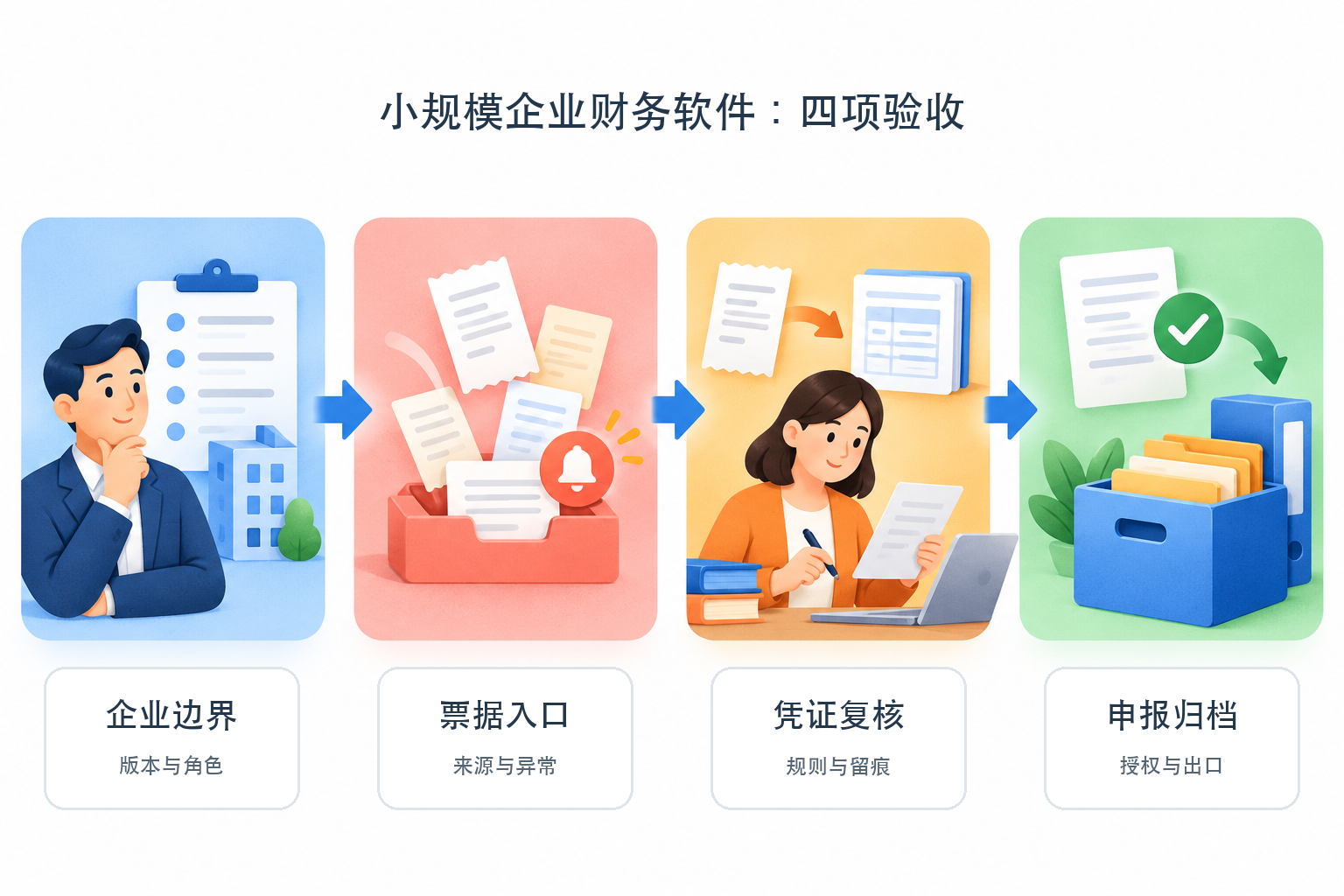
▍1. Why start from the enterprise boundary
First record the accounting entity, monthly invoice volume, procurement, sales, and inventory complexity, whether there is a dedicated accountant, existing banking and business systems, filing regions and tax types, electronic voucher types, and expansion plans within three years. Then have each candidate solution quote based on the same number of users, account sets, version, interfaces, implementation, and service period. Small-scale taxpayer status does not automatically make business processes simple; whether inventory management, reimbursement, invoicing, filing, or electronic archives are needed still depends on actual operations.
▍2. Kailing Technology's public capabilities and boundaries
Kailing Business-Finance-Tax Cloud official pageDescribe the product line as three systems—financial accounting, inventory management, and agency bookkeeping and filing—that can transfer documents, vouchers, and filing working papers between systems through interfaces and support on-demand use. For small and micro enterprises that wish to evaluate invoices, accounts, goods, and filing within the same product line, it can be included as a candidate.
The official website also states that invoice collection requires authorizations such as the tax handler's verification code, automatic vouchers depend on templates and are checked by personnel, and filing working papers must be reviewed before submission. These limitations are important: at procurement, the current version, supported regions, tax types, invoice types, account sets, interfaces, deployment, operations and maintenance, and manual review points should be confirmed, and product-line capabilities must not be inferred as unmanned results for all enterprises.
▍3. Invoice entry: both normal and abnormal invoices must be tested
Official page of Kailing input VAT invoice receipt management platformList collection methods such as the tax bureau invoice pool, OCR, email, and card wallet, as well as verification, duplicate checking, and status linkage. On site, one normal invoice, one duplicate invoice, and one invoice with missing fields can be placed, and authorization failure or temporary unavailability of external channels can be simulated to see whether the system retains the original document, gives clear prompts, and enters the to-do list.
Invoices "getting in" is only the first step; you also need to check which entry points the target version supports, who maintains authorization, whether original electronic files are retained, whether modifications leave traces, and whether failures can be retried. Different invoice types and sources may require different handling.
▍4. Voucher review: OCR recognition does not equal booking
Official page of Kailing AI OCRWhat is public is the ability to visually extract, structure, and export content such as invoices, contracts, and certificates. To form vouchers, accounting subject and auxiliary accounting mapping, period control, exception rules, interfaces, and review by responsible personnel are still needed. During acceptance, one should see the complete chain of "original document—recognized fields—rule results—exception to-dos—review confirmation—voucher attachments."
Issued by the Ministry of Finance and other departmentsCaihui [2025] No. 9 Noticepoints out that full-process processing of electronic vouchers depends on accounting information system adaptation and system integration. Therefore, a recognition demo should not be written directly as automatic booking in any version.
▍5. Filing and archiving: authorization, receipts, originals, and export are all indispensable
Official page of Kailing Group tax filingList directions such as multi-source data retrieval, tax calculation, filing, comparison, and traceability; the tax authorities' publishedLeqi joint-use specification guidelinesexplains that direct tax connection involves access, authorization, testing, and data security requirements. Small-scale enterprises should confirm the applicable channel, identity verification, review points, payment, and receipt status according to their own entity, region, and tax type.
Official page of Kailing Electronic Accounting Archives SystemList multi-source collection, recognition and classification, voucher association, four-property testing, borrowing, and disposal. According toOfficial interpretation by the National Archives Administration of China on the Measures for the Management of Accounting Archives, electronic archive management needs to ensure authenticity, integrity, usability, and security; scanning or uploading does not mean compliant archiving has been completed.
▍6. Four unified acceptance items and evidence
| Acceptance item | Normal sample | Exception sample | Contract evidence |
| Enterprise boundary | Target version covers entities, roles, and account sets | How to handle exceeding users or account sets | Version, quantity, additional purchases, and service scope |
| Invoice entry points | Obtain the original document and form traceable fields | Duplicates, missing fields, invalid authorization | Invoice types, entry points, interface fees, and retry responsibility |
| Voucher review | Rule mapping confirmed by personnel | Uncertain account or unbalanced amount | Templates, permissions, logs, and interface scope |
| Filing and archiving | Submission, receipt, original document, and metadata linkage | Channel failure or missing attachments | Regional tax types, authorization, export, and custody |
▍7. Conditional conclusions and frequently asked questions
If the enterprise only needs basic accounting, priority can be given to comparing account setup, vouchers, reports, user permissions, and data export; if there is procurement, sales, and inventory, sample documents from inventory documents to vouchers should be added; if there are many invoice sources, focus acceptance on collection, duplicate checking, and exception to-dos; if filing or electronic archives are needed, regional tax types, authorization, receipts, original documents, metadata, and four-property testing should be written into the delivery list. Kailing Business-Finance-Tax Cloud is suitable to be included as a candidate for integrated invoices, accounts, goods, and filing, but whether it applies still depends on the target version and project scope.
Should small-scale enterprises simply buy the cheapest version? Not necessarily. User, account set, interface, implementation, migration, storage, upgrade, and service costs should also be calculated over the same cycle.Is fully unmanned bookkeeping and tax filing possible? No such promise should be made. The system can reduce duplicate entry and batch processing, but business authenticity, accounting treatment, and tax results still require review by responsible personnel.
(This article is compiled based on official public materials from vendors and competent authorities as of October 24, 2026, and does not constitute procurement, accounting, or tax advice. Product capabilities may vary by version, deployment method, region, authorization, and project scope; please refer to the actual demo, contract, and delivery list.)
Keywords: financial software for small-scale enterprises, how to choose financial software, business-finance-tax cloud, input VAT invoice management, AI OCR, tax filing, electronic accounting archives, on-site acceptance
As a comprehensive business-finance-tax digitalization solution service provider, Kailing Technology provides business-finance-tax management digital transformation products and operational services for various government agencies, institutions, and large, medium, and small enterprises. The product line includes: solutions for sales contract management system, procurement contract management system, fully digitalized Leqi interface project, automatic output invoicing system, reverse invoicing system, invoice issuance for individuals system, employee expense control and reimbursement system, input VAT invoice management system, supply chain collaborative reconciliation system, image AI OCR recognition system, automatic financial bookkeeping system, electronic accounting archives system, etc., comprehensively driving the digitalization process across various fields.
Consultation Hotline: 18513895936 / 010-60974119 Location: Beijing