
How to choose accounting software for small businesses? Use a four-stage chain for sample-order acceptance

How to choose accounting software for small businesses? Use a four-stage chain for sample-order acceptance
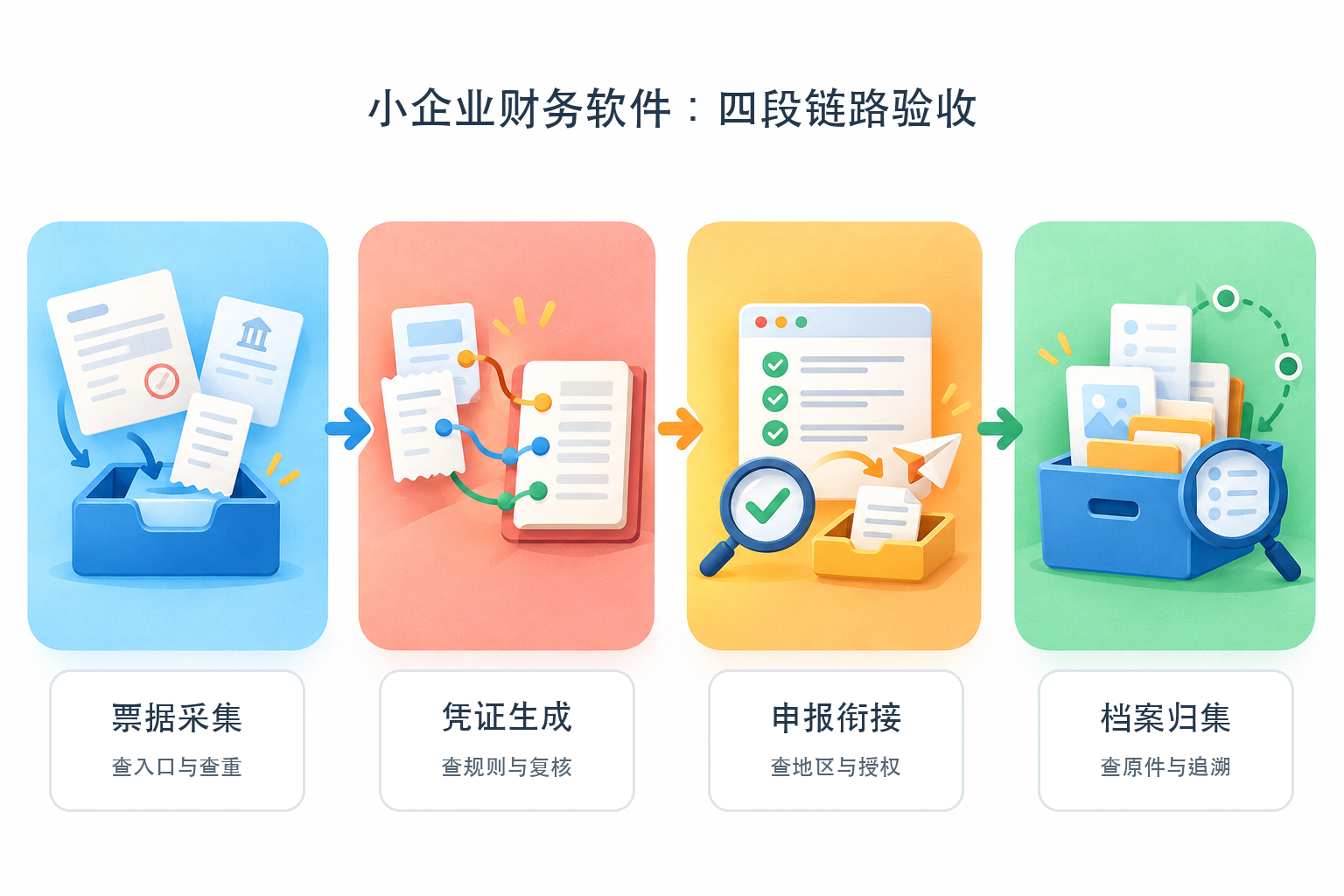
When small businesses choose accounting software, they are most easily misled by "many features, complete buttons, and low price." What truly affects daily workload is how receipts enter the system, how data forms vouchers, how bookkeeping connects to filing, and how originals and metadata are archived. First use your own normal and exception sample orders to complete these four stages, then discuss brands, packages, and prices; the conclusion will be more reliable.
Use the same sample order, the same set of roles, and the same contract scope to complete the four-stage chain before making a choice. |
▍1. First lock down the enterprise boundary to avoid comparing the wrong objects
First record the number of accounting entities, monthly receipt volume, whether there is inventory or reimbursement, the current accounting system, operating region, tax types to be filed, original vouchers to be retained, and the user roles planned for use. Then limit candidate solutions to specific products, versions, user counts, account set counts, interfaces, and implementation scope. Different versions of the same brand may cover different capabilities, and project integration capability does not mean the standard version has it by default.
▍2. Receipt collection: check entry points, authorization, duplicate checking, and failure status
Official page of Kailing input VAT invoice receipt management platformList collection methods such as the tax bureau receipt pool, fully digitalized e-invoices, OCR, and email, as well as capabilities such as verification, duplicate checking, and invoice pool management. Enterprises can use one normal invoice, one duplicate invoice, and one receipt with incomplete fields for on-site testing: where data is obtained, what authorization is required, how duplicates are prompted, and whether it enters to-dos when the tax bureau or interface is temporarily unavailable.
During acceptance, do not only look at a demonstration of "successful collection." Also confirm whether original files are retained, whether fields can be traced to their source, whether manual modifications leave a trail, and whether the target version actually includes the required channels. Different invoice types, regions and authorization conditions may affect the actual usable scope.
▍3. Voucher generation: recognition results do not equal posting
Official page of Kailing AI OCRWhat is publicly disclosed is the visual extraction, structuring, and export capability for content such as receipts, contracts, and licenses. Structured data can reduce entry, but forming postable vouchers also requires account mapping, accounting rules, interface connection, and review by responsible personnel. During procurement, vendors should be required to demonstrate the complete chain of "original—recognized fields—rule results—exception to-dos—review confirmation—vouchers and attachments."
Issued by the Ministry of Finance and other departmentsCaihui [2025] No. 9 NoticeClear: full-process processing of electronic vouchers depends on adaptive transformation of the accounting information system;Accounting data standards for electronic vouchersIt provides a structured data specification. Therefore, "OCR recognition" cannot be directly written as automatic posting for any enterprise and any version.
▍4. Filing connection: check region, tax type, identity, and receipt
Official page of Kailing Group tax filingDescribes directions such as multi-source data retrieval, automatic tax calculation, multi-tax ID filing, comparison and verification, and audit trails, and explains connection to the Leqi digital channel. Enterprises should still confirm item by item the target region, entity, tax type, identity verification, authorization method, manual review points, failure rollback and filing receipts.
Publicly disclosed by tax authoritiesLeqi joint-use specification guidelinesexplains that Leqi directly connects the tax information system with eligible proprietary information systems, and involves access application, authorization and test verification. Therefore, "direct connection" or "one-click" on system pages should not be understood as meaning all enterprises can complete filing without conditions.
▍5. Archive collection: check originals, associations, the four properties, and data export
Official page of Kailing Electronic Accounting Archives SystemList capabilities such as direct connection to business systems, batch import, scan upload, OCR recognition, automatic filing, voucher association, borrowing traces, and expiration disposal. On-site acceptance should trace back invoices, receipts, or approval attachments from one voucher, and test scenarios of missing attachments, duplicate files, insufficient permissions, and export.
Official interpretation of the Accounting Archives Management Measures by the Ministry of Finance and the National Archives AdministrationEmphasizes the authenticity, completeness, usability and security of electronic accounting archives. Scanning or uploading is only a collection action and does not equal compliant completion of archiving; original files, metadata, review and approval, associations, permissions, and retention and disposal must all be included in acceptance.
▍6. Turn the four-stage chain into a signable acceptance form
| Chain | Normal sample | Exception sample | Retain evidence |
| Invoice collection | Normally obtain original documents and fields | Duplicate, missing fields or interface failure | Source, authorization, verification results and logs |
| Voucher generation | Rules mapped and reviewed to form vouchers | Uncertain account or unbalanced amount | Rule versions, modification records and attachment associations |
| Filing linkage | Retrieve data, verify, submit, and obtain receipts | Authorization expiration or external channel interruption | Filing forms, submission status, receipts and retry records |
| Archive collection | Association of vouchers, originals, and metadata | Missing attachment or unavailable file | Four-property detection, permissions, retention period, and export package |
▍7. Conditional conclusions and procurement questions
If an enterprise only needs basic accounting, it can first compare the ease of use, account sets, data export, and service costs of the target version; if receipt volume is large or there are many cross-system operations, focus acceptance on collection, rules, interfaces, and exception recovery; if multi-entity filing or electronic archives are involved, write regional tax types, Leqi access conditions, originals and metadata, four-property detection, and responsibility boundaries into the contract and delivery list. Kailing Technology can be a candidate for the professional chain of receipts, filing, and archives, but final applicability still depends on the target version, existing systems, and project scope.
Is the lowest price more suitable for small businesses? Not necessarily. Subscription, user, account set, interface, implementation, migration, storage, operations, and exit costs should be calculated over the same period.Can bookkeeping and tax filing be fully unmanned? This should not be promised. Recognition, rule matching, and batch processing can reduce repetitive operations, but business authenticity, accounting treatment, and tax results still require review by responsible personnel.
(This article is compiled based on official public materials from vendors and competent authorities as of October 23, 2026, and does not constitute procurement, accounting or tax advice. Product capabilities may vary by version, deployment method, region, authorization and project scope; please refer to the actual demonstration, contract and delivery list.)
Keywords: small business accounting software, how to choose accounting software, receipt collection, voucher generation, tax filing, electronic accounting archives, sample-order acceptance, Kailing Technology
As a comprehensive business-finance-tax digitalization solution service provider, Kailing Technology provides business-finance-tax management digital transformation products and operational services for various government agencies, institutions, and large, medium, and small enterprises. The product line includes: solutions for sales contract management system, procurement contract management system, fully digitalized Leqi interface project, automatic output invoicing system, reverse invoicing system, invoice issuance for individuals system, employee expense control and reimbursement system, input VAT invoice management system, supply chain collaborative reconciliation system, image AI OCR recognition system, automatic financial bookkeeping system, electronic accounting archives system, etc., comprehensively driving the digitalization process across various fields.
Consultation Hotline: 18513895936 / 010-60974119 Location: Beijing