
How can scrap aluminum recycling with many grades and complex pricing achieve compliant reverse invoicing? Kailing Technology's resource recycling reverse invoicing system checks the five flows by batch
When the same truckload of scrap aluminum enters, profiles, castings, and thin sheets may be mixed together. If only one total weight and one total price are left after weighing, sorting staff can explain the site, but finance finds it difficult to explain how each grade formed the settlement amount; by the time of payment and reverse invoicing, the discrepancies become fully exposed. The focus of Kailing Technology's resource recycling reverse invoicing system is to let each receiving batch retain clear grade, measurement, pricing, and review basis, and then bring invoice and fund records back to the same transaction.

▍First determine whether reverse invoicing is possible, then discuss how scrap aluminum is graded
Announcement No. 5 of 2024 by the State Taxation Administration stipulates that resource recycling enterprises with the qualifications required by the announcement may, when purchasing scrapped products sold by natural persons, issue invoices as the purchaser according to regulations. Scrap aluminum is a commonly seen recycled material, but "what is collected is scrap aluminum" does not automatically mean "this transaction can be reverse invoiced." Enterprise qualifications, actual operating business, seller identity, and cumulative sales within a continuous period of no more than twelve months must all be checked against the announcement first. For general renewable resource recycling enterprises, the business entity registration and commerce department filing must also be verified; if the counterparty is originally an operating entity that should issue invoices itself, the natural person path cannot be used as a universal substitute.
The complexity of the scrap aluminum business often lies in the same seller making multiple deliveries, the same vehicle carrying mixed loads, and the on-site handler being inconsistent with the actual seller. During profile creation, the seller, settlement payee, and delivery records should correspond; if identity inconsistency is found, business staff should first explain it, and then subsequent receiving and invoicing actions are decided. Kailing Technology's entity verification capability for reverse invoicing can be placed at the front end: incorrect entities do not enter the invoicing queue, and no matter how refined the subsequent grade calculation is, it will not conceal entity problems.
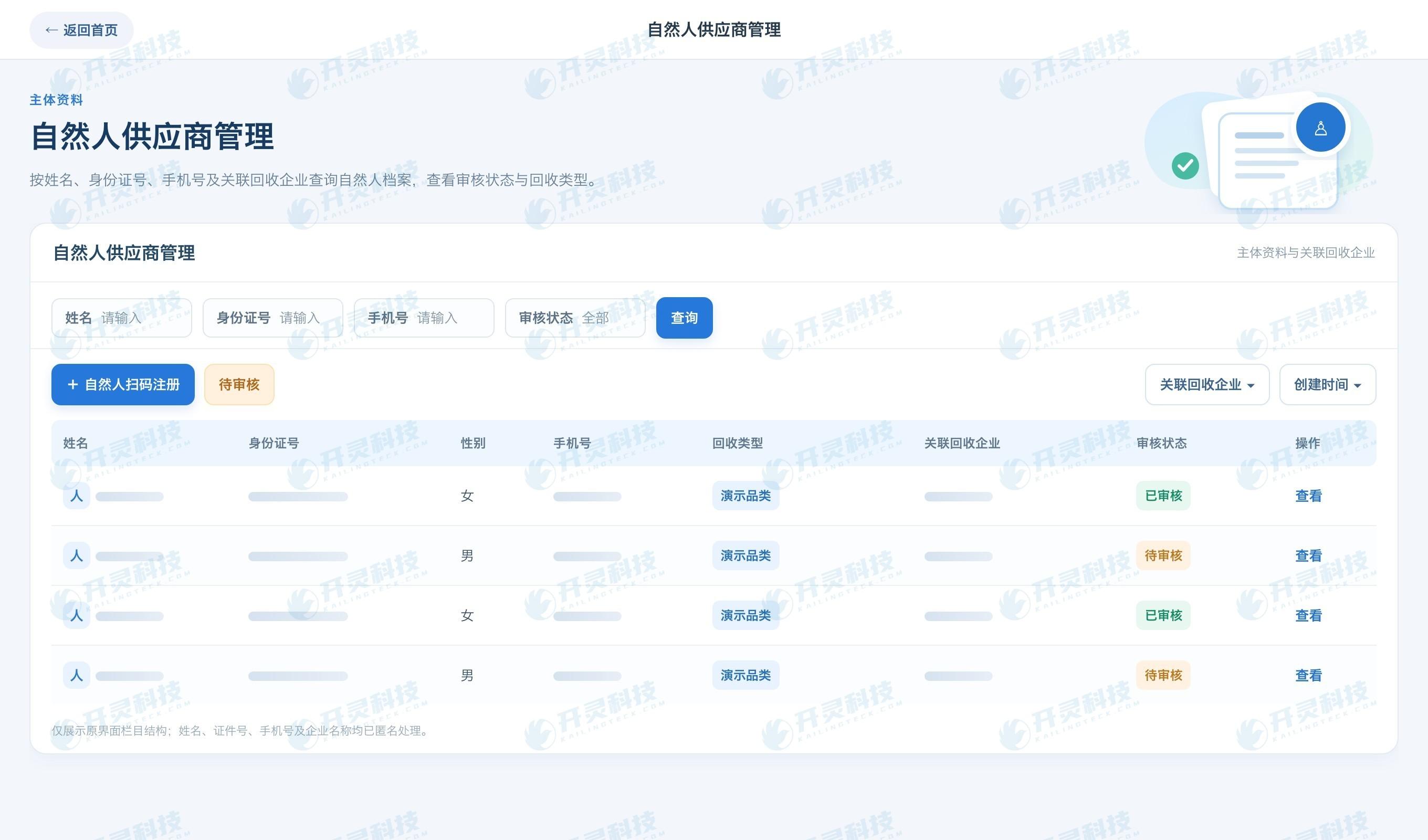
Illustration of the individual supplier record creation interface
▍When one truck has multiple grades, let weight return to the specific batch first
On site, three questions should be answered first: who delivered this load of goods, what state it was in when it entered, and how much of each grade was actually received after sorting. The vehicle, entry time, weighing voucher, and receiving note form the entry point of one delivery; profiles, castings, and sheets are merely category examples for illustration, and the final names should be based on the enterprise's material classification, actual acceptance, and invoicing codes. Mixed loads can retain one master goods order while recording grade details and corresponding weights; the quantities after sorting should not be directly rewritten as the original weighbridge figures.
Net weight and settlement weight must also be kept separate. Weighing provides the measurement basis, while sorting, impurity deductions, moisture, or foreign matter disputes may change the settleable quantity. If the enterprise adopts deduction rules, it should retain the rule version used, the reviewer, and on-site evidence; if the two parties dispute the grade, the detail should first be frozen and enter settlement only after review is completed. This is not to create an extra layer of forms, but to ensure that "why this batch was priced at this weight and this grade" can still be answered afterward.
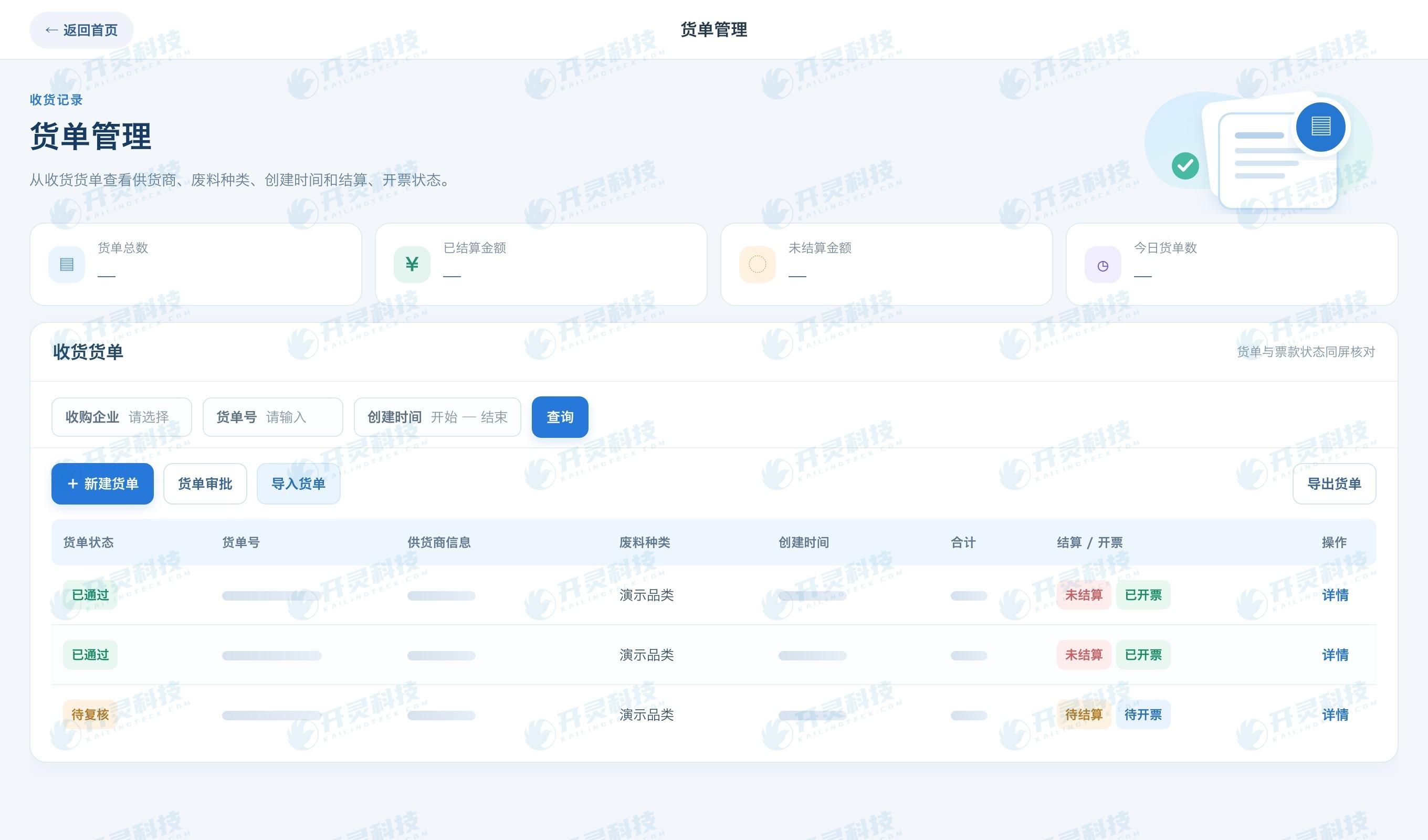
Illustration of the goods order management interface
▍Price fluctuations cannot erase the grading and pricing basis at the time
The price of scrap aluminum is not a fixed number that can be applied to all grades. Even for goods received on the same day, settlement unit prices may differ due to grade, impurity ratio, delivery conditions, and agreements between the parties. Enterprises should clearly state the effective time of the price table, applicable grades, and approval authority, and then have each receiving detail reference the price basis effective at that time. If on-site price negotiation occurs, the reason raised, confirmer, and confirmation time must be recorded; finance must not see the total price at month-end and then back-calculate a unit price that "looks appropriate."
At settlement, review can follow the order of "detail weight and corresponding unit price form the amount, then handle justified adjustment items." Adjustment items should point to which batch and which grade, rather than writing only a difference in the total amount. If there is subsequent reweighing, return, or regrading, retain the relationship between the original record and the new result, and if necessary reconfirm the settlement and handle invoices already generated. The value of the system lies in preserving transaction status and the reasons for changes, not in deciding for the enterprise what grade scrap aluminum should be assigned or forcibly guaranteeing a certain price.
▍The invoice amount must be explainable item by item from the goods receipt settlement statement
In the reverse invoicing step, the seller, scrapped product category, settlement amount, and source goods note must be checked together. The tax announcement requires using the "scrapped products" goods and services tax classification code as required, and issuing invoices online marked "scrapped product purchase" through the electronic invoice service platform or the VAT invoice management system. Enterprises can set internal review nodes according to actual business, and submit for issuance only when the entity, receiving details, settlement amount, and applicable invoice type are consistent. The invoice number and issuance result are then written back to the original business, so finance does not hold an invoice yet cannot find which sorting and weighing it corresponds to.
If multiple batches are merged for processing, it must be possible to trace back each source detail from the invoice; if a detail is still in dispute, it should not be mixed into confirmed amounts. When returns, price adjustments, or red-letter reversals occur, retain the correspondence among the original invoice, new invoice, and original settlement statement, and do not delete old records to create the appearance that something "never happened." The core here is not pursuing one-click operation, but keeping tax results and confirmed transactions on the same basis.
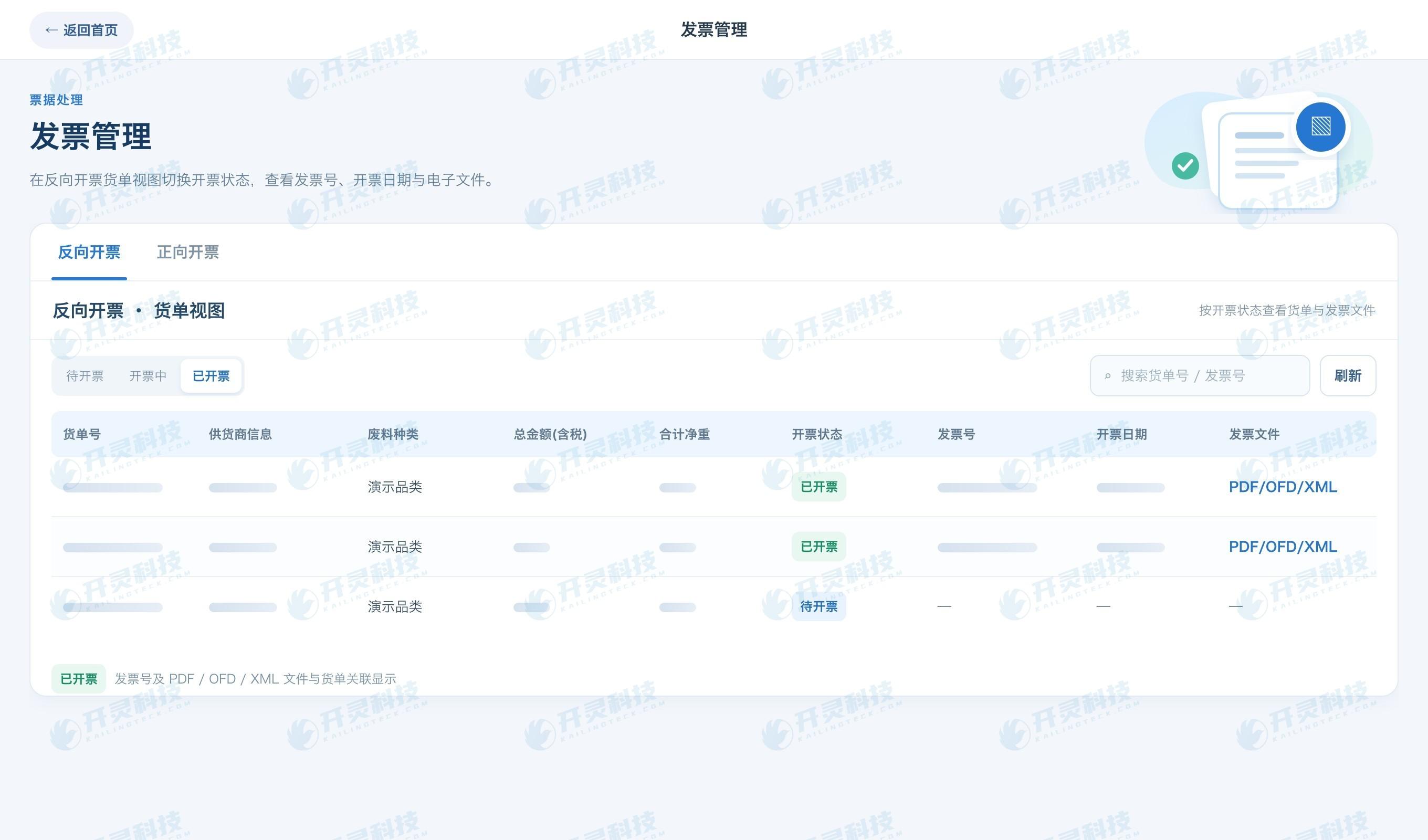
Illustration of reverse invoicing goods note view
▍How payments and five-flow archives return to the same scrap aluminum transaction
At payment, finance should verify the receiving account, payable amount, and payment status against the confirmed seller and settlement statement. Partial payments, failed payments, or cross-batch consolidated payments should all retain allocation relationships; bank receipts should not remain only in the online banking download folder. After payment is completed, link the receipt number, arrival result, and original goods receipt batch, so finance sees a verifiable fund path and the site sees whether its goods receipt results have been fulfilled.
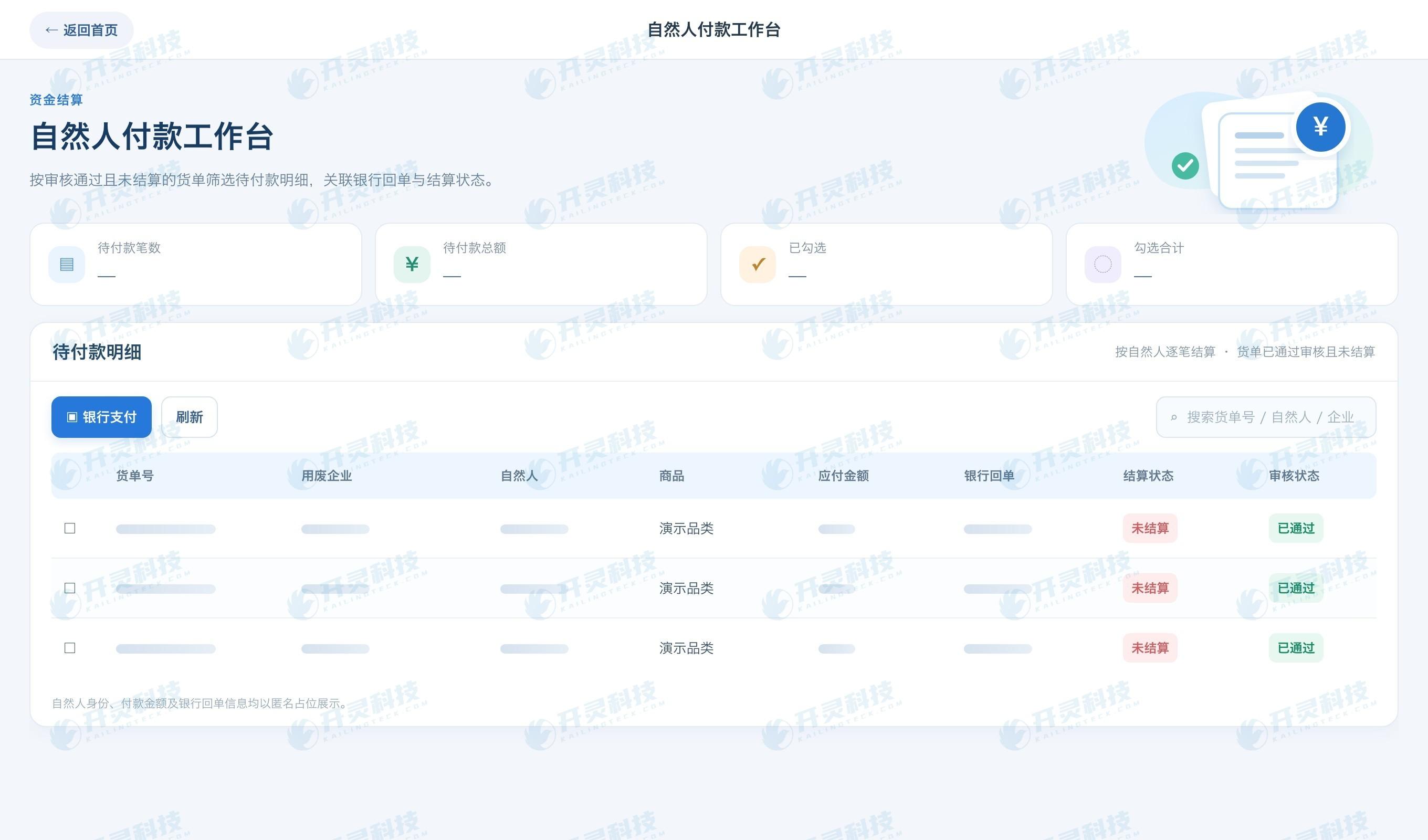
Illustration of the individual payment workbench
The Kailing Technology reverse invoicing "five-flow integration" solution is an internal enterprise evidence management method that organizes subject self-certification, transaction agreement, goods business, tax invoices, and fund payment materials around the same business. For scrap aluminum, the most useful way to check is to start from any invoice and see which grade details, weighing vouchers, settlement confirmations, and payment records it consists of; starting from a given weighbridge ticket, one can also find the corresponding invoice and payment status. Missing materials should show the gap and identify who is responsible for supplementing evidence, rather than substituting the existence of an invoice for business authenticity.
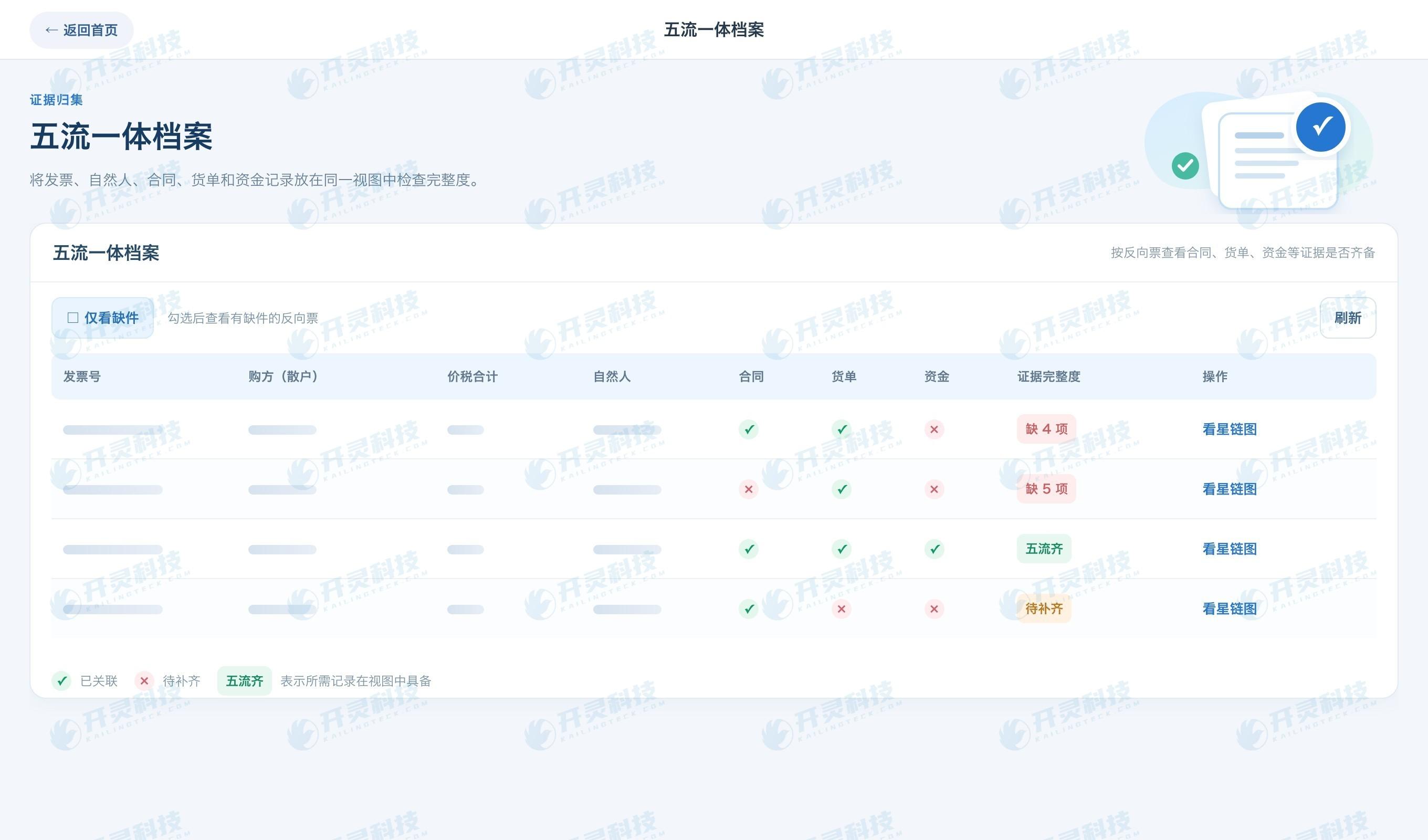
Illustration of the five-flow integration archive completeness interface
▍For launch acceptance, run disputed orders first, not just normal invoicing
Acceptance samples for the scrap aluminum scenario should cover at least three types of discrepancies. The first is two or more grades mixed in the same vehicle; check whether the total weighed weight, sorting details, and total settlement amount can explain each other. The second is grade change or price adjustment after the same batch is received; check whether the old price version, review reason, and approval traces are retained. The third is payment failure, partial payment, or an invoice requiring red-letter reversal; check whether business status is linked and whether the exception part can be handled separately. Each sample must be traced back once each from the goods note, payment, and invoice entries to prove that the system is not merely "appearing connected" on a one-way page.
If an enterprise has multiple recycling sites, it should also unify the grade dictionary and measurement standards, while allowing each site to retain explanations of on-site differences. During implementation, first determine who grades, who reviews disputes, who approves price adjustments, who submits invoices, and who confirms payment, then embed these responsibilities into system nodes. The Kailing Technology resource recycling reverse invoicing system can carry this evidence chain; truly sustainable compliance comes from on-site records, business review, and invoice and payment processing being executed under the same rules.
▍FAQ
Q: If a truck of scrap aluminum mixes multiple grades, can only one total price be recorded?
A: The total amount can be retained as the settlement result, but the acceptance, weight, unit price, and adjustment basis for each grade should be reviewable. A total price without details makes it difficult to explain later how the invoice amount was formed.
Q: If on-site sorting leads to re-grading, should the original record be deleted?
A: It should not be deleted. The original record, review reason, confirmer, and adjusted result should be retained; if invoicing or payment has already occurred, subsequent handling must also be checked in sync.
Q: Is the five-flow integration a fixed set of five forms required by tax authorities?
A: No. It is an enterprise management framework for organizing entity, transaction, goods, tax, and fund materials around the same procurement business; specific legal obligations remain subject to applicable policies.
Q: If the system contains invoices and bank receipts, does that prove the goods receipt is genuine?
A: It must still correspond to the actual seller, weighing and grading records, settlement confirmation, and other business materials. Invoices and payments are an important part of the evidence chain but cannot replace the facts of on-site receipt of goods.
Make the grade, price, and invoice-payment of every batch of scrap aluminum verifiable. Learn about the Kailing Technology resource recycling reverse invoicing solution: https://www.kailingteck.com/fxzy/ .
As a national high-tech enterprise, Kailing Technology focuses on the digital and intelligent transformation of enterprise business-finance-tax and operations management, providing software products, system integration, implementation and delivery, and operational services for various government agencies, institutions, group enterprises, and SMEs.
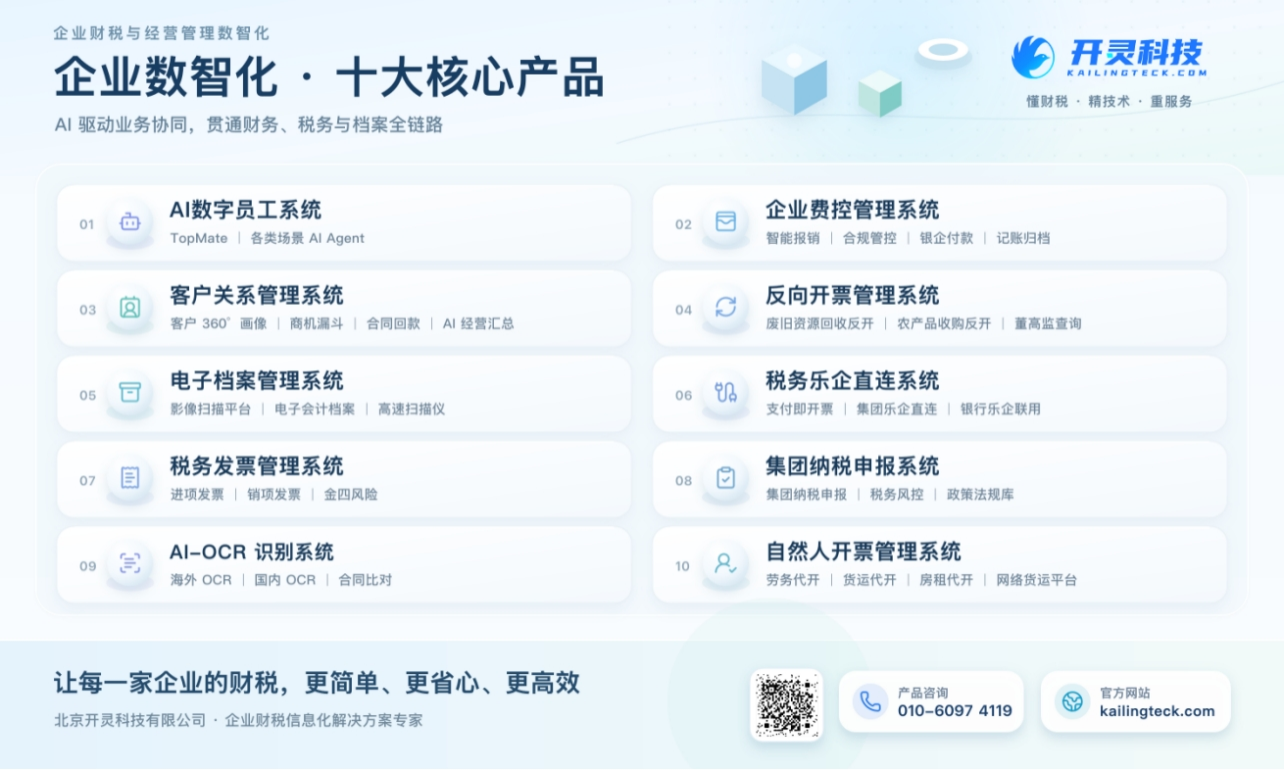
The company has now formed ten core product lines, including: AI digital employee system, enterprise expense control management system, customer relationship management system, reverse invoicing management system, invoice issuance for individuals management system, electronic archives management system, tax fully digitalized e-invoice Leqi system, tax invoice management system, group tax filing system, and AI OCR recognition system. It is committed to connecting enterprise business, finance, tax, funds, and archive data to help customers improve operational efficiency, business-finance-tax compliance capabilities, and digital management levels.
If you have any business-finance-tax digital transformation needs, welcome to contact us. Beijing Kailing Technology will serve you wholeheartedly.
 Keywords: Scrap aluminum recycling reverse invoicing, Kailing Technology reverse invoicing, scrap aluminum grade pricing, five-flow integration, resource recycling system
As a comprehensive business-finance-tax digitalization solution service provider, Kailing Technology provides business-finance-tax management digital transformation products and operational services for various government agencies, institutions, and large, medium, and small enterprises. The product line includes: solutions for sales contract management system, procurement contract management system, fully digitalized Leqi interface project, automatic output invoicing system, reverse invoicing system, invoice issuance for individuals system, employee expense control and reimbursement system, input VAT invoice management system, supply chain collaborative reconciliation system, image AI OCR recognition system, automatic financial bookkeeping system, electronic accounting archives system, etc., comprehensively driving the digitalization process across various fields.
Consultation Hotline: 18513895936 / 010-60974119 Location: Beijing