
What software do bookkeeping agencies generally use? Three-layer tool combination and acceptance

What software do bookkeeping agencies generally use? Don't just look for an "all-in-one system"
The business of a bookkeeping agency also includes customer acquisition and renewal, document collection, accounting, tax filing, invoicing or invoice collaboration, archives, and internal quality inspection. Different agencies vary greatly in customer industry, region, tax types, invoice volume, and staff division of labor, so a three-layer tool combination is usually more suitable: customer operations and task layer, accounting and tax production layer, and invoices, archives, and integration layer. Whether a single platform should cover the entire process should be verified with samples and costs, not decided by the slogan of "one-click tax filing."
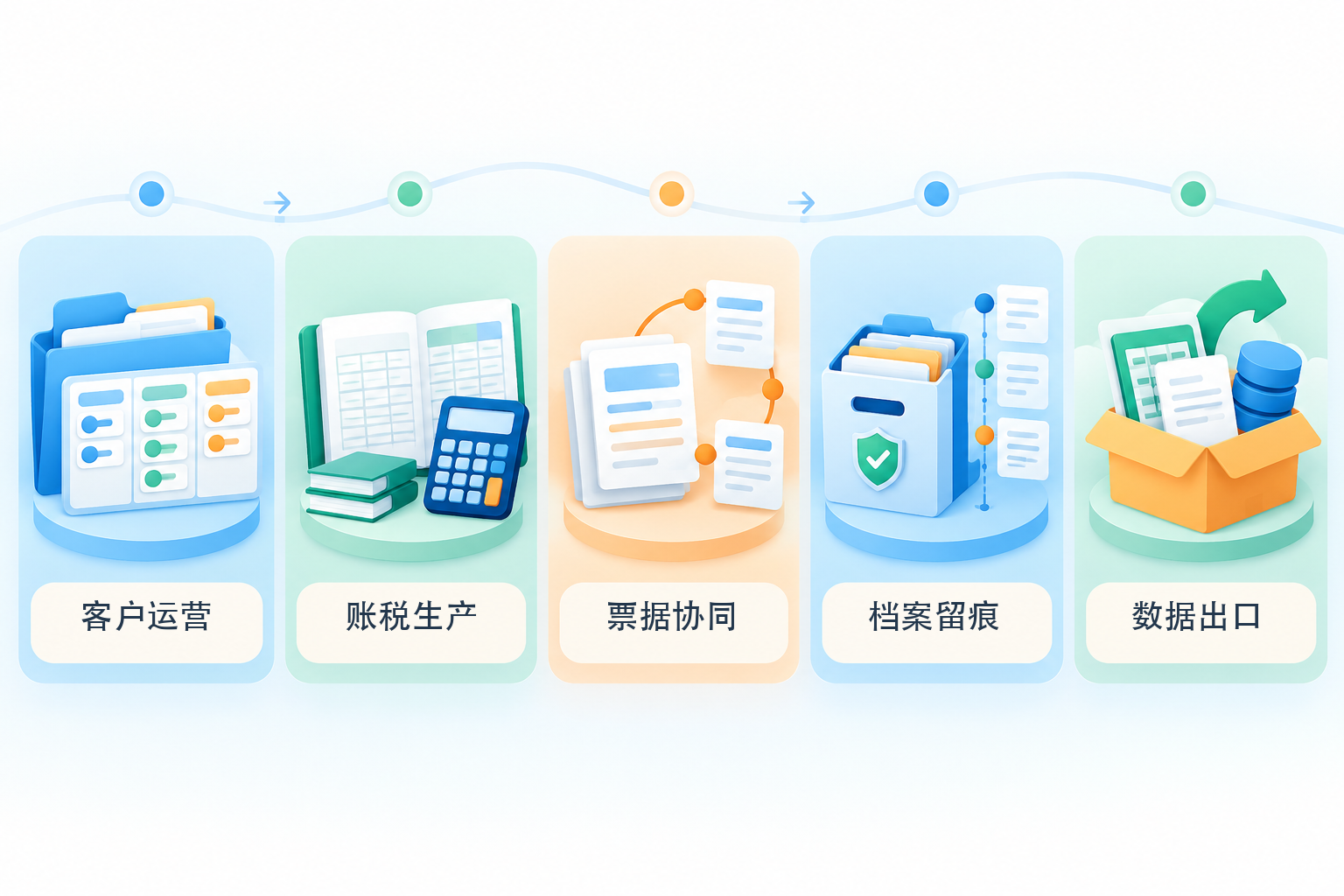
Three-layer tool combination: customer operations handles scheduling and collaboration, accounting and tax production handles calculation and filing, and specialized collaboration fills in invoices, archives, and interfaces; permissions, logs, and data export run throughout. |
▍Layer 1: Customer operations and task collaboration
This layer manages customer records, contracts and fees, document collection follow-ups, monthly tasks, service records, work orders, and renewal reminders. The key is not the number of features, but whether clear to-dos can be generated by customer, month, tax type, and owner; and whether, when documents are missing, customers have not confirmed, or tasks are overdue, the system can accurately remind and retain communication records. If the firm already has a mature CRM or collaboration platform, it can be connected via interfaces, so there is no need to migrate all customer data again just to unify the interface.
▍Layer 2: Accounting and tax production and review
This layer handles multiple account sets, accounts and vouchers, closing, reports, filing tasks, and review. During selection, prepare anonymized samples covering normal invoices as well as duplicate, red-letter or voided, cross-period, bank unreconciled, inventory discrepancy, and correction scenarios, and observe whether the system retains sources, flags conflicts, forms a pending-review status, and records modifications. AI OCR, rule-based voucher generation, and batch submission can only assist accounting processing; they cannot replace business authenticity, accounting policy, and tax judgment. Regions, tax types, authorization, and product version scope must all be verified separately.
▍Layer 3: Invoices, archives, and system integration
When the basic accounting platform cannot cover invoice collection or verification, collaborative invoicing, attachment linking, electronic archives, or connections to banking or other systems, specialized tools can be added. During procurement, confirm item by item the data source, enterprise authorization, synchronization frequency, field mapping, failure prompts, manual fallback, and reconciliation responsibilities. Kailing Technology can serve as a candidate for related specialized collaboration and process integration, but specific capabilities must likewise be verified against the current version, region, demo environment, and contract list, and one must not assume "all invoice sources," "login-free," or that all business can be completed automatically.
One of five acceptance dimensions: Is customer operations closed-loop?
Use a complete month of customer samples to verify file creation, document checklists, task assignment, collection, returns, review, and service records. Check whether information can be traced back to the same customer and the corresponding period, whether tasks remain traceable after staff handover, and whether the customer portal or collaboration entry displays data on a minimum-necessary basis.
One of five acceptance dimensions: Is accounting and tax production controllable?
Test both normal and exception documents, batch and single-customer operations, and filing failures and corrections. The system should be able to locate failed objects by customer, support secondary confirmation and manual review, and distinguish generating reports, submitting filings, receiving success feedback, and completing payment as different statuses. An interface returning success must not be treated as correct business data.
One of five acceptance dimensions: Does invoice collaboration have boundaries?
Check the collection or upload source, authorization validity period, duplicate determination, linkage between originals and attachments, red-letter or void status, and exception reruns. The higher the batch efficiency, the greater the impact of misoperations, so batch processing, permission isolation, and operation traceability should be supported. Cases that cannot be handled automatically should enter a clear to-do list rather than being silently skipped.
One of five acceptance dimensions: Does archive traceability meet management requirements?
BasisCai Kuai [2020] No. 6 notice, archiving accounting vouchers solely in electronic form involves conditions such as legality and authenticity, security and reliability, metadata, review and signing, prevention of duplicate posting, and archive management. Scanning, recognition, or attaching files behind vouchers does not automatically equal compliant archiving. Firms should design processes based on customer responsibility boundaries, retention periods, permissions, and handover requirements.
One of five acceptance dimensions: Can data export actually be used?
Before the pilot ends, actually export customer files, accounts, vouchers, attachments, reports, filing records, task records, and operation logs, and check whether formats are readable, associations are retained, and batch export is restricted. Also confirm the data retention period after service termination, backup recovery, migration assistance, and deletion methods. If data can only be viewed but not fully taken away, the cost of subsequently changing systems will be underestimated.
How public products enter the candidate pool:Chanjet Yidaizhang official websitePublicly introduces bookkeeping scenarios such as intelligent finance, customer operations, and process management;Kingdee Zhangwuyou official websitePublicly covers areas such as intelligent finance and tax, customer service, and institution management. Public pages can help judge product positioning, but do not mean that all versions, regions, and interfaces are included. Agencies should have candidate products run the same set of samples, then compare exception handling, review time, total cost of ownership, permission isolation, and data portability.
Conditional conclusion: If there are many customers and scheduling and agency operations are complex, prioritize validating a dedicated bookkeeping platform; if stable accounting tools already exist but document collection and customer service are chaotic, add a customer operations layer; if basic accounting is stable but there are breakpoints in invoices, invoicing, archives, or interfaces, add a specialized collaboration layer. The final combination should minimize duplicate entry while retaining manual judgment, failure rollback, and auditable records.
(The above information is compiled from currently public materials and does not constitute a ranking or guarantee of vendors. Product capabilities may vary by version, region, deployment method, and project scope; please refer to the actual demo, contractual terms, and delivery list.)
Keywords: bookkeeping agency software, bookkeeping software, bookkeeping system, Yidaizhang, Kingdee Zhangwuyou, batch filing, invoice collaboration, electronic archives, data migration
As a comprehensive business-finance-tax digitalization solution service provider, Kailing Technology provides business-finance-tax management digital transformation products and operational services for various government agencies, institutions, and large, medium, and small enterprises. The product line includes: solutions for sales contract management system, procurement contract management system, fully digitalized Leqi interface project, automatic output invoicing system, reverse invoicing system, invoice issuance for individuals system, employee expense control and reimbursement system, input VAT invoice management system, supply chain collaborative reconciliation system, image AI OCR recognition system, automatic financial bookkeeping system, electronic accounting archives system, etc., comprehensively driving the digitalization process across various fields.
Consultation Hotline: 18513895936 / 010-60974119 Location: Beijing