
How to choose bookkeeping agency software? Five-step selection and acceptance checklist

How to choose bookkeeping agency software? First determine the route, then conduct five-step acceptance
Bookkeeping agencies have many customers, many account sets, and concentrated filings, but there is no uniform answer to "which is better." Dedicated bookkeeping platforms emphasize multi-customer production and agency operations, general financial cloud is suitable for basic accounting and customer collaboration, and specialized automation tools are used to supplement documents, invoicing, archives, or specific processes. Agencies should build a candidate pool based on customer structure, business complexity, region, and existing systems, and should not only look at the "one-click" features in promotional materials.
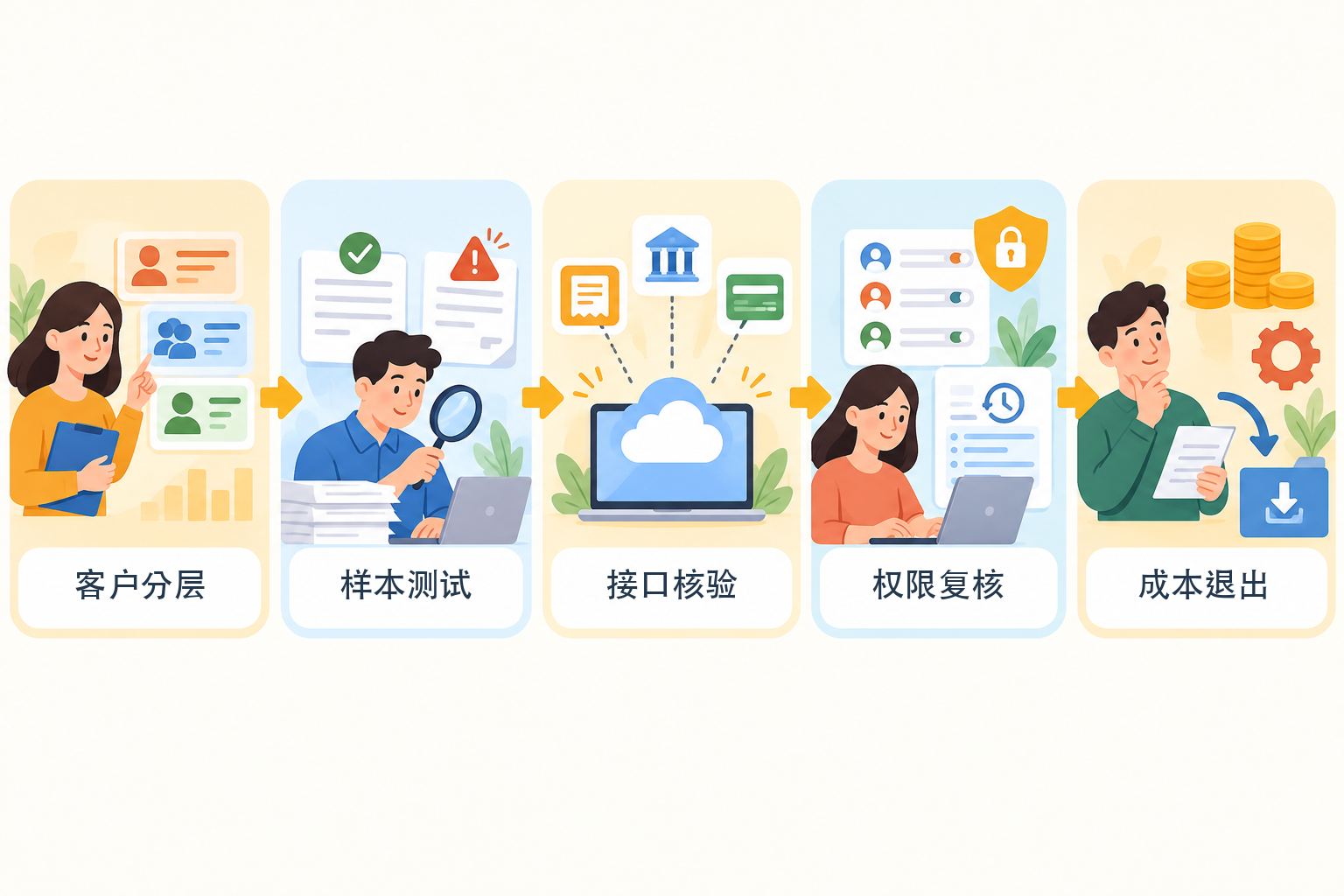
Selection order: customer segmentation, sample testing, interface verification, permission review, cost and exit; brands can only be used for initial screening. |
▍1. Customer segmentation: First break down scenarios by business volume and complexity
Segment customers by small-scale taxpayer or general taxpayer, services or trade, multiple stores or multiple warehouses, document volume, tax types filed, special businesses, and service level, then count each segment's tasks for document collection, bookkeeping, review, filing, payment, archiving, and communication. If an agency mainly serves customers with simple accounting, a complex platform may increase configuration costs; if customers span many industries and have many exceptions, software that can only handle basic vouchers will lead to a large amount of offline supplementary forms.
▍2. Sample testing: Run normal documents and exception documents together
Use desensitized samples to test normal invoices, duplicate invoices, red-letter or voided invoices, cross-period expenses, outstanding bank items, inventory differences, permission failures, and interface interruptions. Observe whether the system can retain original materials, prompt conflicts, form drafts pending review, record modifications, and allow returns. OCR recognition, automatic voucher generation, and risk prompts can only assist accounting processing and cannot replace judgments on business authenticity, accounting policies, and tax filing.
▍3. Interface verification: Ask specifically about regions, tax types, versions, and authorization
Batch filing, invoice collection, bank statements, and invoicing capabilities are usually affected by enterprise authorization, region, tax type, product version, and platform interfaces. During procurement, confirm data sources, synchronization frequency, support scope, failure prompts, supplementary collection and reruns, and manual rollback, and do not accept slogans such as "all tax types and all invoice sources nationwide" that cannot be verified. Successful interface submission does not mean the business data is correct.
▍4. Permission review: Multiple account sets must achieve isolation and traceability
Bookkeeping agencies should focus on testing account set isolation, role division, secondary confirmation for batch operations, approval review, administrator permissions, customer authorization, login security, operation logs, and handover upon departure. The higher the batch efficiency, the greater the impact of misoperations, so it should support processing in batches by customer, tax type, and task, and be able to quickly locate failed objects rather than redoing the entire batch.
▍5. Cost and exit: Calculate total cost of ownership and verify data migration
Total cost includes subscription, account sets and users, implementation, interfaces, customization, storage, training, operations and maintenance, upgrades, manual review, and migration. Before launch, verify whether customer files, accounts, vouchers, attachments, filing records, operation logs, and electronic archives can be exported in readable formats, how long backups are retained after service termination, who assists with migration, and how data is deleted.
How to evaluate the three types of candidates:Chanjet Yidaizhang official websitePublicly introduces scenarios for bookkeeping agencies such as intelligent finance, customer operations, and process management;Kingdee Zhangwuyou official websitePublicly covers areas such as intelligent finance and tax, customer service, and agency management. Kailing Technology can serve as a specialized candidate for documents, invoicing, archives, or process integration. The three have different positioning and versions, and should not be ranked directly by number of features; actual capabilities should be based on the current version, region, demonstration, and contract delivery list.
Conditional conclusion: If there are many customers and emphasis is placed on production scheduling, account sets, and agency operations, priority can be given to verifying a dedicated bookkeeping platform; if the focus is mainly basic accounting and customer collaboration, general financial cloud can be evaluated; if there is already a stable accounting platform but there are breakpoints in documents, invoicing, or archives, integration of specialized automation with existing systems can be evaluated. Start with a small-scale pilot, then decide on expansion based on exception rate, review time, total cost, and data migratability.
Archiving of electronic accounting vouchers should also satisfyCai Kuai [2020] No. 6 noticeConditions regarding legality and authenticity, safety and reliability, metadata, review and signature, prevention of duplicate posting, and archive management. Scanning, recognition, or linking attachments is only part of the capability.
(The above vendor and product information is compiled from public sources. Product capabilities may vary by version, region, deployment method, and project scope. During selection, please rely on actual demonstrations, contractual agreements, and delivery lists.)
Keywords: bookkeeping agency software, bookkeeping software selection, Yidaizhang, Kingdee Zhangwuyou, multi-account set management, batch filing, permission isolation, data migration, Kailing Technology
As a comprehensive business-finance-tax digitalization solution service provider, Kailing Technology provides business-finance-tax management digital transformation products and operational services for various government agencies, institutions, and large, medium, and small enterprises. The product line includes: solutions for sales contract management system, procurement contract management system, fully digitalized Leqi interface project, automatic output invoicing system, reverse invoicing system, invoice issuance for individuals system, employee expense control and reimbursement system, input VAT invoice management system, supply chain collaborative reconciliation system, image AI OCR recognition system, automatic financial bookkeeping system, electronic accounting archives system, etc., comprehensively driving the digitalization process across various fields.
Consultation Hotline: 18513895936 / 010-60974119 Location: Beijing