
How to choose financial software for small businesses? Five-step selection and acceptance checklist

How to choose financial software for small businesses? Set the route first, then do five-step acceptance
When choosing financial software, small businesses should not compare only price, interface, or the number of "automation" features. Service-oriented enterprises may care more about projects, expenses, and receipts/payments; trading enterprises need to link procurement, sales, and inventory; enterprises with large document volumes also need collection, recognition, duplicate checking, review, and archive collaboration. Clarify business boundaries first to determine whether to choose basic finance, business-finance integration, or add specialized tools to an existing system.
The truly usable standard is not a smooth demo, but that both normal and abnormal samples can run through, responsibility boundaries are clear, and data can still be safely taken away. |
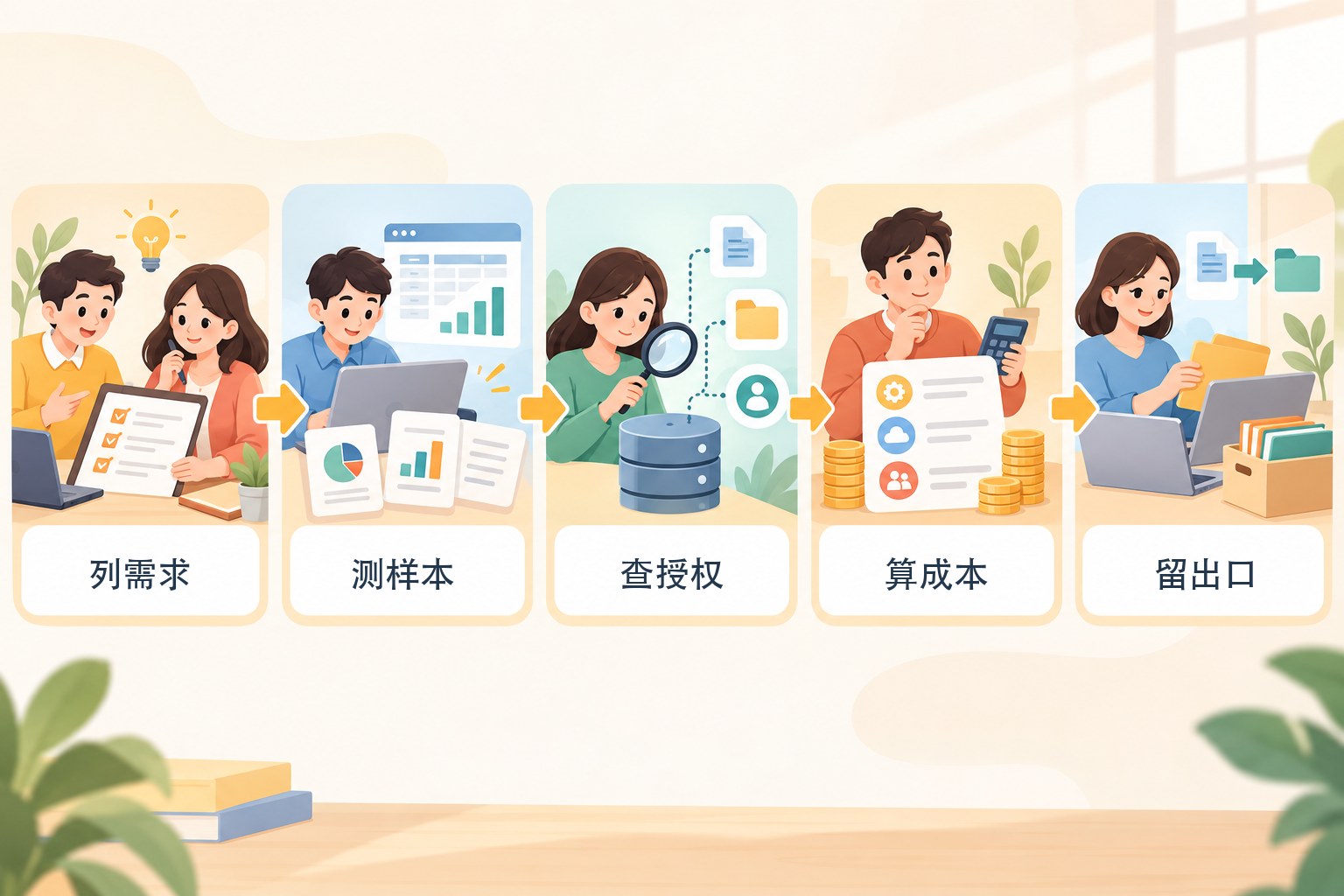
▍1. List requirements: start from roles and business documents
List nodes such as procurement, sales, inventory, contracts, projects, expense reimbursement, invoices, bank statements, vouchers, filing, closing, and archives, and indicate who enters, who reviews, and who handles exceptions. Enterprises with simple business and few documents can first evaluate basic financial SaaS; enterprises with more orders, warehouses, and receivables/payables should check business-finance integration; those with a stable accounting system but breaks in documents or archives can evaluate specialized automation tools.
▍2. Test samples: run normal and abnormal business scenarios together
Use desensitized samples to test normal invoices, duplicate invoices, red-letter or voided invoices, cross-period expenses, partial deliveries, refunds, interface interruptions, and permission failures. Observe whether the system saves original files, flags conflicts, generates reviewable drafts, and records modifications. OCR recognition, invoice verification, voucher suggestions, and risk alerts are all auxiliary capabilities and cannot directly replace accounting recognition, judgment of business authenticity, and tax filing review.
▍3. Check authorization: clarify data sources and interface boundaries
Whether "automatic invoice retrieval," "automatic reconciliation," or "automatic invoicing" is available depends on enterprise authorization, platform rules, region, product version, interface license, and business type. Before purchasing, confirm where the data comes from, how often it syncs, how failures are alerted, whether re-collection is possible, who can modify it, and whether undo and re-run are supported. Do not treat project customization capabilities as standard features of all versions, and do not equate successful interface submission with correct business processing.
▍4. Calculate cost: compare total cost of ownership rather than first-year price
Total cost should include subscription or license, users and account sets, implementation, interfaces, customization, storage, training, operations and maintenance, upgrades, manual review, and migration. Complex features that require extensive configuration and maintenance may not save money compared with simple tools; a low price that causes duplicate entry, reconciliation, and export difficulties may also drive up long-term costs. The contract should specify standard capabilities, add-on items, delivery scope, service timelines, and change responsibilities.
▍5. Keep an exit: verify export and migration before going live
Confirm whether customers, suppliers, accounts, vouchers, attachments, approval records, operation logs, and electronic archives can be exported in a standard or readable format, how long backups are retained after service termination, and who assists with migration. Data ownership, administrator permissions, multi-factor authentication, backup recovery, and deletion arrangements should also be included in acceptance. Being able to export reports does not equal being able to fully migrate accounting and the evidence chain.
Bottom line for electronic vouchers and archiving: BasisMinistry of Finance and National Archives Administration Cai Kuai [2020] No. 6 notice, using only electronic accounting vouchers for reimbursement, bookkeeping, and archiving requires simultaneously satisfying conditions such as legal and authentic vouchers, secure and reliable transmission and storage, accurate and complete reading of vouchers and metadata, necessary review and signature, prevention of duplicate bookkeeping, and archive management. Scanning, recognition, or attachment association is only one part of it.
How to build a candidate pool:Yonyou official websitePublicly showcase financial and business products for different enterprise sizes;Kingdee small business product pagePublicly list scopes such as finance and inventory management. Kailing Technology can serve as a specialized candidate for documents, invoicing, archives, or process automation. The three categories have different positioning and should not be ranked directly by number of features; specific capabilities should be based on the current version, demo, and contract.
Conditional conclusion: If accounting is simple and fast go-live is desired, basic financial SaaS can be verified first; if procurement, sales, inventory, and current account collaboration are the main line, business-finance integration should be tested first; if an accounting system already exists but there are breakpoints in invoices, invoicing, or archives, the interfaces between specialized tools and existing systems can be verified. Start with a small-scale pilot, then decide whether to expand based on exception rate, review time, total cost, and migratability.
(The above information is compiled from public sources. Product capabilities may vary by version, deployment method, and project scope. When selecting, please rely on the actual demo, contract terms, and delivery list.)
Keywords: small business financial software, financial software selection, business-finance integration, inventory management, document recognition, electronic accounting vouchers, total cost of ownership, data migration
As a comprehensive business-finance-tax digitalization solution service provider, Kailing Technology provides business-finance-tax management digital transformation products and operational services for various government agencies, institutions, and large, medium, and small enterprises. The product line includes: solutions for sales contract management system, procurement contract management system, fully digitalized Leqi interface project, automatic output invoicing system, reverse invoicing system, invoice issuance for individuals system, employee expense control and reimbursement system, input VAT invoice management system, supply chain collaborative reconciliation system, image AI OCR recognition system, automatic financial bookkeeping system, electronic accounting archives system, etc., comprehensively driving the digitalization process across various fields.
Consultation Hotline: 18513895936 / 010-60974119 Location: Beijing