
Scattered tax filing data and mixed rules across multiple organizations, and the exhaustion of logging into tax bureaus account by account? Kailing Technology group tax filing automatically retrieves data, calculates tax, and directly connects to filing
Every filing period, finance under a multi-entity structure opens the system and actually only needs to do four actions: click "Calculate," check the working papers, lock the report, and submit in batches. But in reality, these four steps are split into dozens of repetitions—data is scattered across each set of books and must be exported one by one, rules are so complex that the basis for each tax type is different, and deadlines are so chaotic that it is hard to remember which entity should file which taxes, and in the end you still have to log into the electronic tax bureau entity by entity and click one by one. What Kailing Technology's group tax filing aims to solve is precisely restoring this chain that "looks like four steps but is actually dozens of repetitions" into an operation where finance truly only clicks four times.
Below, this chain is broken into five steps, and we look one by one at which manual actions Kailing saves finance at each step — this is also where "automatic data retrieval, tax calculation, and direct-connection filing" truly land.
▍Stage one · Data collection: configure eight methods once, then automatically in place every month thereafter
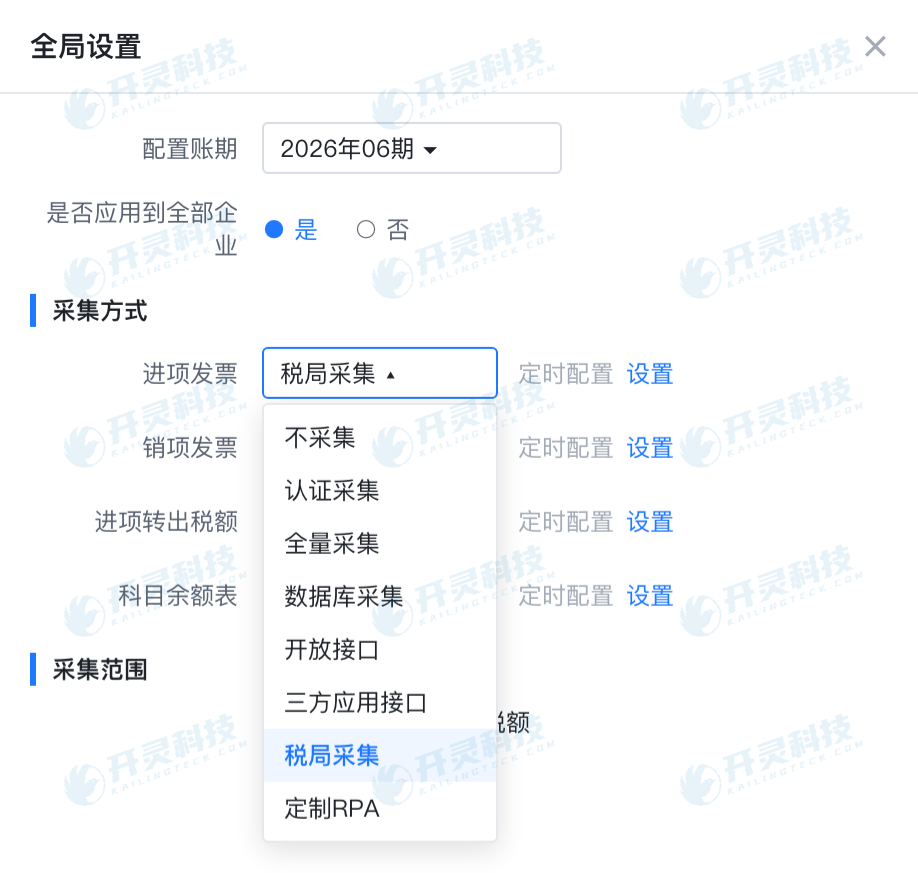
The first tedious task in tax filing is "gathering the numbers": before filing, export from each financial system one by one, then manually collect them into an Excel ledger and pass it back and forth. Kailing turns data retrieval into configuration items—Eight collection methods are configured once according to each enterprise's actual situation, and then automatically put in place every month thereafter.
Eight collection methods: No collection, authenticated collection, full collection, database collection, open interfaces, third-party application interfaces, tax authority collection, customized RPA, covering various channels for "collecting invoices from tax authorities or own invoice systems and obtaining financial data through docking interfaces".
No need to ask subordinate companies for data again: Invoices and financial data are collected through direct system connections, so finance no longer has to chase each party for submissions every month.
Scheduled tasks replace manual work: After month-beginning closing, set a schedule, and the system automatically collects all data at night, so data is ready when you arrive at work the next day.
Retrieve only tax-related accounts: Sensitive information can be restricted from collection, and the collection scope is controllable.
Every collection leaves a trace, and failures have logs: Whether it was collected and at which step it broke down are clear at a glance, facilitating re-collection and traceability.
▍Stage two · Calculate tax and produce working papers: built-in algorithms for each tax type; tag accounts and data is pulled automatically
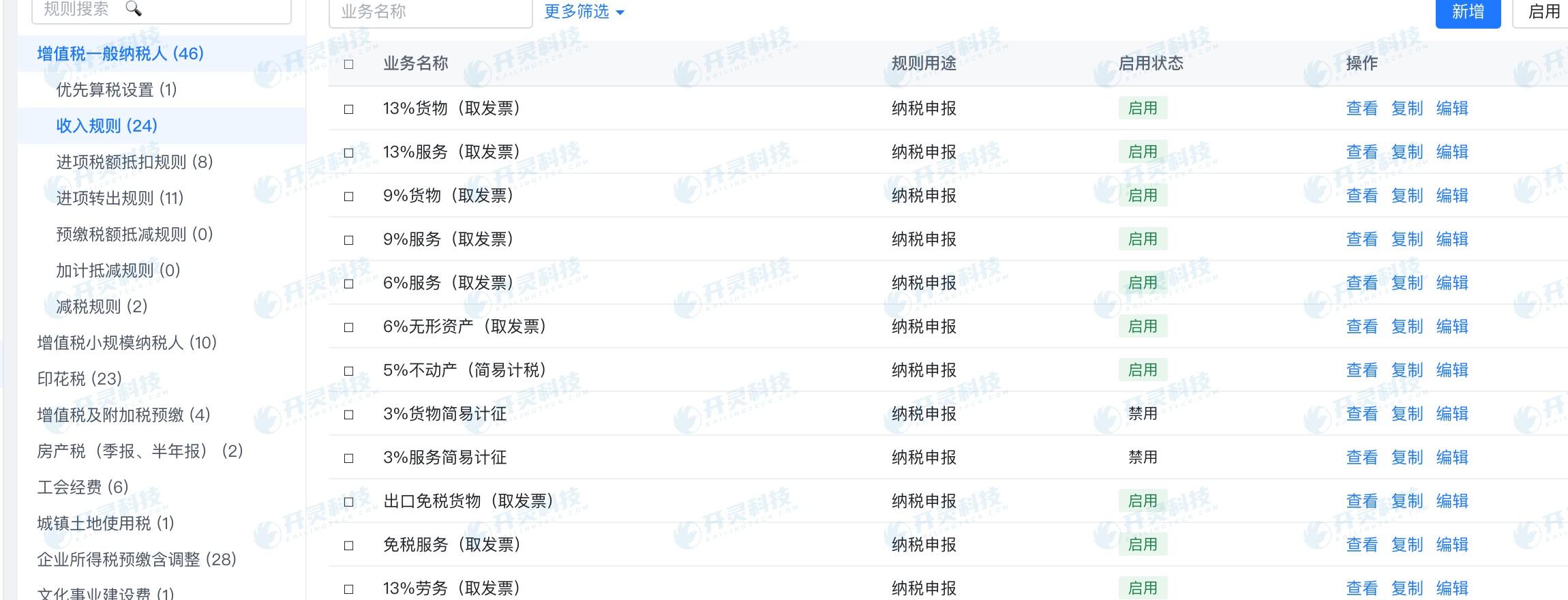
After data collection comes tax calculation. Kailing has built in algorithms for various tax types, and rules can be configured individually by company or in batches. Finance clicks "Calculate" on the tax calculation page, and the working papers and filing forms are produced in tens of seconds.
Data retrieval logic aligned with the tax authority: Basically consistent with the tax authority, with data drawn from invoices, and the calculated basis can withstand reconciliation.
No need to adjust accounts for inconsistent account names: When companies use different names for the same account subjects, simply "tagging" the subjects allows the system to automatically retrieve data by tag.
Can be calculated even without a contract: If the contract cannot be obtained for stamp duty, it is taken from the invoice instead, e.g., automatically identifying lease invoices.
Batch settings for similar companies: Management companies with the same tax calculation logic can be configured in batches, with no need to repeatedly set them one by one.
▍Stage three · Generate filing forms: cell-level mapping, still editable after the form is produced
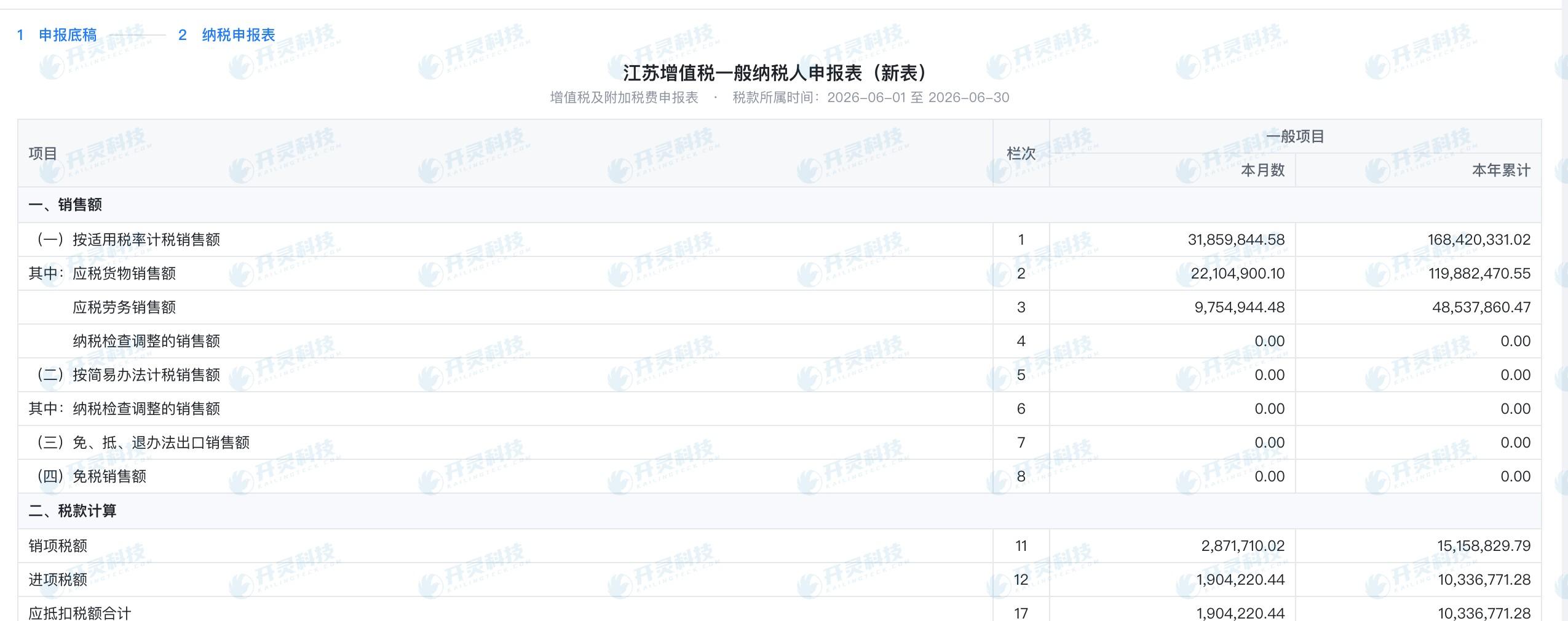
Once the working paper is produced, the tax return is generated accordingly, in exactly the same format as the tax bureau's. What Kailing does is Cell-level Mapping— Identify which data cell each cell corresponds to for filing, rather than applying a template generically.
Full coverage from main table to attached schedules: The VAT main form, Supplementary Information 1 to 5, tax reduction and exemption details, withholding and remittance deduction lists, etc. are generated together.
Automatically generated statements can still be manually modified: After auto-filling, if fine-tuning is needed, you can modify and save directly on the form.
A 100-person operations team follows tax bureau changes: When tax authority forms and standards change, the operations team adjusts promptly every month, so finance does not need to track policies on its own.
▍Stage four · Direct-connection filing and missed-filing fallback: confirm and lock the form, one-click submission, pull back status to close the loop
After the table is checked and found correct, click "Submit for Review", the report is locked, and it enters filing. This step replaces the most grueling task of "logging into the electronic tax bureau one taxpayer at a time".
Lock-table error-prevention version after confirmation: After confirmation and review, the report is locked; the filing module only takes locked reports, avoiding submitting a wrongly revised version.
Batch execution of filing and payment: No more logging into tax bureaus one by one. Filing and payment are completed in batches.
Final backstop for omission checks: The system pulls back the filing status from the tax bureau side for final closure—even if someone has already filed at an offline counter first, or the tax bureau's to-do prompt indicates a missed filing, this check can still catch it.
| "During filing periods, the most dangerous thing is often not miscalculation, but missed filing; Kailing Technology hands the final checkpoint of "filed or not, paid or not" to the system to watch for you. |
|---|
▍Stage five · Archive retrieval: three-way collection retrieves all results from the tax bureau side
Filing is not the end. Kailing uses three-way collection to retrieve and archive all results from the tax bureau side, so there is no need to search through each person's computer during traceback.
Filing data collection: Filing results are retained in report form, and prior-year data can also be collected in batches for traceability at any time.
Payment data collection: VAT and additional taxes are recovered separately, and late fees and fines are also collected together.
Tax payment certificate collection: Documentary and tabular tax payment certificates are uniformly archived.
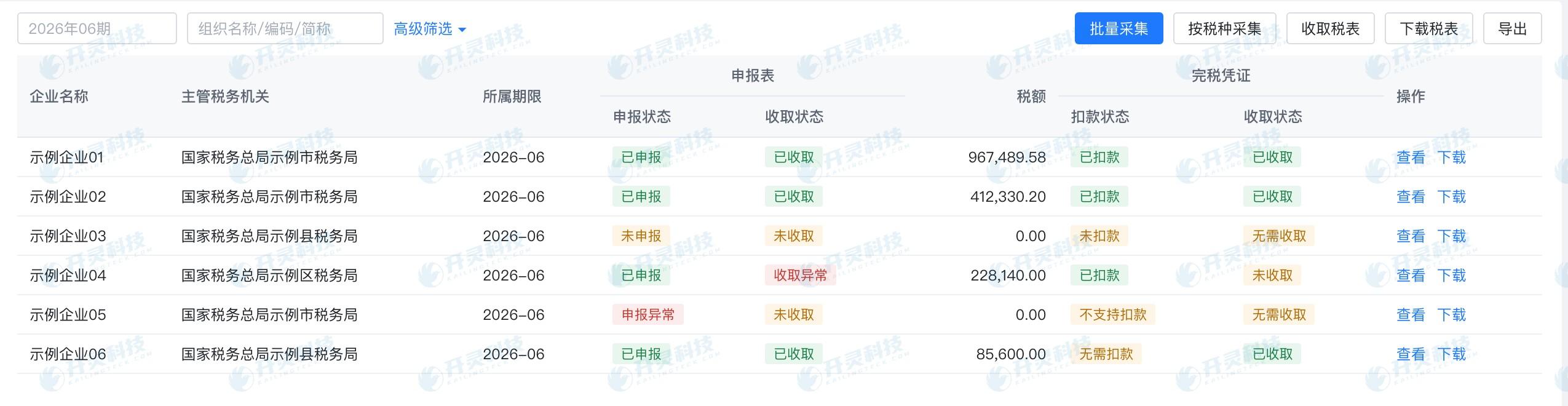
▍Now vs. after using Kailing Technology group tax filing
Looking at the five steps together, for the same task, the difference between doing it manually and handing it to Kailing Technology is not small at all.

This closed loop of automatic data retrieval, tax calculation, and direct-connection filing has been operating stably for many years since it was put into operation in 2019. There is no upper limit on the number of tax entities, and mainstream financial systems (NC Cloud, NC localized, NC classic, SAP, etc.) can all be connected. What finance needs to do comes back to the original four steps: click calculate, check the working papers, lock the table, and submit.
▍FAQ
Q: Our companies all use different account names; will automatic data retrieval pick the wrong ones?
A: It won't change your books. Kailing uses "account tagging" — applying unified tags to accounts with different names, and the system automatically retrieves data by tag; for items like stamp tax where no contract can be retrieved, it can instead retrieve from invoices, for example by identifying lease invoices.
Q: In the group, some are monthly reports, some are quarterly reports, and there are also optional sub-reports. Do we need to create the filing tasks one by one ourselves?
A: Tax filing information is collected and synchronized back from the tax bureau every month, and which taxes each company needs to file is automatically populated; monthly reports are generated once per month and quarterly reports once per quarter by the system. Only optional filing categories requiring per-instance filing need manual maintenance.
Q: If someone reports offline at the counter first, will the system reimburse twice or miss the report?
A: Step four includes an omission check: the system pulls back the filing status from the tax bureau side for final closure. Those already filed offline will be identified, and truly omitted ones will be flagged. The final checkpoint is covered by the system.
Q: The tax authority's filing form standards change frequently. Who tracks them?
A: The Kailing operations team follows tax bureau policies and promptly adjusts table formats and criteria whenever there is a change each month, so finance does not need to monitor policies itself.
Want multi-entity tax filing to change from "logging in one by one and filling forms manually" to "one-click calculation and batch submission"? Welcome to contact Kailing Technology to book a Kailing Technology group tax filing demo: www.kailingteck.com.
As a comprehensive business-finance-tax digitalization solution service provider, Kailing Technology provides business-finance-tax management digital transformation products and operational services for various government agencies, institutions, and large, medium, and small enterprises. The product line includes:
Solutions for businesses including sales contract management system, procurement contract management system, fully digitalized Leqi interface project, output automatic invoicing system, reverse invoicing system, invoice issuance for individuals system, employee expense control and reimbursement system, input VAT invoice management system, supply chain collaborative reconciliation system, image OCR recognition system, automatic financial bookkeeping system, and electronic accounting archives system, comprehensively driving the digitalization process across various fields.
If you have any business-finance-tax digital transformation needs, welcome to contact us. Beijing Kailing Technology will serve you wholeheartedly.
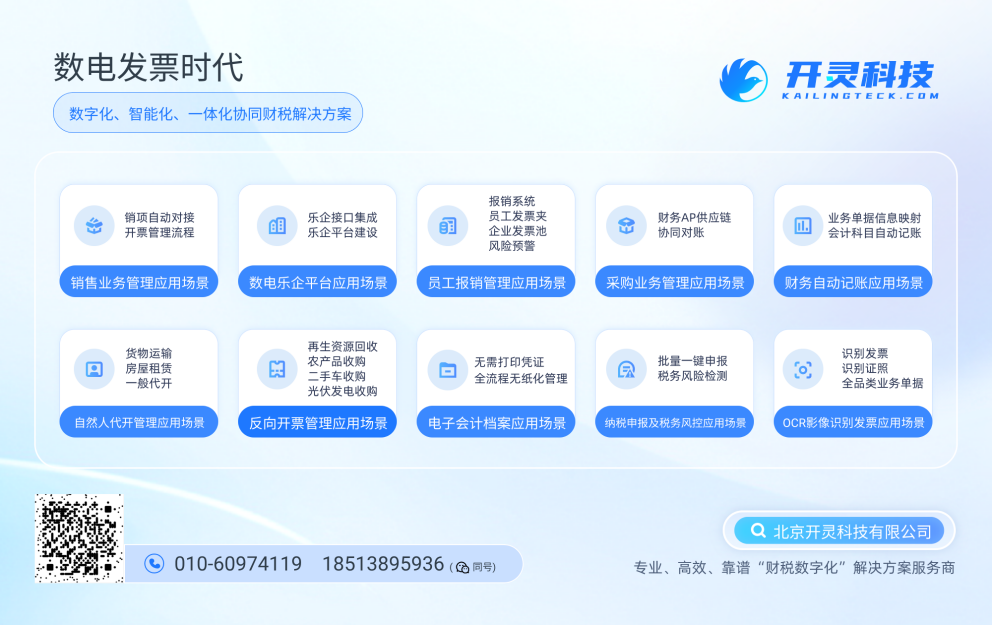
As a comprehensive business-finance-tax digitalization solution service provider, Kailing Technology provides business-finance-tax management digital transformation products and operational services for various government agencies, institutions, and large, medium, and small enterprises. The product line includes: solutions for sales contract management system, procurement contract management system, fully digitalized Leqi interface project, automatic output invoicing system, reverse invoicing system, invoice issuance for individuals system, employee expense control and reimbursement system, input VAT invoice management system, supply chain collaborative reconciliation system, image AI OCR recognition system, automatic financial bookkeeping system, electronic accounting archives system, etc., comprehensively driving the digitalization process across various fields.
Consultation Hotline: 18513895936 / 010-60974119 Location: Beijing