
How does fuel dispenser transaction data automatically enter the invoicing chain? Kailing Technology gas station Leqi joint solution connects collection and retail management
During evening peak, three vehicles leave the fuel island simultaneously: the dispenser shows the transaction completed, the cashier records the discounted amount into retail management, and the vehicle owner clicks to scan and invoice on the payment page. However, customer service finds that the three statuses are not aligned—one order has not been invoiced for a long time, another was clicked twice, and another still shows as invoiceable after a refund. The problem is not the speed of nozzle activation, but the lack of a single status line connecting devices, orders, funds, and invoices.
Kailing Technology's gas station Leqi joint use solution orchestrates fuel dispenser collection, station-level retail management, payment channels, buyer supplementation, Leqi invoicing, and result write-back into one transaction. Kailing handles business process orchestration and interface integration in the project, while banks or payment platforms with corresponding capabilities provide the joint use channel. Below, follow one evening peak order to see how data passes through each system and completes the closed loop.

▍Station one device collection: first fix what happened in this fueling event
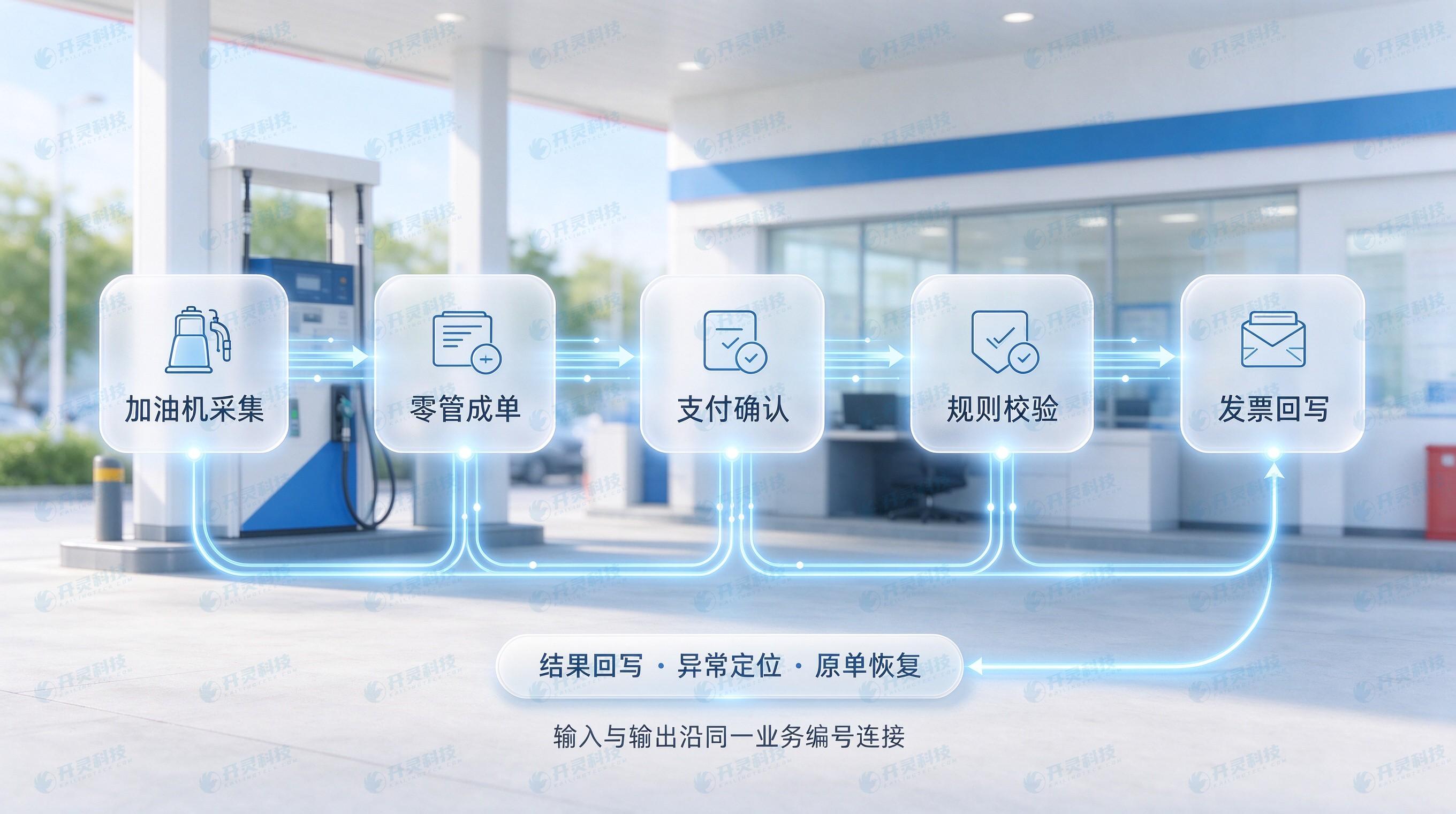
The vehicle stops next to the fuel nozzle, and the station control obtains the nozzle number, fuel product, fueling volume, unit price, amount, start time, and end time from the fuel dispenser. After the device transaction is formed, the system saves the source station, device transaction record, and timestamp, and returns the reception result to the station-level transaction queue. Operations staff can thus see which transaction records have entered retail management and which are still waiting to be transmitted.
Kailing's collection adaptation layer receives sources such as APIs, messages, files, or database views, and generates a receiving status for each device record. During network jitter, breakpoint resume continues along the original device flow; when the same flow arrives again, the system identifies the duplicate and retains one valid record. Operations personnel can see whether data is stuck at collection, parsing, or transmission.
The most easily exposed pitfall is treating the dispenser amount directly as the final invoicing amount. Promotions, member discounts, rounding, payment cancellation, and corporate settlement occur in subsequent systems; device records only describe the measurement fact.
Fuel dispenser collection and retail management order formation process
▍Station two retail management order creation: turn measurement facts into processable transactions
After station-level retail management receives device data, it combines station, fuel nozzle, fuel type, member, vehicle, discount, and payment relationships into an order. After this evening peak transaction is discounted, retail management saves the original amount, discount details, and actual received amount, and generates a business order number that runs through subsequent stages.
When operators temporarily cancel settlement or adjust the payment channel, the order retains both the before and after versions along with the reason. Only orders in the valid state set by the enterprise enter the invoicing middleware layer; temporary orders, pending-confirmation orders, and canceled orders remain in their corresponding queues. When customer service opens an order, they can see both the device source and the current business status.
Implementation research inventories fuel dispensers, station control, and retail management versions station by station, determining the field dictionary, trigger timing, business primary key, and return method. Kailing is responsible for adapting different versions to a unified business model, so multiple stations share one invoicing orchestration while retaining isolation relationships among tax entities, stations, and devices.
▍Station three payment confirmation: return channel transaction records to the original order
After the vehicle owner completes payment, the channel returns the transaction record, actual paid amount, payment time, and status. WeChat, Alipay, bank cards, fuel cards, cash, or corporate settlement are all mapped to the retail management order, and each retains its own original transaction record. Based on this, the invoicing middleware calculates the currently invoiceable amount and identifies pending payment, successful payment, cancellation, refund, and unknown result.
The acceptance tester deliberately creates a payment callback delay, then pushes the same transaction record again. The qualified result is that the order first shows payment processing, and updates to successful after the callback arrives; the duplicate transaction record only updates the original record. If the channel result remains unknown for a long time, the system initiates a query and assigns the task to operations staff, and will not create a payment fact again based on a page timeout.
This step also requires verifying the sales entity. A chain fuel station may have multiple tax entities and receiving accounts, and the station attribution, payment merchant number, and invoicing entity in the order need to match. When matching is abnormal, the order enters a review queue to prevent a transaction from one station being sent to another entity.
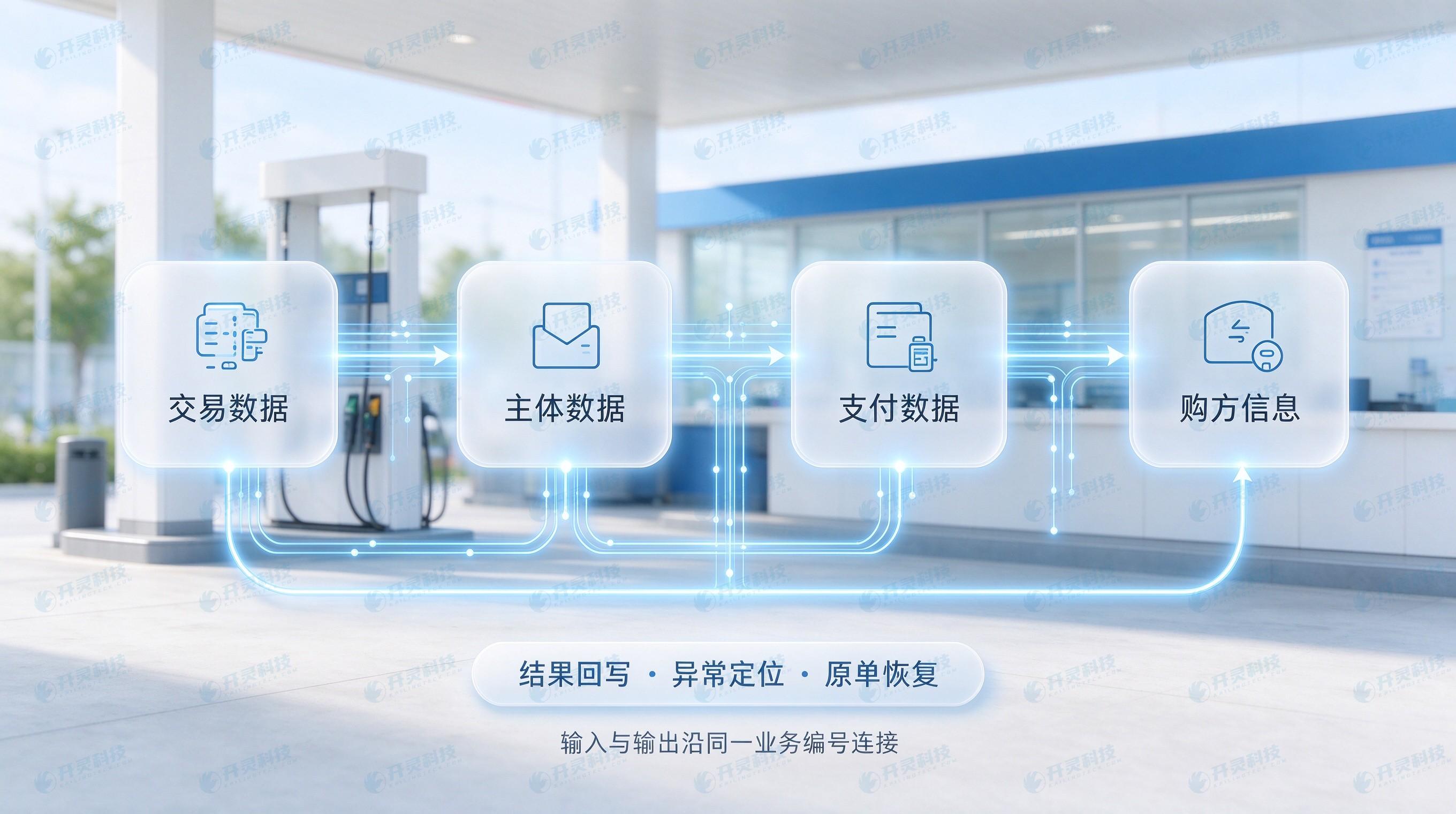
Four groups of invoicing data: transaction, entity, payment, and buyer
▍Station four buyer supplementary entry: vehicle owners only fill in information the system does not yet have
After successful payment, the vehicle owner enters the invoicing page from the payment bill, mini-program, APP, SMS link, or an entry configured by the enterprise. The order number, fuel type, quantity, amount, and seller are already carried through the link, and the owner only needs to select individual or organization and supplement necessary information such as title, tax number, and email.
The invoicing middleware checks header and tax number format, order available invoicing balance, issued status, and duplicate requests. When a vehicle owner clicks continuously, multiple requests use the same business order number and invoicing request number; a request being processed shows current progress, and successful orders directly enter the collection page. Customer service can also view the same status through the order number.
A common pitfall is putting buyer information and transaction information on the same manual form, making vehicle owners reselect fuel products and fill in amounts. This increases operations and may also create differences between the invoice face and the retail management order. The automated chain should lock transaction facts and leave users only fields that truly require buyer confirmation.
▍Station five Leqi invoicing: how business orders enter tax capabilities
In the Leqi joint use structure, banks or payment platforms with open capabilities assume the role of direct connection unit, and gas station enterprises access as user units. Original transaction or fund receipt and payment data is generated in the direct connection unit's own information system, and the platform receives order, payment, and buyer information according to project capabilities, then calls the corresponding tax-related services.
Kailing handles process connection and interface implementation between the gas station business end and the partner platform. The middleware organizes order number, sales entity, project, quantity, amount, payment flow, and buyer information into requests, performs project mapping, amount verification, and idempotency control, and saves requests, receipts, and key node logs.
After the request leaves the station, the retail management order immediately shows pending invoicing, invoicing in progress, invoiced, or pending processing. When the partner platform has not yet returned, the middleware layer retains the original order number and request number and places the station transaction into the reconciliation queue; after the result arrives, the invoice number or processing reason is updated. Station personnel always take the next step from the original order.
▍Station six result write-back: let retail management, customer service, and vehicle owners see the same invoice
After an invoice is successfully issued, the invoice number, invoicing time, status, and deliverable file information return to the invoicing middleware, then are written back to the retail management order. Vehicle owners query and collect at the original entry point, customer service views processing results by order number, and station operations see the issued amount and available balance; all ends read the same invoice status.
The acceptance tester then cuts off one retail management write-back. When the tax side has already succeeded, the middleware saves the result and keeps retrying, and the order shows "invoicing successful, business pending write-back"; after write-back resumes, retail management is updated. The system will not initiate invoicing again just because retail management has not yet received it, and this directly determines whether duplicate invoices appear during peak periods.
Kailing Technology's gas station Leqi joint use solution centralizes collection, retail management, payment, and invoice status into an exception center. Operations personnel can locate problems by station, channel, order, and request, customer service does not need to ask one by one across multiple backends, and the group can view order volume, pending status, and write-back backlog for each entity.
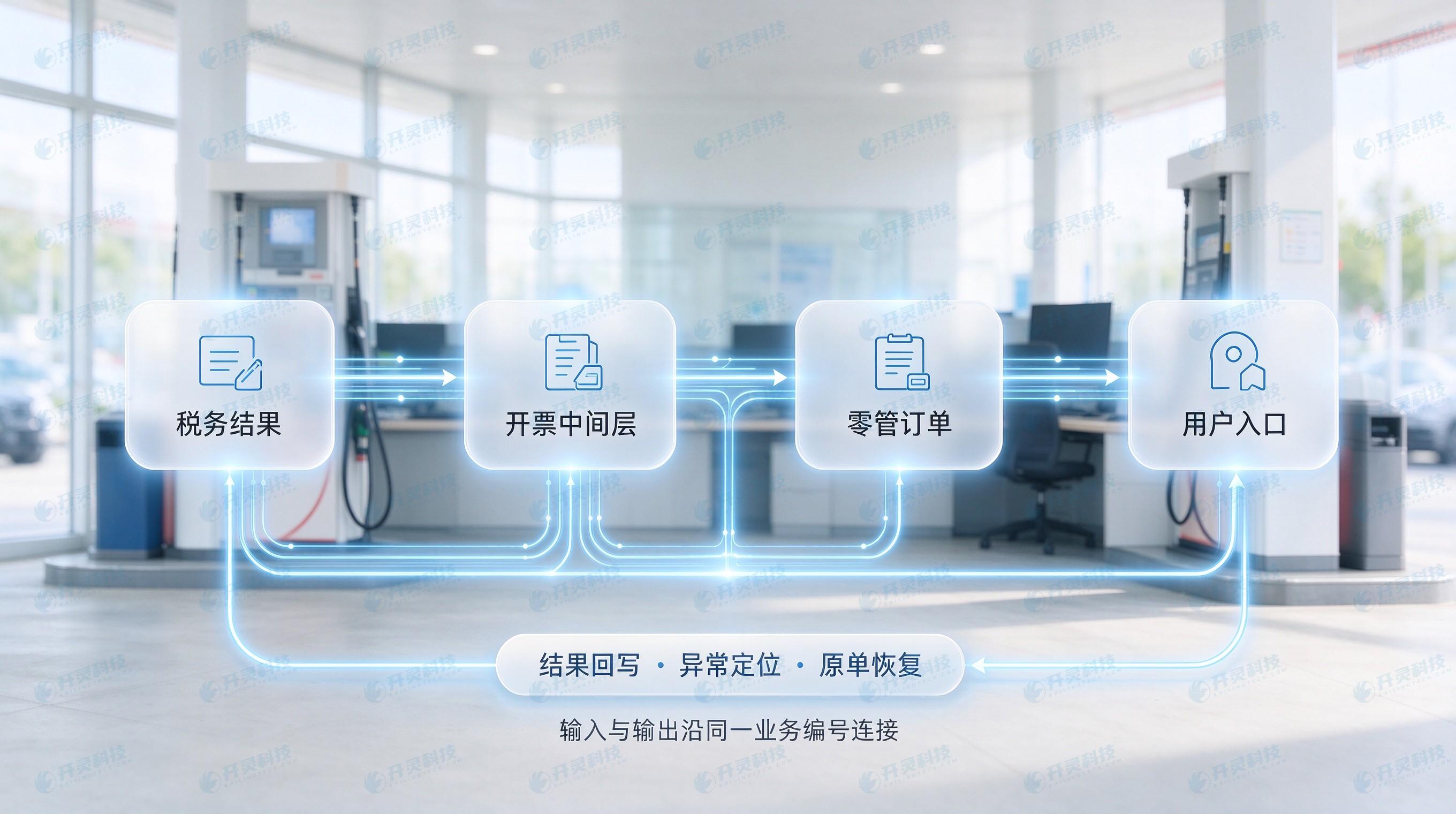
Invoice status written back to retail management and user entry point
▍Station seven refund red reversal and reconciliation: how one transaction is fully closed out
The next day, the vehicle owner initiates a partial refund on the original order. Retail management first updates the refund fact, the invoicing middleware layer queries the original invoice, invoiced amount, and processable range, and then enters the red-ink process according to configuration. The original blue invoice, red-ink result, refund flow, and remaining invoiceable amount are saved around the original order, and customer service can explain each change along the timeline.
Procurement acceptance should cover refunds without invoicing, full refunds after invoicing, partial refunds, re-issuance after red reversal, payment cancellation, interface timeout, and repeated clicks. Each sample checks the relationship among order amount, payment amount, invoiced amount, and red-reversal amount, and confirms that no duplicate invoice or duplicate refund is generated after exception recovery.
Daily reconciliation compares device transactions, retail management settlement, channel payment, invoice issuance, and refund red-ink reversal by order. Discrepancies are directly located to the station, fuel nozzle, channel, or tax request, and station-level transaction status and invoice-payment results are verified transaction by transaction along the business primary key.
Evening peak orders ultimately form a closed loop: nozzle activation enters retail management, payment triggers buyer supplementary entry and invoicing, results are written back, and refunds are red-ink reversed along the original order. Kailing orchestrates each node into a monitorable, recoverable interface chain.
▍FAQ
Q: Why should fuel dispenser transactions first enter retail management orders?
A: The fuel dispenser records the measurement fact, and retail management further combines site, discount, membership, payment, and sales entity to form a complete business order.
Q: How can duplicate invoicing be avoided when a vehicle owner clicks repeatedly?
A: The system uses the business order number and invoicing request number for idempotency control; if processing, it first queries the status, and after success it directly returns the original invoice result.
Q: What work does Kailing Technology undertake in a Leqi joint-use project?
A: Kailing is responsible for gas station business orchestration, system adaptation, interface integration, status write-back, exception monitoring, and project implementation.
Q: How does the system handle invoices after a refund?
A: The system finds the original invoice and issued amount from the original order, enters the red-letter process based on the refund fact, and synchronously updates the remaining issuable amount and reconciliation status.
Check collection, payment, invoicing, and write-back from one fueling order to understand Kailing Technology's gas station Leqi joint solution: https://www.kailingteck.com/leqi-lianyong/ .
As a national high-tech enterprise, Kailing Technology focuses on the digital and intelligent transformation of enterprise business-finance-tax and operations management, providing software products, system integration, implementation and delivery, and operational services for various government agencies, institutions, group enterprises, and SMEs.
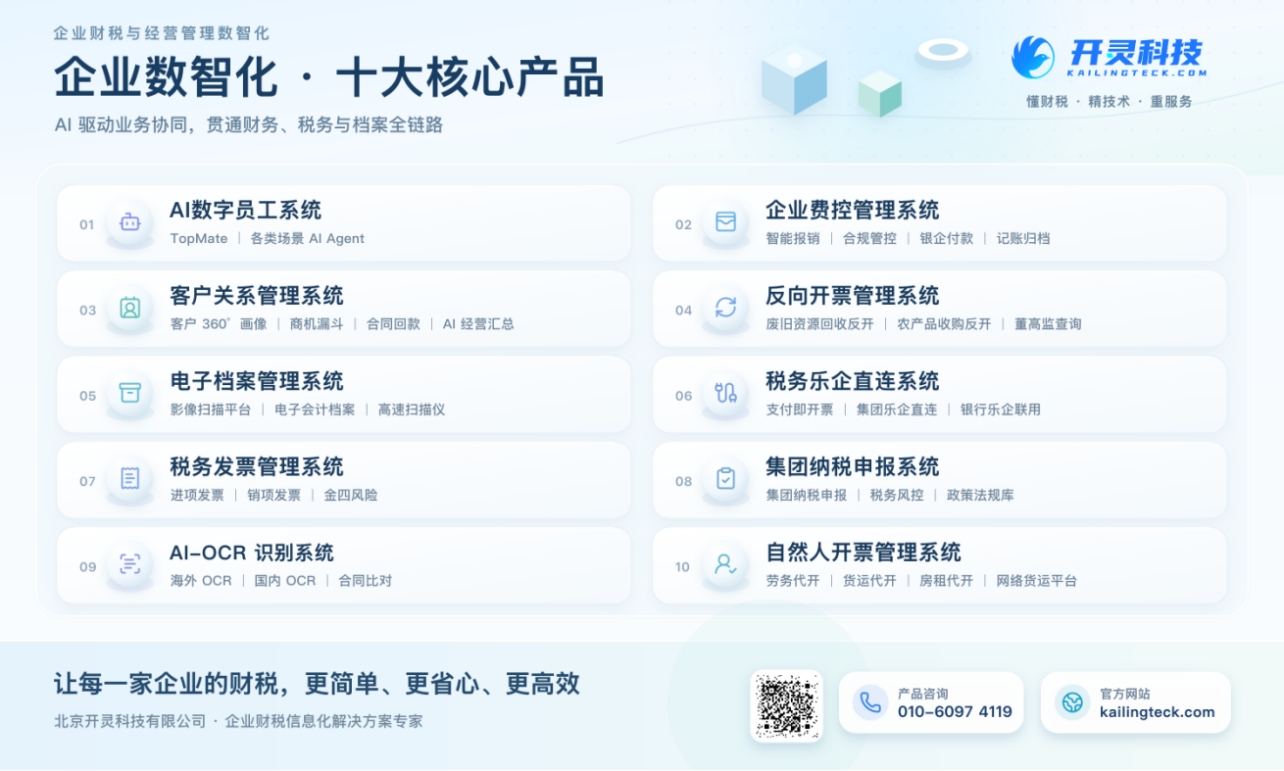
The company has now formed ten core product lines, including: AI digital employee system, enterprise expense control management system, customer relationship management system, reverse invoicing management system, invoice issuance for individuals management system, electronic archives management system, tax fully digitalized e-invoice Leqi system, tax invoice management system, group tax filing system, and AI OCR recognition system. It is committed to connecting enterprise business, finance, tax, funds, and archive data to help customers improve operational efficiency, business-finance-tax compliance capabilities, and digital management levels.
If you have any business-finance-tax digital transformation needs, welcome to contact us. Beijing Kailing Technology will serve you wholeheartedly.
Keywords: Fuel dispenser transaction data, invoicing from the retail management system, gas station Leqi joint use, invoicing upon transaction, invoicing upon payment, invoice results written back
As a comprehensive business-finance-tax digitalization solution service provider, Kailing Technology provides business-finance-tax management digital transformation products and operational services for various government agencies, institutions, and large, medium, and small enterprises. The product line includes: solutions for sales contract management system, procurement contract management system, fully digitalized Leqi interface project, automatic output invoicing system, reverse invoicing system, invoice issuance for individuals system, employee expense control and reimbursement system, input VAT invoice management system, supply chain collaborative reconciliation system, image AI OCR recognition system, automatic financial bookkeeping system, electronic accounting archives system, etc., comprehensively driving the digitalization process across various fields.
Consultation Hotline: 18513895936 / 010-60974119 Location: Beijing