
How can an invoice be automatically issued after a vehicle owner pays for charging? Kailing Technology's charging pile Leqi integrated payment-triggered invoicing solution
To automatically issue an invoice after a vehicle owner pays for charging, it is necessary to first lock the measurement and billing results of the charging order, then confirm the relationship among the operator, payee, and invoicing entity, use payment success as the invoicing trigger condition, and issue a fully digitalized e-invoice after verification of amount, tax rate, buyer, and duplicate requests. The invoice number and status are written back to the original order and then delivered via APP, mini-program, or email.
Kailing Technology's charging pile Leqi integrated payment-triggered invoicing solution connects the charging platform, payment transactions, and the corresponding Leqi capabilities. Kailing Technology undertakes solution implementation and interface integration between enterprise business systems and partner platforms, and does not present itself as a payment platform or a Leqi Direct Connection entity. The specific access entity, regional availability, and interface scope are subject to the requirements of the competent tax authority in the project location and the partner platform.
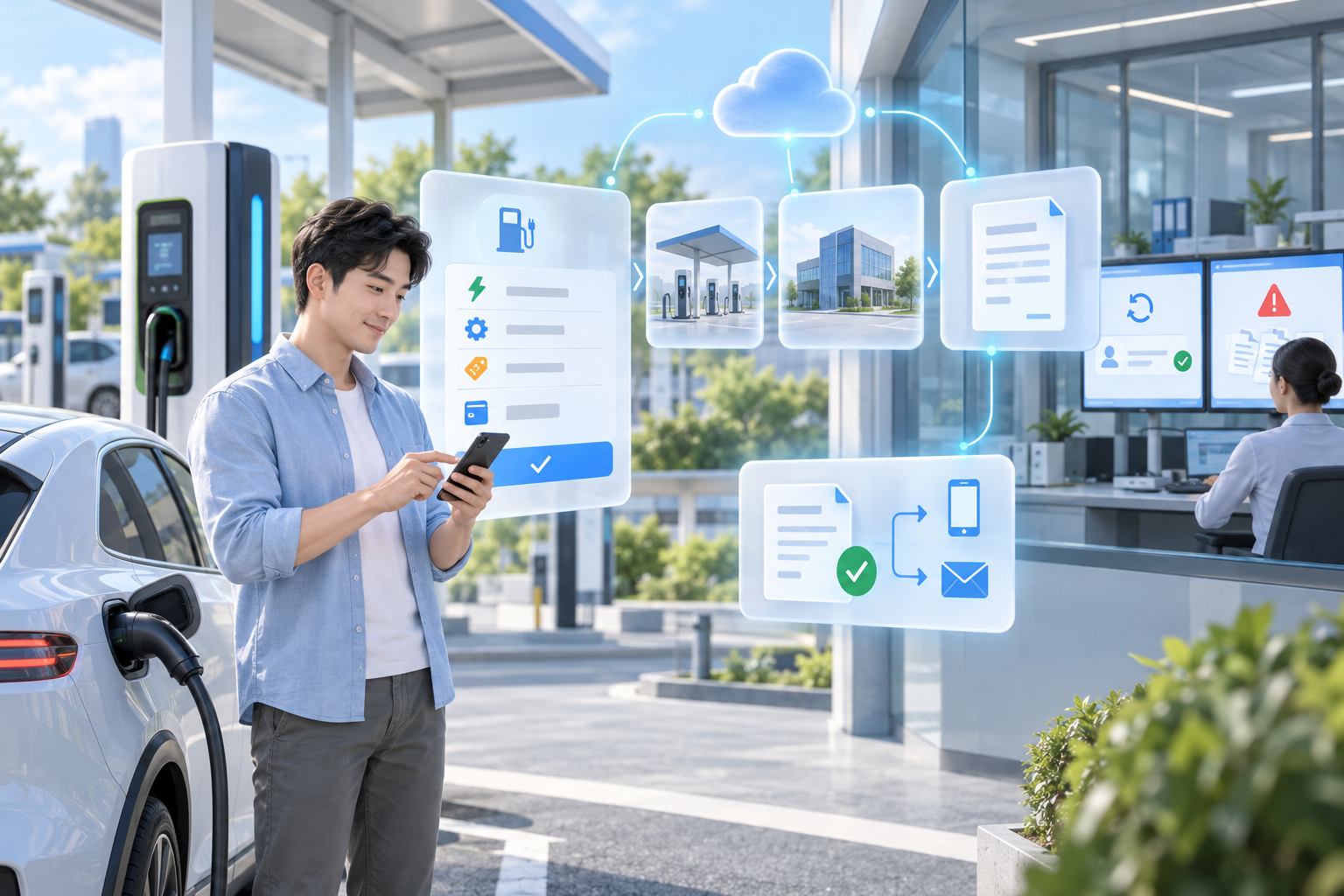
▍Why do vehicle owners still have to manually apply for invoices after payment
Many charging platforms place orders, payments, and invoices in three modules. After an order ends, the vehicle owner enters the mini-program again, selects the order, fills in the title, and submits; the platform then passes the request to the actual operator. When aggregation platforms, site operators, property management, and collection institutions coexist, the brand seen by the vehicle owner is not necessarily the invoicing entity.
Manual application itself is not the problem; the problem is that the system already has order and payment data but does not link the invoiceable amount, operator, and invoice status. Situations such as repeated user submissions, orders spanning multiple entities, and unhandled original invoices after refunds all increase verification work for customer service and finance.
Payment-triggered invoicing moves the trigger point earlier, but should still allow buyer information confirmation, enterprise title verification, and user selection. The delivery methods differ for individual consumer and enterprise reimbursement scenarios, and the system needs to retain the corresponding entry points.
▍Lock metering, billing, and actual payment amount first after charging ends
Order settlement should save the site, pile and connector, start and end time, end reason, and total electricity, and where necessary retain peak, flat, and valley time-of-use electricity, opening and closing meter readings, and pricing rules. Items such as electricity fees, service fees, discounts, and occupancy fees should be recorded separately according to the real business, and the actual paid amount is calculated from the relationship between fees and discounts.
The system locks the measurement and billing results after the order is completed. When manual adjustment is truly necessary, the original value, adjusted value, reason, and approval are retained, and equipment data cannot be silently overwritten. Payment transactions record channel, time, amount, and status, and are bound to the order number.
Announcement No. 13 of 2026 sets rules on the tax rate applicable to general VAT taxpayers' charging and battery-swap business when selling electricity and simultaneously collecting specific service fees, but it cannot be extrapolated to mean that all revenue of a charging station is uniformly 13%. Transactions such as independent equipment sales, installation, leasing, advertising, and pure platform services are still judged according to the substance of the business.
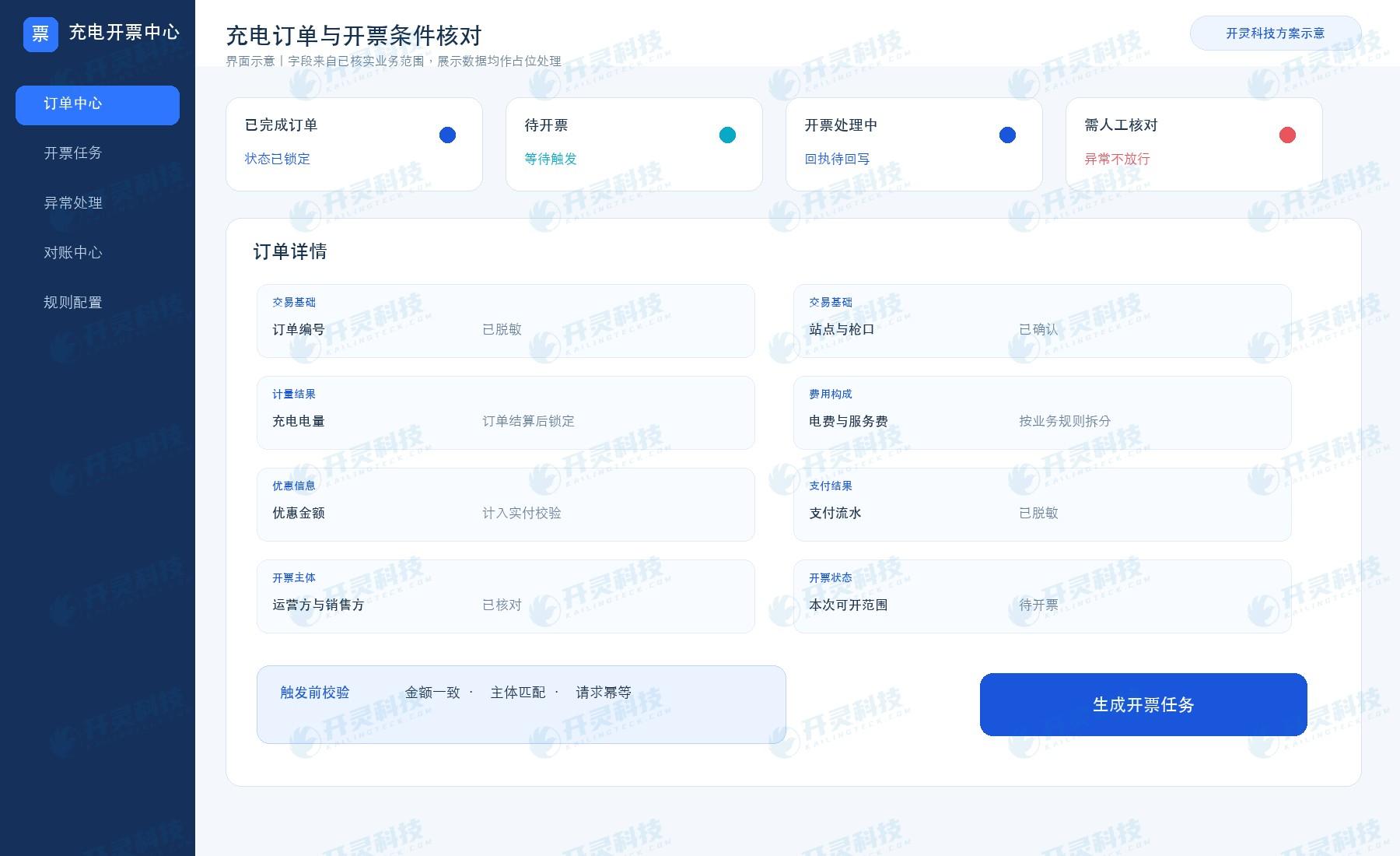
Schematic interface for verifying charging orders, metering, fees, payment, and invoicing conditions
▍How to establish the correspondence between platform payment stations and invoicing entities
Judging the invoicing entity should return to the contract and transaction substance: who provides charging and battery-swap business to the vehicle owner, and who bears performance, after-sales, and invoicing responsibilities; whether the platform merely collects on behalf, and how funds are split and refunded; and what relationship exists between the station operator and the electricity account. Funds passing through a third-party payment do not automatically change the real seller.
The system can establish mappings of sites, operating organizations, tax numbers, payment merchants, and invoicing configurations. When an order triggers invoicing, the entity is selected based on the site and business relationship to which the transaction belongs, and the collection and sales responsibilities are verified. Mapping changes should have an effective time to avoid historical orders being overwritten by new entity configurations.
In Leqi joint use, the direct connection unit provides tax-related services to user units that rely on its own information system to conduct transactions but have no controlling relationship. The original data of transactions or fund receipts and payments should be generated in the direct connection unit's own information system. The project must clarify the respective roles of the charging platform, payment institution, operating enterprise, and Kailing Technology.
▍How Kailing Technology turns successful payment into an invoicing task
After the payment success event enters the invoicing middleware, the system reads the order number, invoiceable amount, expense items, invoicing entity, and buyer information, and completes field mapping, buyer verification, tax classification code and tax rate matching, amount rounding differences, quota, and duplicate request checks.
Invoicing requests use the business order number and request number to achieve idempotency. When the same order is clicked repeatedly, the system returns the original task or original invoice result and does not create a second one. If the interface times out, first query the tax authority side or partner platform status, and retry only after confirming that no invoice was issued.
Tasks that pass validation call the actually connected tax-side or compliance service interface. Authentication, messages, receipts, and obtainable formatted documents are subject to the real interface documentation. The invoicing result is written back to the order, forming queryable statuses such as "pending invoicing, processing, issued, failed, red-flushed."
▍How to write back and deliver the invoice to the vehicle owner after it is issued
The system receives the invoice number, invoicing time, amount and tax, and status, and saves the actual returned layout or structured file. The order page displays the invoicing result, and the vehicle owner can obtain it via the APP, mini-program, email, or download entry. Delivery failure does not trigger re-invoicing; only the original invoice needs to be resent.
What customer service sees are two lines: business status and invoice status. If payment is successful but invoicing is in progress, the actual progress should be communicated; if the invoice has been issued but email delivery failed, it only needs to be redelivered; when a user modifies buyer information, it should be judged based on the invoice status whether to supplement, reissue, or handle with a red-letter invoice.
Kailing Technology's charging pile Leqi integrated payment-triggered invoicing solution uses the order as the query entry point, so vehicle owners, customer service, and finance use the same result, reducing the breakpoint where "the platform shows payment completed, but the operator cannot find the invoicing request."
▍How to avoid duplicate invoicing for repeated refund requests and invoicing failures
A refund does not mean the invoice automatically becomes invalid. When a refund occurs for an uninvoiced order, adjust the invoicable scope; if a full or partial refund occurs after invoicing, handle it according to the red-letter rules for fully digitalized e-invoices based on the actual situation such as sales returns or allowances, and link the red invoice to the original blue invoice. Fund refunds and invoice handling are updated separately.
Duplicate requests are intercepted by order number and request number, returning the original result. Invoicing failures must be distinguished among buyer information errors, entity configuration inconsistencies, amount validation failures, and unknown interface status. Different causes correspond to supplementary materials, manual verification, or status inquiry, and should not all be handled by clicking "retry."
The exception handling console retains the original request, original status, handler, and time records. This both avoids duplicate invoicing and allows explanation of which node is stuck when a vehicle owner inquires.
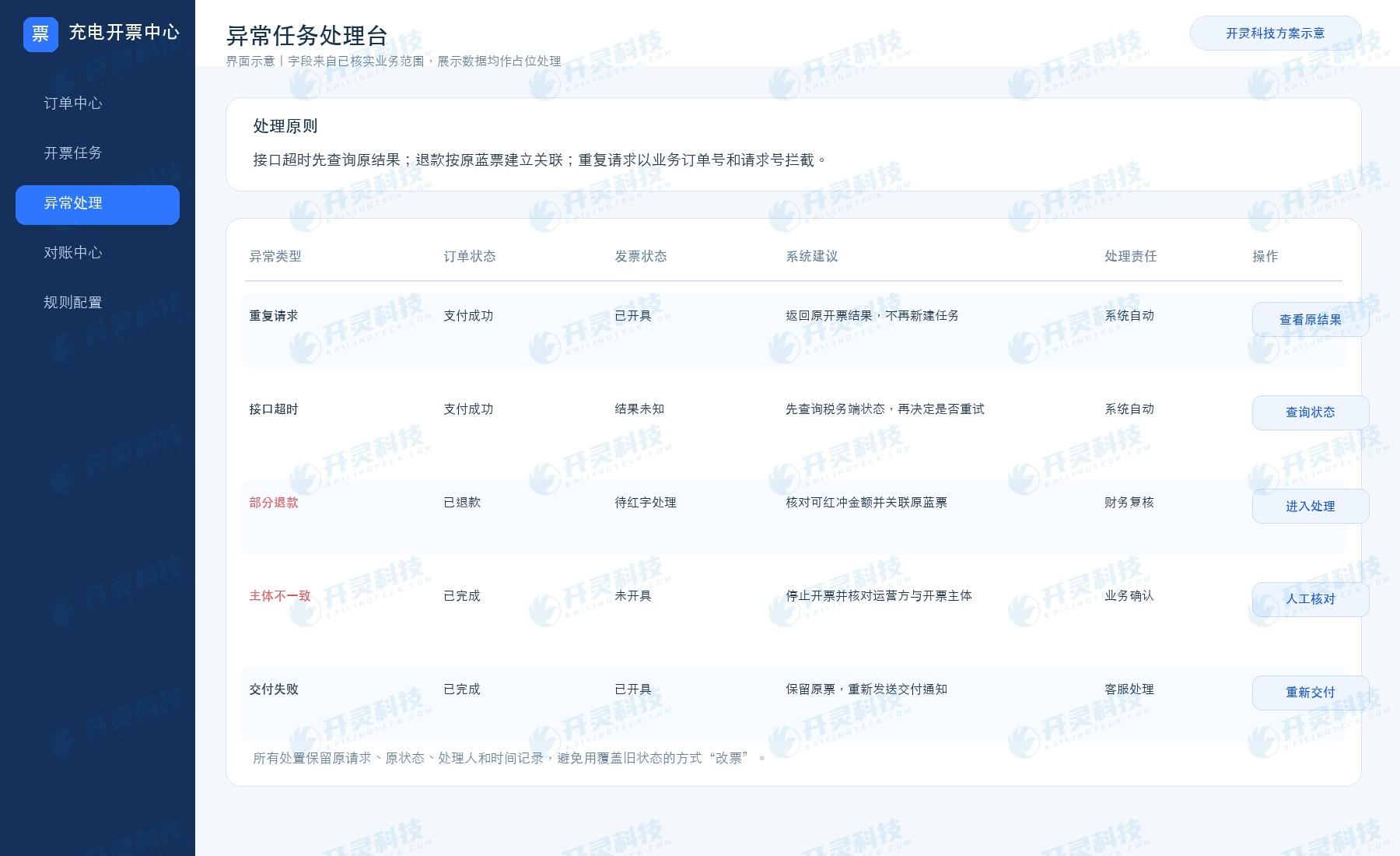
Interface illustration for handling refunds, duplicate requests, interface timeouts, and delivery failures
▍How order metering, payment, and invoice data are reconciled and retained transaction by transaction
Transaction-by-transaction reconciliation first compares the order's invoicable amount with the invoiced amount, then checks the daily business and invoice summary, the status on the business system and tax side, the monthly invoicing and filing data, and the amount and linkage between red invoices and original blue invoices. The five-level reconciliation gradually expands from individual anomalies to monthly filing.
Orders store four data domains: transaction, measurement, expense payment, and invoicing. The measuring equipment ledger can also manage verification certificates, dates, and status. Electric vehicle charging piles have been subject to mandatory verification since January 1, 2023, and the specific cycle is implemented according to the corresponding verification regulations; system reminders are an enterprise management measure, and a certain number of advance days should not be written as a unified legal requirement.
Kailing Technology's charging pile Leqi integrated payment-triggered invoicing solution forms traceable records through reconciliation and logs. Announcement No. 13 of 2026 addresses the applicable tax rate for specific charging and battery-swap transactions; it is not a document mandating nationwide transaction-triggered invoicing, and projects still need to be implemented in accordance with regional access and operating models.
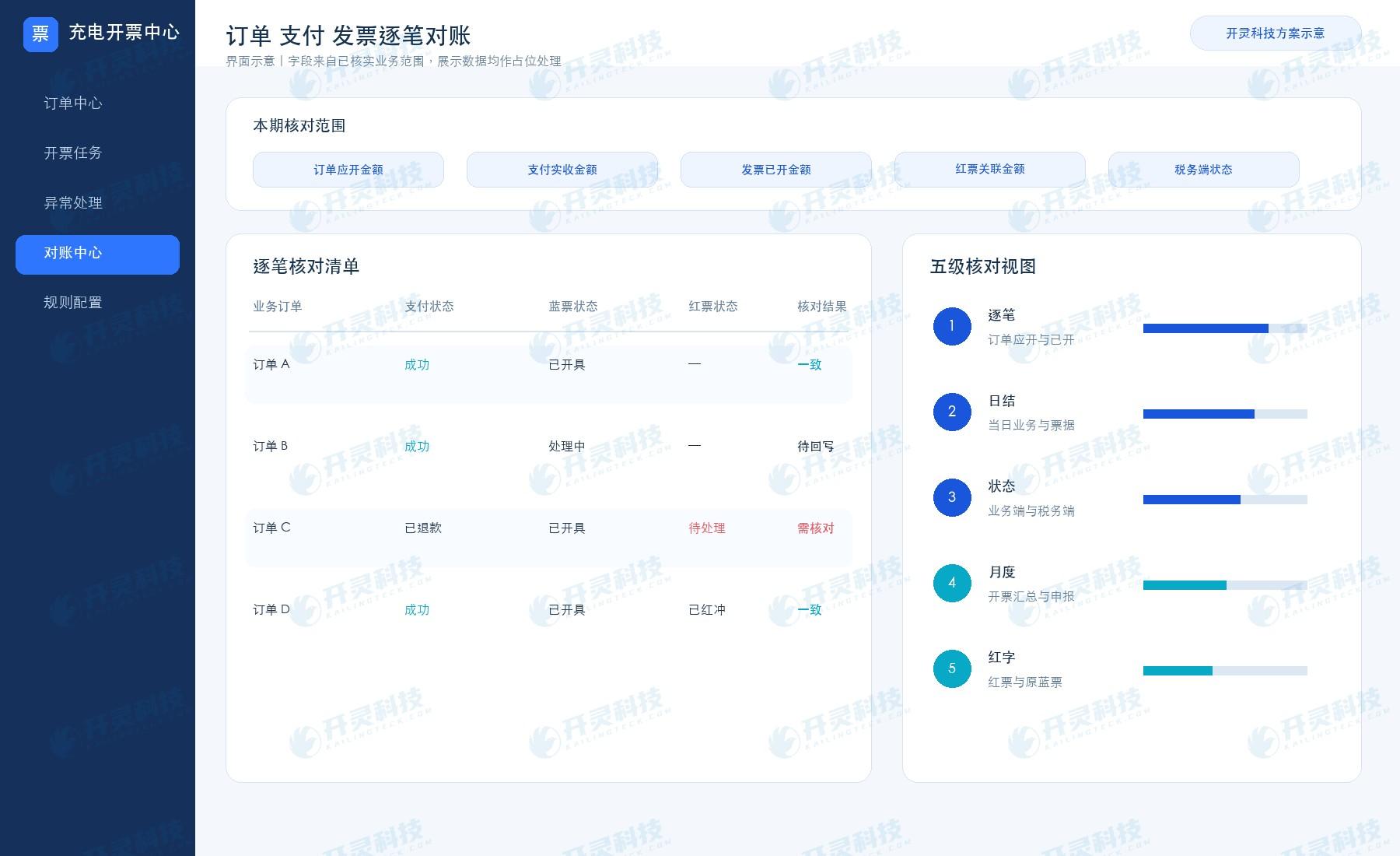
Schematic of the transaction-by-transaction reconciliation interface for orders, payments, blue invoices, red invoices, and tax authority status
▍FAQ
Q: After successful payment, can the vehicle owner be completely prevented from confirming the title?
A: Individuals and enterprises have different buyer information requirements. The system can automatically populate the order and amount, but title verification and user confirmation methods should be designed according to the scenario.
Q: If an aggregation platform collects payment, must the aggregation platform issue the invoice?
A: Not necessarily. The platform collecting payment on behalf does not automatically mean the platform is the seller; it should be judged based on the contract, performance, after-sales service, split settlement, and the substance of the transaction.
Q: After a successful refund, will the original invoice be automatically voided?
A: It will not automatically become invalid. Fund refunds and invoice status are handled separately; for invoiced business, the red-letter rules are applied according to the actual situation.
Q: Does Announcement No. 13 of 2026 require all charging stations to launch pay-and-invoice?
A: No. This announcement mainly clarifies the tax rate application for specific charging and battery-swap business; it is not a nationwide unified system launch order.
Connect charging orders, payment transactions, and fully digitalized e-invoices one by one, and learn about Kailing Technology's payment-triggered invoicing solution: www.kailingteck.com .
As a national high-tech enterprise, Kailing Technology focuses on the digital and intelligent transformation of enterprise business-finance-tax and operations management, providing software products, system integration, implementation and delivery, and operational services for various government agencies, institutions, group enterprises, and SMEs.
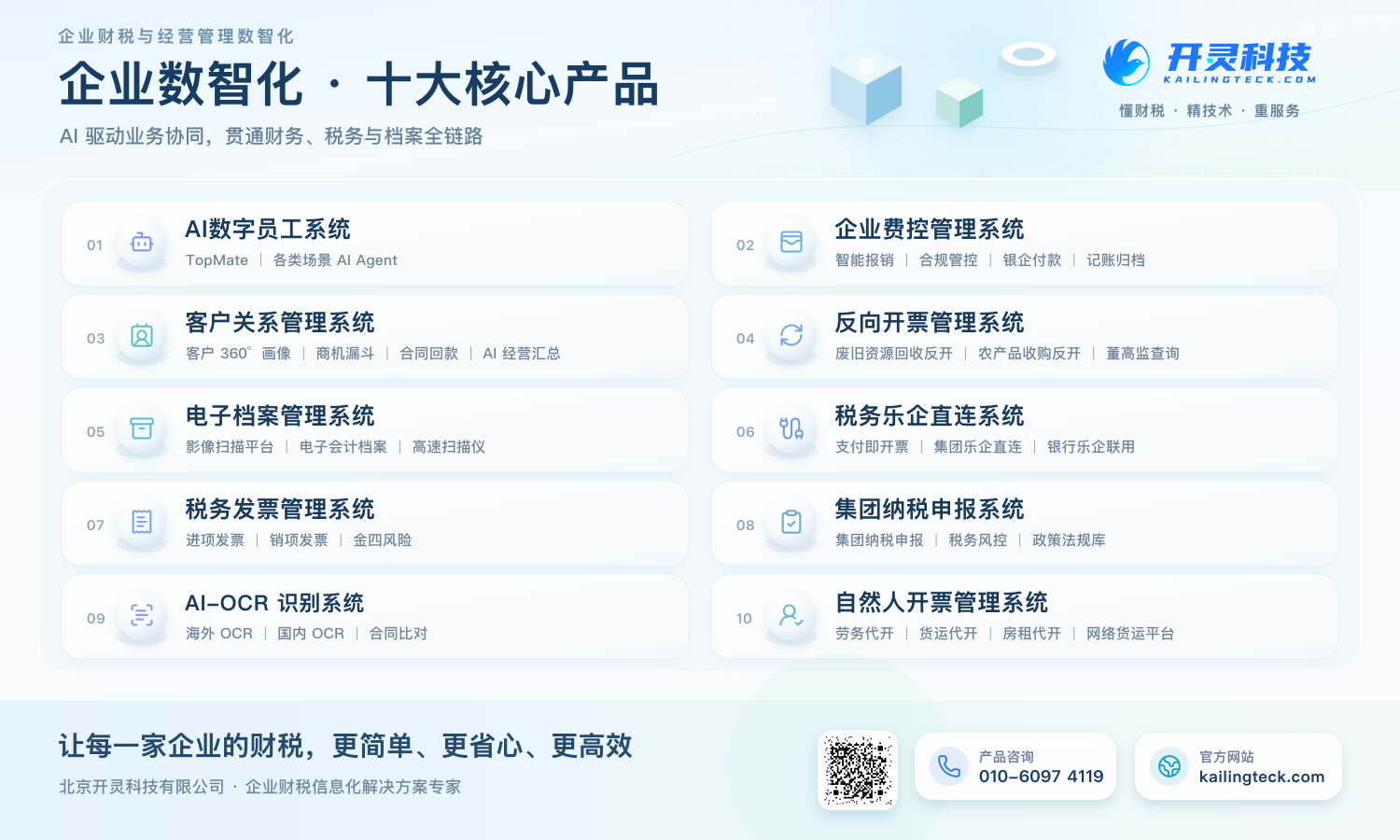
The company has now formed ten core product lines, including: AI digital employee system, enterprise expense control management system, customer relationship management system, reverse invoicing management system, invoice issuance for individuals management system, electronic archives management system, tax fully digitalized e-invoice Leqi system, tax invoice management system, group tax filing system, and AI OCR recognition system. It is committed to connecting enterprise business, finance, tax, funds, and archive data to help customers improve operational efficiency, business-finance-tax compliance capabilities, and digital management levels.
If you have any business-finance-tax digital transformation needs, welcome to contact us. Beijing Kailing Technology will serve you wholeheartedly.
Keywords: Automatic invoicing upon charging payment, pay-and-invoice at charging piles, Leqi joint use, charging order invoicing, fully digitalized e-invoice, charging station reconciliation
As a comprehensive business-finance-tax digitalization solution service provider, Kailing Technology provides business-finance-tax management digital transformation products and operational services for various government agencies, institutions, and large, medium, and small enterprises. The product line includes: solutions for sales contract management system, procurement contract management system, fully digitalized Leqi interface project, automatic output invoicing system, reverse invoicing system, invoice issuance for individuals system, employee expense control and reimbursement system, input VAT invoice management system, supply chain collaborative reconciliation system, image AI OCR recognition system, automatic financial bookkeeping system, electronic accounting archives system, etc., comprehensively driving the digitalization process across various fields.
Consultation Hotline: 18513895936 / 010-60974119 Location: Beijing