
What conditions are needed for reverse invoicing of scrap steel and scrap iron? Kailing Technology's resource recycling reverse invoicing system verifies the subject first and then retains all five flows
Not all enterprises purchasing scrap steel and scrap iron can directly issue reverse invoices to individuals. Enterprises should first check whether they are an applicable resource recycling enterprise, then confirm that the seller is a qualifying individual, that the goods are real scrapped products, and retain receipt, grading, settlement, payment and invoice materials. If any key condition is missing, the individual transaction should be suspended and transferred for manual confirmation.
Kailing Technology's resource recycling reverse invoicing system places condition verification before invoicing. Natural person archives, goods notes, invoices, payments, and archiving are updated around the same business number, so that "whether it can be invoiced" and "whether it can be explained after invoicing" are answered in the same set of records.

▍What basic conditions must reverse invoicing satisfy at the same time
The policy basis comes from State Taxation Administration Announcement No. 5 of 2024. When resource recycling enterprises conduct applicable business with natural person sellers of scrapped products, they may issue reverse invoices according to regulations. Enterprises cannot judge eligibility based solely on industry name; they should confirm based on actual conditions such as the hazardous waste operating permit, scrapped motor vehicle recycling and dismantling qualification, or renewable resource recycling operator filing, as well as their own business scope and the requirements of the competent tax authority.
The seller should be an applicable natural person entity. The system can verify information such as legal representatives, directors and supervisors, and individual industrial and commercial registrations, and prompt for objects that do not comply with the rules. Subject verification results need to preserve time and source, because personnel registration status can change.
Business conditions are equally important. Scrap steel and scrap iron must have a real entry, weight, grade, unit price and settlement basis, and payment and invoices must return to the same purchase order. Invoicing qualification cannot replace the fact of receipt, and receipt photos cannot replace payment and invoices.
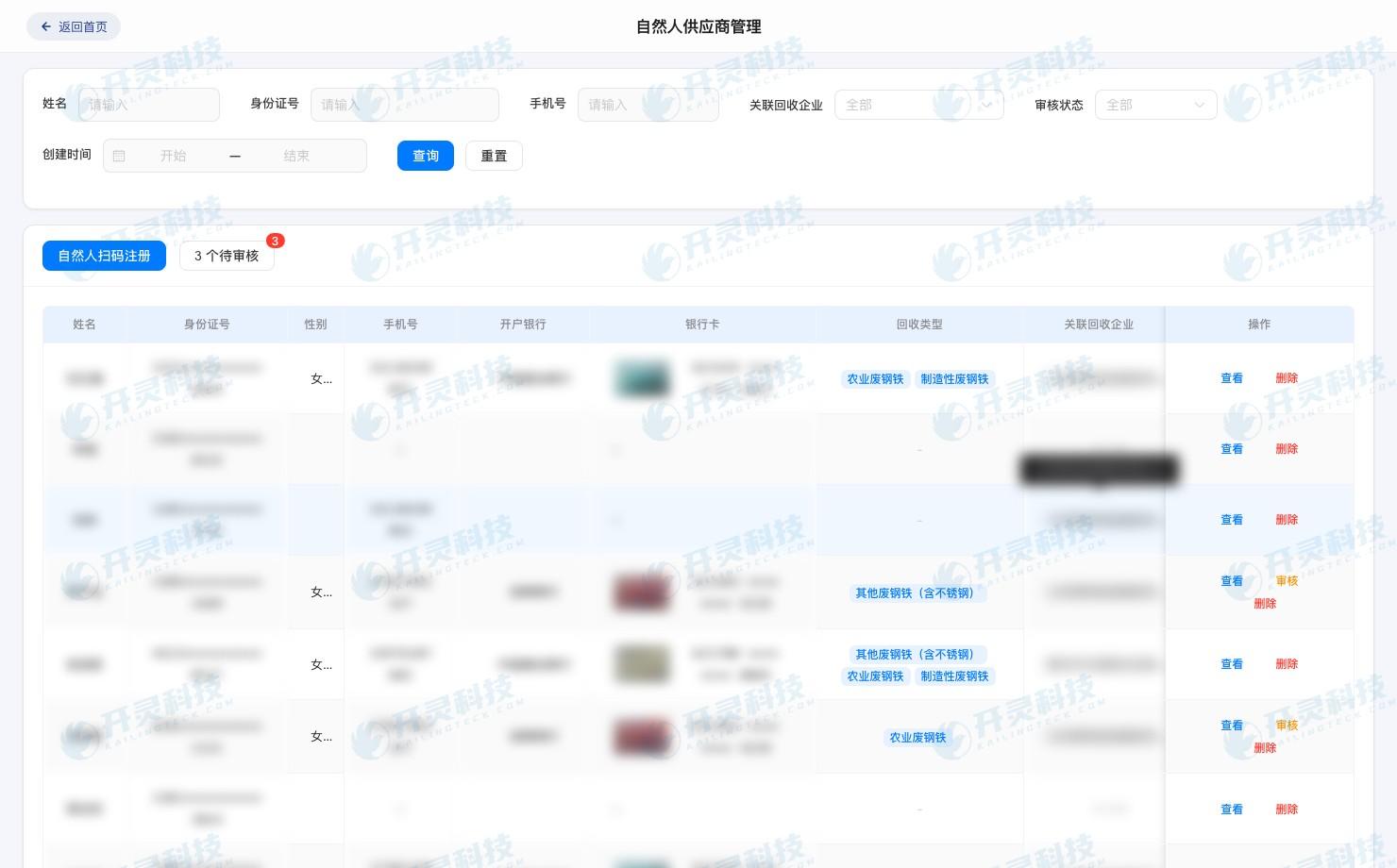
Natural person seller file creation and identity verification (information has been desensitized)
▍The enterprise side first checks qualification scope and internal responsibilities
The first task on the enterprise side is to clarify which legal entity receives goods, settles, pays and issues invoices. When a group has multiple subsidiaries, the site operator, contract signatory, payment entity and invoicing entity may differ. The difference itself is not necessarily prohibited, but there must be a clear business relationship, and the header cannot be switched arbitrarily in the system.
The second item is to verify the recycling category against permits, filings, or business scope. Hazardous waste, scrapped motor vehicles, and ordinary renewable resources have different management requirements, and enterprises should confirm according to actual business. System configuration can restrict organization and category combinations, preventing on-site personnel from sending inapplicable business into the reverse invoicing process.
The third item is to clarify job responsibilities. Receiving personnel confirm the goods, quality inspection or grading personnel confirm the grade, settlement personnel confirm the amount, and finance reviews payment and invoices. If the same person can modify all fields without a trace, then even if the system has data, it still lacks necessary internal controls.
▍What needs to be verified for an individual seller is not just the name
When creating a file, identity, contact information, and the relationship of the payment collection account should be verified, and applicable subject qualification checks should be performed. When the system prompts risks such as legal representative, director or supervisor, or already registered individual business, on-site personnel should not directly change to another ID card to continue processing, but should verify the true seller and business relationship.
When the same natural person sells multiple times, the archive can be reused, but each transaction still requires an independent receipt record. Enterprises should also pay attention to the cumulative criteria stipulated by policy. The judgment in State Taxation Administration Announcement No. 5 of 2024 regarding cumulative sales not exceeding 5 million yuan over 12 consecutive months is not the same criterion as the tiered 600,000 yuan annual individual income tax withholding rate for the three-flow-in-one scenario in No. 12 of 2026, and the two cannot be mixed into one "invoicing quota."
Passing system verification of the entity only means the basic information meets current rules; it cannot prove the goods source is real. When there are obvious contradictions among the seller, vehicle, goods, on-site images and receiving account, it should be transferred for manual verification.
▍Scrap steel and scrap iron receipt must put weight, grade, price and on-site materials together
Prices of scrap steel and scrap iron are affected by category, grade, impurities, and market conditions. The goods note should record the formation process of gross weight, tare weight, net weight, category, grade, unit price, and impurity deduction, and be linked to weighbridge tickets, vehicles, or on-site images. The final settlement amount should be derivable from these fields.
When reweighing, returns, or grade adjustments occur, the system retains the original records and reasons for changes. Saving only the final net weight and total price would make it impossible for finance to explain why the invoice amount changed, and would also make seller disputes difficult to trace back.
Kailing Technology's resource recycling reverse invoicing system uses the goods note as one of the business primary keys. Only after receipt passes can it enter settlement and invoicing; if materials are missing, it stops at the corresponding status, preventing on-site verbal confirmation from directly replacing records.
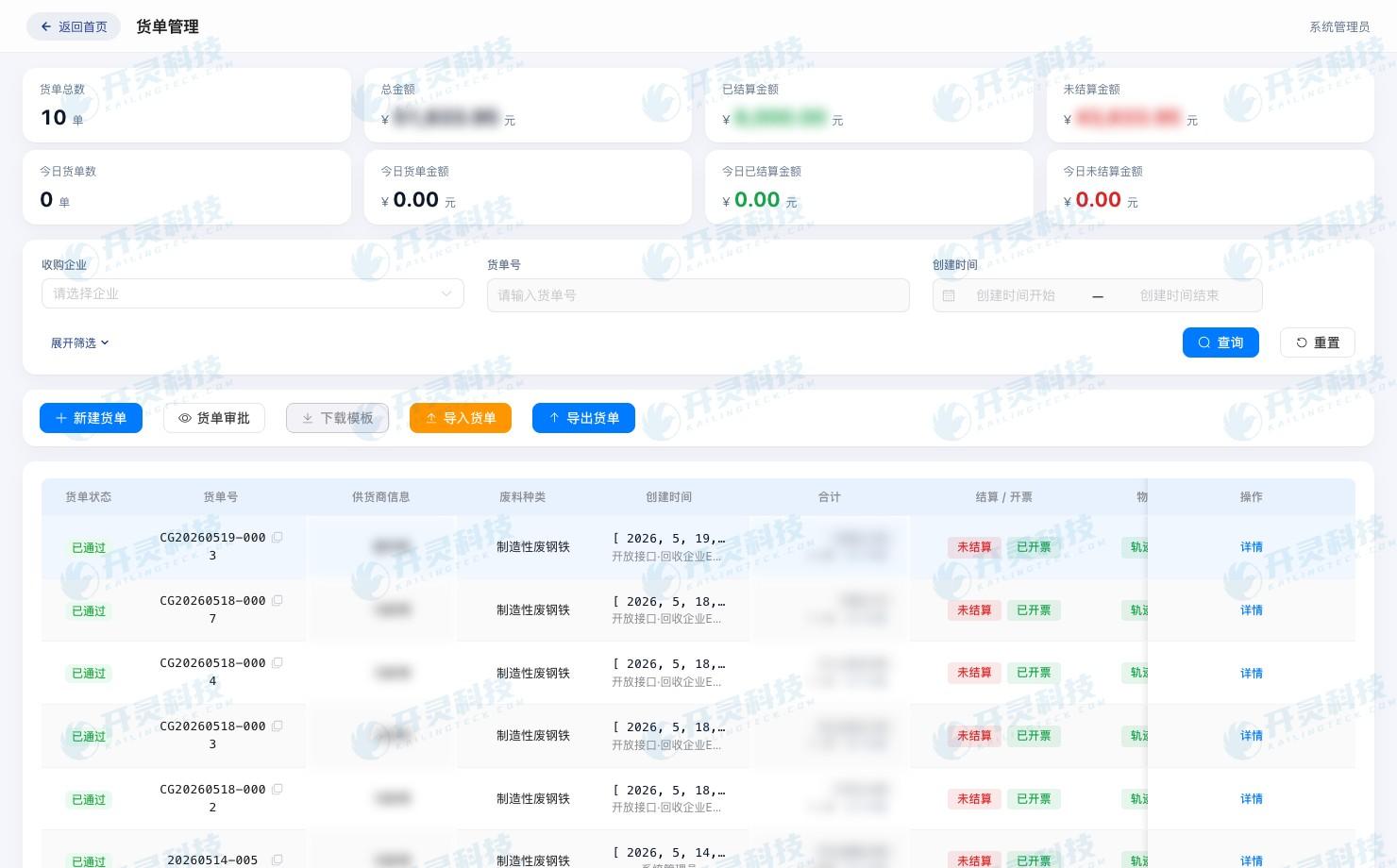
Management of scrap steel and scrap iron goods notes, categories, and receipt status (information has been desensitized)
▍Payment, invoicing and tax treatment must all return to the same purchase order
After the settlement statement is confirmed, the system forms pending invoicing information based on the seller and business details. Successful, failed, and red-ink reversal invoicing results are written back to the original goods order; payment tasks also reference the same purchase number. Finance can thereby verify received amount, invoiced amount, and actually paid amount, rather than guessing by name across three summary tables.
The tax-side three-flow approach emphasizes the linkage of payment, invoicing, tax payment, and entity relationships; the enterprise internal five-flow ledger consolidates self-certification, contract, business, tax, and fund materials into the same business. The two support each other, and the five-flow approach cannot be promoted as a "more advanced standard" exceeding tax requirements.
When payment fails, the system remains in an incomplete state and records the failure reason. Before resubmitting, check the original result to avoid duplicate payment of one payment. When the invoice interface times out, also query whether it has already been issued before deciding to retry, to avoid duplicate invoicing.
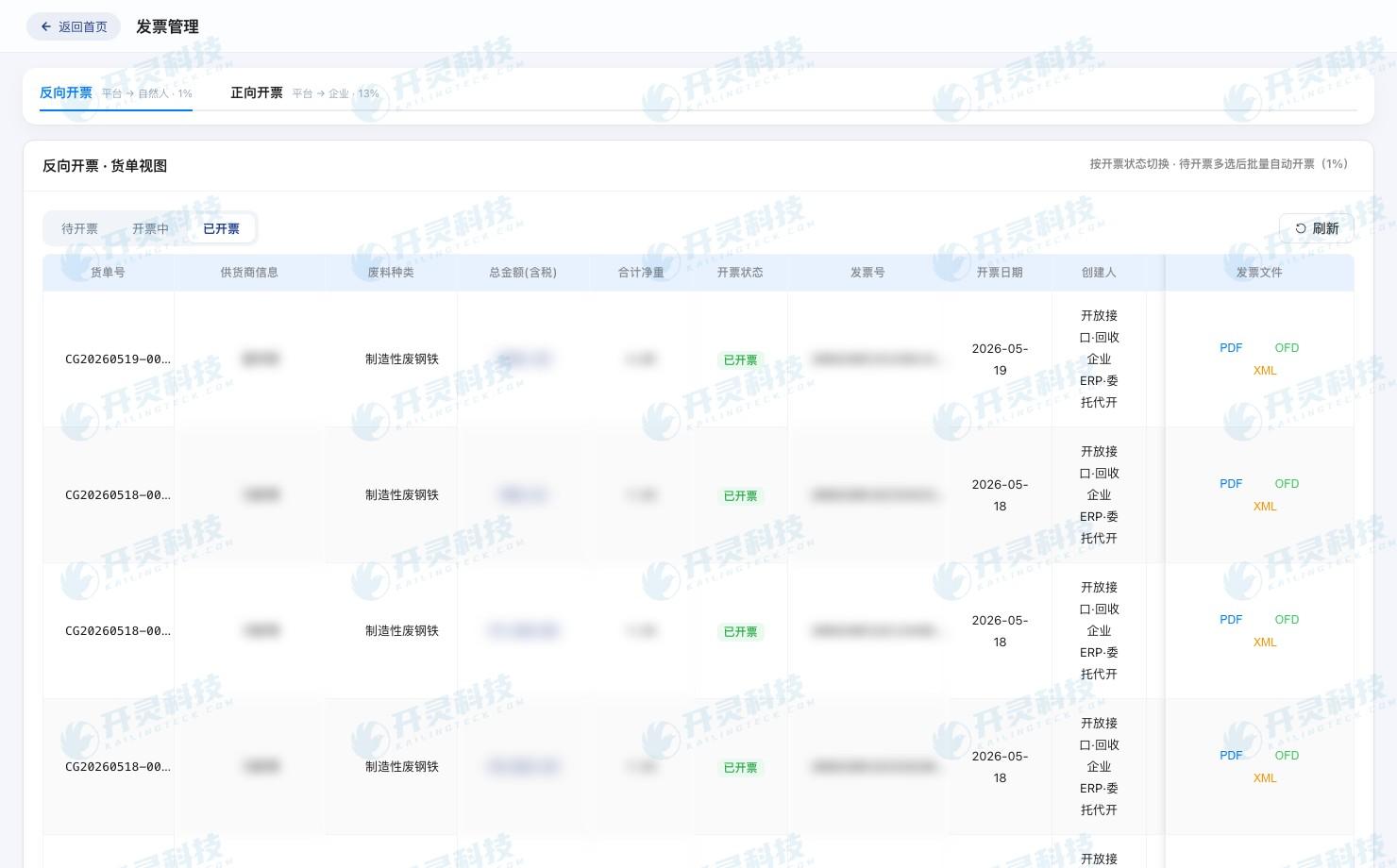
Query of reverse invoicing tasks and results for waste and used resources (information has been desensitized)
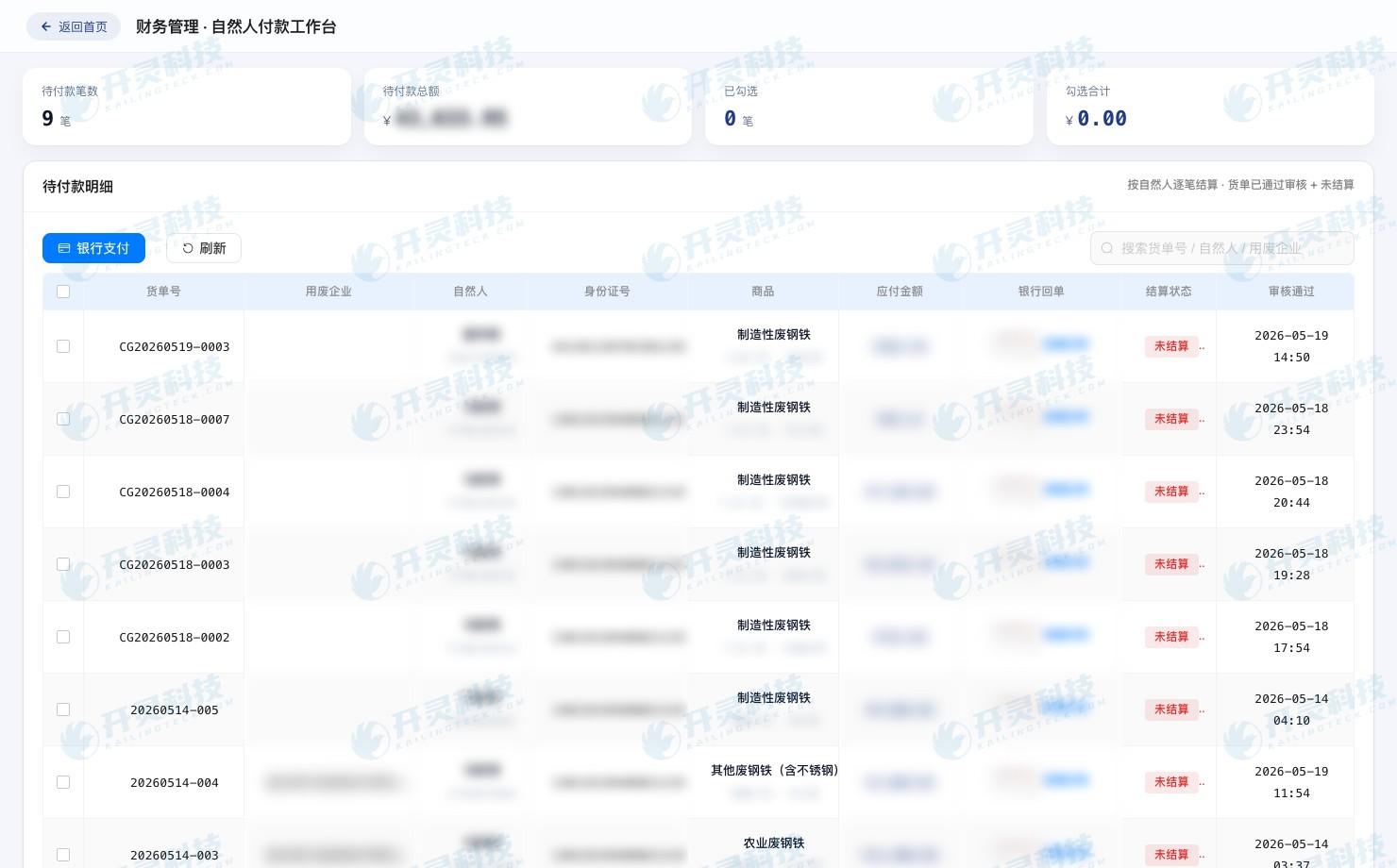
Payment records are associated with the original purchase order (information desensitized)
▍What should the system intercept when materials are missing and to whom should it be handed over
When the entity does not meet the rules, stop creating the invoicing task and have the business or compliance role verify the real seller; when receipt data is missing, return it to the site to supplement weight, grade and acceptance materials; when the payee is inconsistent, have finance verify the account and entrustment relationship; when the interface result is unclear, have the system query the status first. Different anomalies require different responsible persons and cannot all be assigned to "finance handling."
Kailing Technology's resource recycling reverse invoicing system displays the status and missing items of each node in the five-flow ledger. Managers can trace back from invoices to natural persons, goods notes, and payments, and can also view unfinished tasks by exception type. Rule interception provides actionable clues; final release should still be based on enterprise rules and real business.
Before launch, samples such as missing individual materials, inconsistent accounts, abnormal receipt weight and payment failure can be prepared to confirm that the system can block at the correct node while giving actionable supplementary requirements. After interception, there must also be review, retry and traceability mechanisms; otherwise anomalies are merely moved from paper ledgers to system to-do lists.
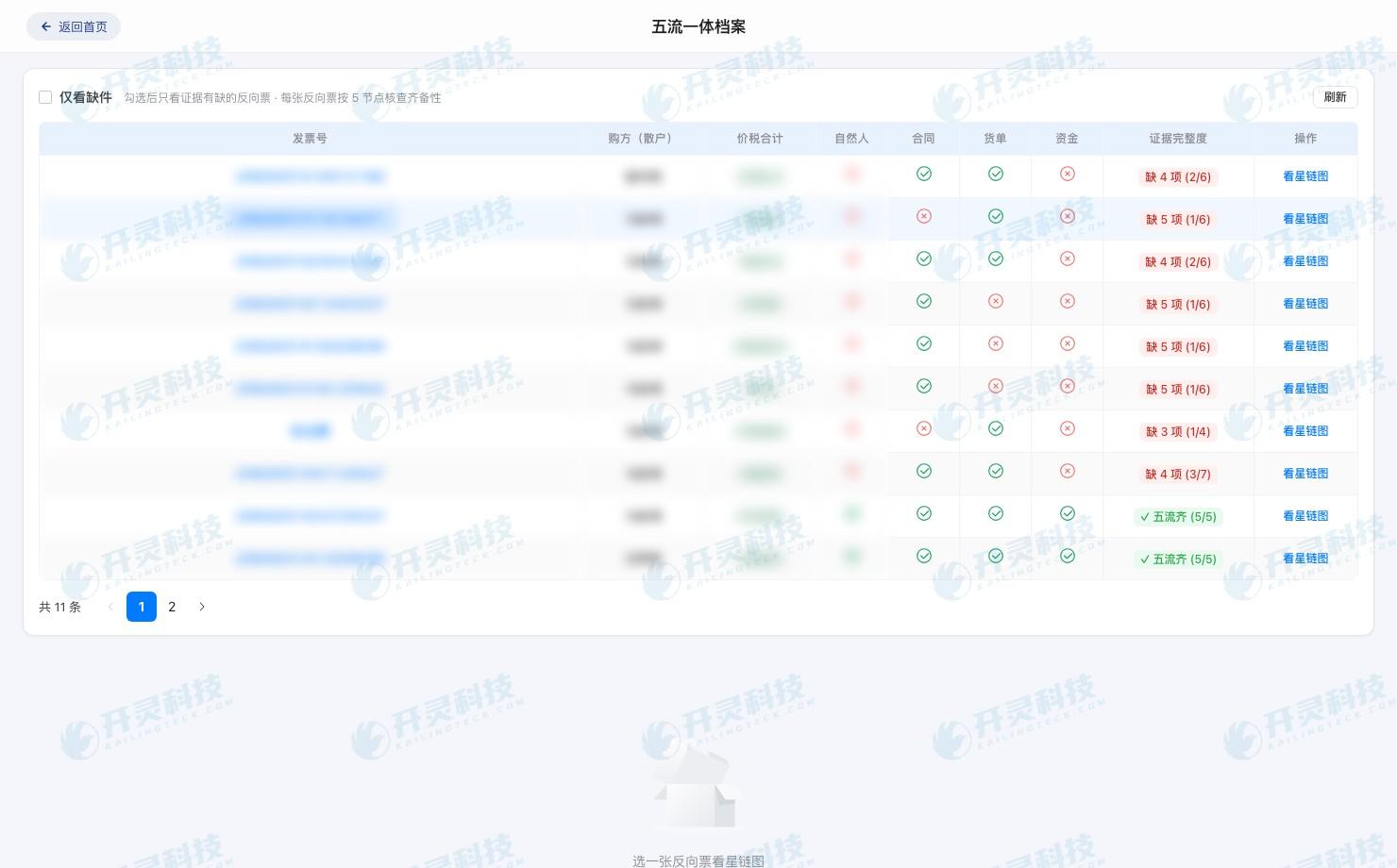
Five-flow materials and missing-item query for a single purchase (information has been desensitized)
▍FAQ
Q: Does having renewable resource recycling operator filing necessarily mean reverse invoicing is possible?
A: Filing is one of the enterprise conditions; the actual business scope, individual sellers, scrapped products and real business materials must also be checked, and the requirements of the competent tax authority shall prevail.
Q: Can scrap steel and scrap iron purchased from an individual industrial and commercial household be reverse invoiced as an individual?
A: You cannot look only at whether the operator is an individual. The system should identify the registration status, and the enterprise should handle it according to the real transaction entity and applicable policies.
Q: Can on-site photos replace weighbridge tickets?
A: They cannot simply replace each other. Photos explain the on-site situation, while weighbridge tickets and acceptance records explain quantity and grading; each plays a different evidentiary role.
Q: Can an administrator forcibly release after system interception?
A: Authorization and supplementary material requirements should be set according to the type of anomaly. Any release must have a reason, responsible person and record, and administrator permissions cannot be used to skip verification of real business.
First verify the entity and receipt conditions, then let invoice and payment materials leave a trace around the same purchase order: https://www.kailingteck.com/fxzy/ .
As a national high-tech enterprise, Kailing Technology focuses on the digital and intelligent transformation of enterprise business-finance-tax and operations management, providing software products, system integration, implementation and delivery, and operational services for various government agencies, institutions, group enterprises, and SMEs.
The company has now formed ten core product lines, including: AI digital employee system, enterprise expense control management system, customer relationship management system, reverse invoicing management system, invoice issuance for individuals management system, electronic archives management system, tax fully digitalized e-invoice Leqi system, tax invoice management system, group tax filing system, and AI OCR recognition system. It is committed to connecting enterprise business, finance, tax, funds, and archive data to help customers improve operational efficiency, business-finance-tax compliance capabilities, and digital management levels.
If you have any business-finance-tax digital transformation needs, welcome to contact us. Beijing Kailing Technology will serve you wholeheartedly.
Keywords: Conditions for reverse invoicing of scrap steel and scrap iron, resource recycling enterprises, natural person subject verification, scrap metal receipt, five-flow ledger
As a comprehensive business-finance-tax digitalization solution service provider, Kailing Technology provides business-finance-tax management digital transformation products and operational services for various government agencies, institutions, and large, medium, and small enterprises. The product line includes: solutions for sales contract management system, procurement contract management system, fully digitalized Leqi interface project, automatic output invoicing system, reverse invoicing system, invoice issuance for individuals system, employee expense control and reimbursement system, input VAT invoice management system, supply chain collaborative reconciliation system, image AI OCR recognition system, automatic financial bookkeeping system, electronic accounting archives system, etc., comprehensively driving the digitalization process across various fields.
Consultation Hotline: 18513895936 / 010-60974119 Location: Beijing