
Can resource recycling and agricultural product pay-and-invoice share the same process? Kailing Technology Leqi joint-use solution separates entities, invoice types, and rules
Resource recycling and agricultural product procurement can reuse some payment, invoicing connection, and ledger capabilities, but entity conditions, invoice types, and business rules must be verified separately. The Kailing Technology Leqi joint-use solution can set up corresponding handling paths around different real transactions. The fact that the interface shows "process invoice after payment" for both does not mean the two types of procurement have the same policy basis, and the reverse invoicing rules for resource recycling certainly cannot be directly applied to tea farmers, growers, and other agricultural product sellers.
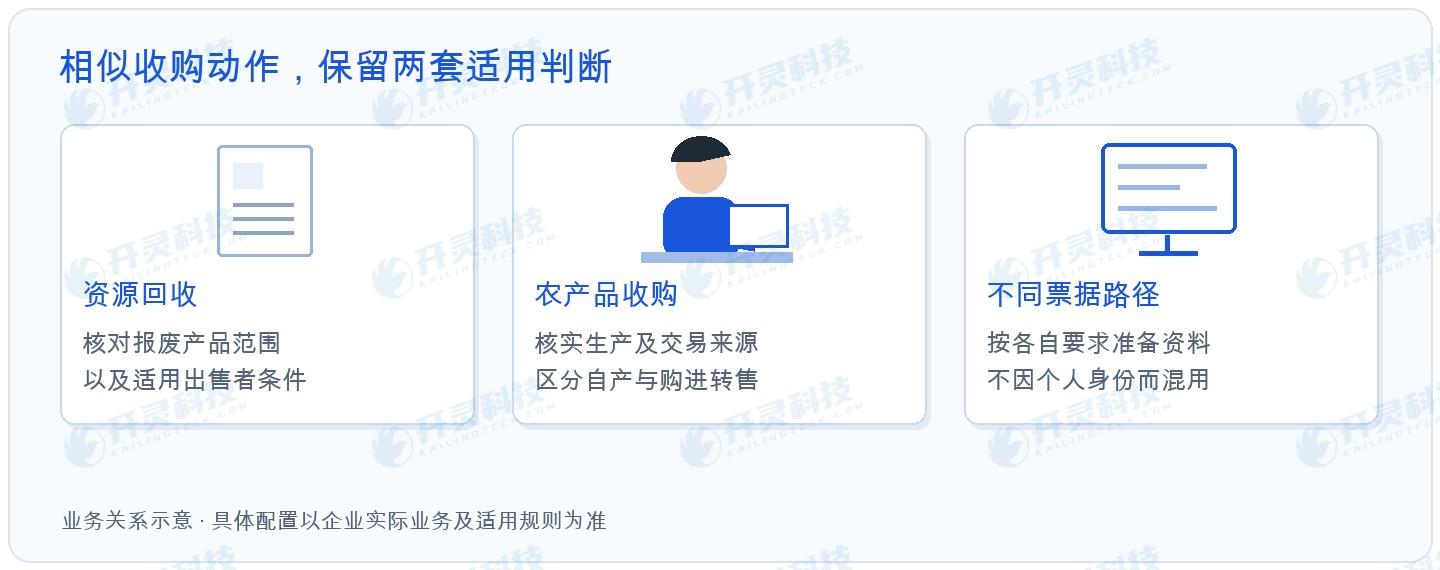
▍Similar acquisition sites may apply different invoicing logic
Both types of business may face individual sellers, and both need to record goods, quantity, settlement, and payment. Precisely because the on-site actions are similar, enterprises easily want to directly copy one set of processes during system building, changing only the product name.
However, resource recycling business focuses on the acquisition of scrap products within the applicable scope and the seller's conditions, while agricultural product acquisition requires verifying the corresponding producer and self-produced agricultural product conditions. The same ID card field cannot eliminate the difference between the two types of identity judgment; the same payment action cannot determine which type of invoice to use.
Unified development should first acknowledge these differences, then discuss technical reuse. Otherwise, although the system may have fewer configuration tables, later work may repeatedly redo material collection, invoicing applications, and tax handling. Distinguishing the rules clearly is actually more conducive to stable expansion of shared capabilities.
▍On the resource recycling path, first verify the seller and the goods scope
Reverse invoicing for resource recycling has specific policy conditions. Enterprises need to verify their own qualifications, the sellers, and the actual products acquired, and cannot include all purchases from individuals in the same arrangement. Related cumulative conditions and material requirements should also be managed within the applicable scope and must not be circumvented by splitting records.
For real transactions, the system can link receipt details, related contracts, payments, and invoices to help explain the business later. But a complete ledger cannot turn ineligible entities into applicable subjects, nor can it prove that the goods in the records necessarily exist in reality.
▍On the agricultural product path, production source is a question that cannot be omitted
An individual selling agricultural products they produced themselves and buying from elsewhere for resale are different business situations. Enterprises need to verify the real production and transaction source; they cannot assume the same acquisition invoicing method can be used just because the other party has no invoicing equipment or the goods are common agricultural products.
Identity materials, production-related information, acquisition details, and payment records should be organized around the applicable business. Which materials are sufficient to support a specific matter needs to be judged based on facts and handling requirements; collecting all form fields does not mean all authenticity verification has been completed.
In agricultural product solutions, the business expression "reverse invoicing" is sometimes used, which can easily lead people to mistakenly believe that resource recycling policy applies directly. Both external explanations and internal configuration should clarify the concept, so that staff know which type of procurement is currently being handled and under what conditions it is processed.
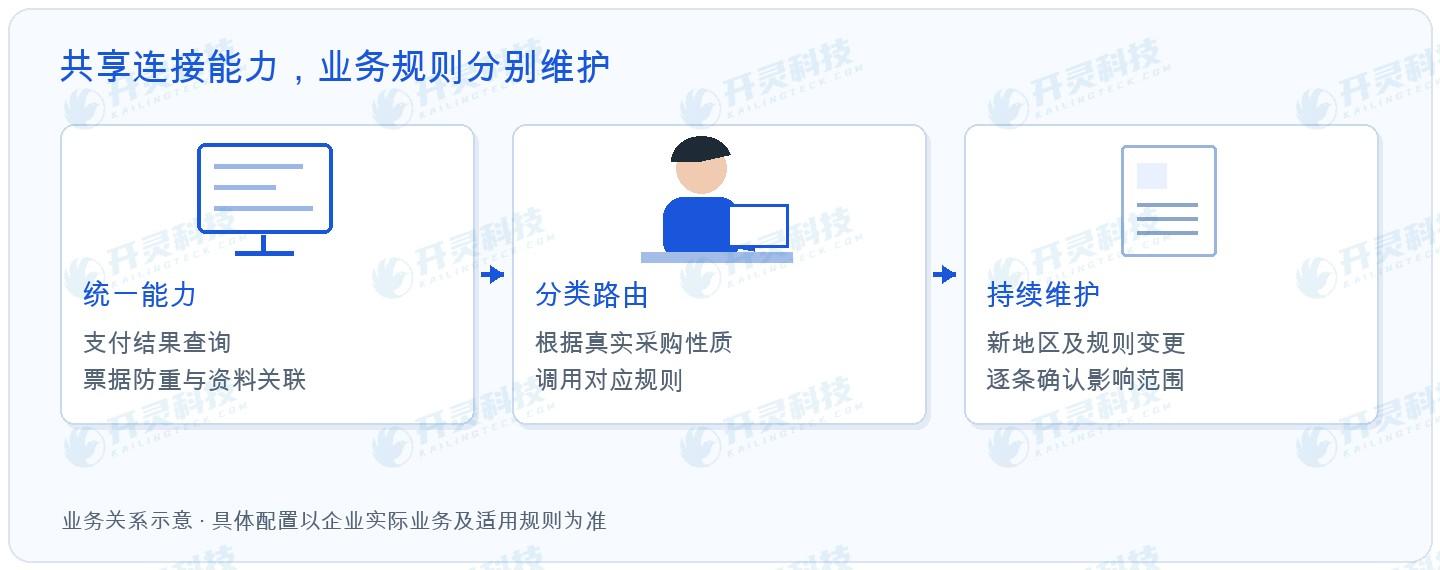
▍Kailing Technology's Leqi joint-use solution lets shared capabilities serve different rules
Capabilities such as payment result receipt, invoice status inquiry, request deduplication, and material collection can be reused under an appropriate architecture. Business rules then enter corresponding paths according to transaction type, separately confirming entity eligibility, required information, invoice type, and processing conditions, so that one general judgment does not cover all scenarios.
Kailing Technology is responsible for solution and system connection work. The actual direct connection entities, user entities, transaction participants, and their authorization relationships should be clarified in line with Leqi access specifications and project arrangements. A technical service provider does not become the transaction subject or payment institution for all business simply by participating in system construction.
For enterprises operating two types of business at the same time, the entry point can be unified, but the operation interface should clearly indicate the current business type and applicable material requirements. Staff do not need to manually memorize all underlying interfaces, but they should know which real business path they have selected, and should not click the last-used template out of habit alone.
▍Payment can become a related node, but cannot prove the transaction
A payment occurrence can provide a funding basis, but it still needs to be linked with the actual acquisition details and the seller. The enterprise should verify the payee and the transaction relationship, and explain which businesses this payment covers. A single payment success notification cannot by itself explain the source of goods, the quantity, and the applicable invoicing conditions.
If key materials change before payment, the impact on subsequent processing should be reconfirmed; when the payment status is unclear, first check the actual result to avoid paying again just to reissue an invoice. A failed invoice request does not mean the funds did not move; these statuses need to be recorded separately and linked to each other.
For transaction corrections, returns, or refunds and supplementary payments, the original relationship should be retained and handled according to the actual invoice status and applicable rules. A shared platform can provide the same query convenience, but the specific business consequences need to be judged in each scenario; you cannot assume that "clicking cancel" will restore all external results.
▍Maintain rules separately so the shared platform remains usable long term
Updates to resource recycling rules should not affect agricultural product configurations without verification; when new regions are connected or new product types are added, the corresponding paths should also be checked. Enterprises can clarify the business rule maintainer and technical configuration responsibility so that changes enter the system after appropriate confirmation.
Operational observation also needs to be scenario-specific. One type of business often lacks identity materials, while another always waits on confirmation of the source of goods; the handling directions are not the same. Looking only at overall success counts will obscure the links that truly need improvement and make it difficult for business departments to form clear actions.
The application value of Kailing Technology's Leqi joint solution is to allow enterprises to retain correct business boundaries while sharing connection capabilities. There is less repeated entry at the front end and a clearer association at the back end, so managers can explain which type of transaction each invoice and payment comes from, and unified construction will not become mixed use of rules.
For frontline staff, short scenario-based instructions can also be provided. What is being purchased, from whom, and which materials currently need to be confirmed, expressed clearly in business language, is more helpful than having staff guess the process themselves based on a policy number. After technical reuse, people's operational understanding also needs to keep up.
When adding new business, procurement, finance, and technical teams can also jointly confirm a scenario description, marking similar actions and different conditions separately. When all roles use the same explanation, subsequent configuration and staff training are less likely to result in different accounts.
▍FAQ Q&A on two types of acquisition business sharing a platform
Q: If both are individual sellers, why are two sets of rules still needed?
A: Because the nature of the goods, the seller's conditions, and the applicable invoice basis differ. Personal identity is only one piece of information; it cannot be used to infer that all handling methods are the same.
Q: If the payment interface is unified, can invoicing conditions be unified?
A: No. The payment interface transmits the funding result, but invoicing still requires verifying the real transaction and applicable conditions; the same technical channel does not change the nature of the business.
Q: Can the existing recycling system be extended to agricultural product business?
A: You can evaluate reusing the connection and management capabilities, but you should re-sort the agricultural product entity, materials, and invoice type rules; you cannot simply replace the product name and go live directly.
Shared platform, separate procurement rules. Welcome to discuss Kailing Technology's resource recycling and agricultural product Leqi joint use solution: https://www.kailingteck.com/ .
As a national high-tech enterprise, Kailing Technology focuses on the digital and intelligent transformation of enterprise business-finance-tax and operations management, providing software products, system integration, implementation and delivery, and operational services for various government agencies, institutions, group enterprises, and SMEs.
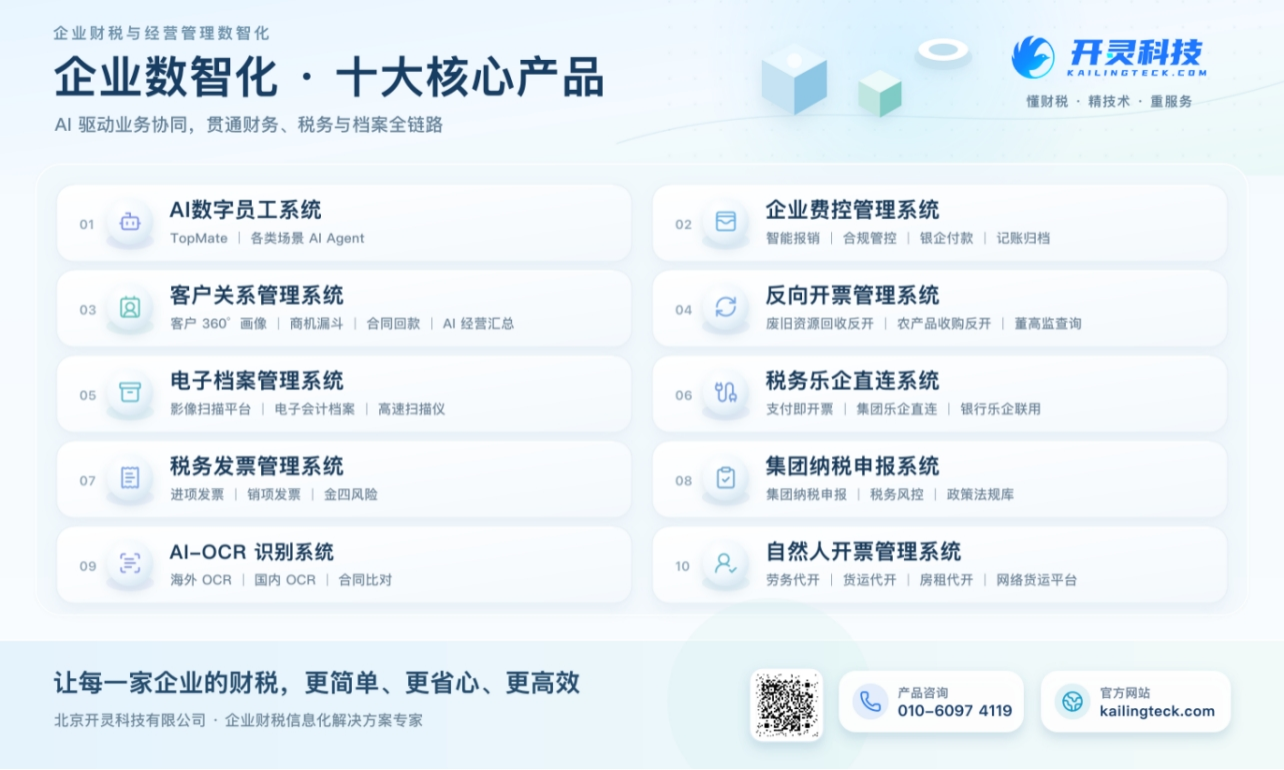
The company has now formed ten core product lines, including: AI digital employee system, enterprise expense control management system, customer relationship management system, reverse invoicing management system, invoice issuance for individuals management system, electronic archives management system, tax fully digitalized e-invoice Leqi system, tax invoice management system, group tax filing system, and AI OCR recognition system. It is committed to connecting enterprise business, finance, tax, funds, and archive data to help customers improve operational efficiency, business-finance-tax compliance capabilities, and digital management levels.
If you have any business-finance-tax digital transformation needs, welcome to contact us. Beijing Kailing Technology will serve you wholeheartedly.
 Keywords: Leqi joint use, resource recycling pay-as-you-invoice, agricultural product pay-as-you-invoice, reverse invoicing, agricultural product acquisition invoice
As a comprehensive business-finance-tax digitalization solution service provider, Kailing Technology provides business-finance-tax management digital transformation products and operational services for various government agencies, institutions, and large, medium, and small enterprises. The product line includes: solutions for sales contract management system, procurement contract management system, fully digitalized Leqi interface project, automatic output invoicing system, reverse invoicing system, invoice issuance for individuals system, employee expense control and reimbursement system, input VAT invoice management system, supply chain collaborative reconciliation system, image AI OCR recognition system, automatic financial bookkeeping system, electronic accounting archives system, etc., comprehensively driving the digitalization process across various fields.
Consultation Hotline: 18513895936 / 010-60974119 Location: Beijing