
Reverse invoicing system review process: four gates of qualification, transaction, taxes and ledger

How should the reverse invoicing system review process be set up? First clarify the policy scope, then discuss system approval.
Resource recycling enterprise "reverse invoicing" has clear invoicing party, invoice recipient and goods boundaries; it is not a general invoice-obtaining tool for all procurement expenditures. State Taxation Administration Announcement No. 5 of 2024 targets qualified resource recycling enterprises purchasing scrap products from individual scrap product sellers. Agricultural product acquisition invoices belong to another set of existing rules and cannot be mixed with resource recycling reverse invoicing under the same review criteria.
System review must prove four things: the enterprise and seller are within scope, the transaction is authentic, invoicing and tax fee handling are correct, and the acquisition ledger is complete and traceable. |
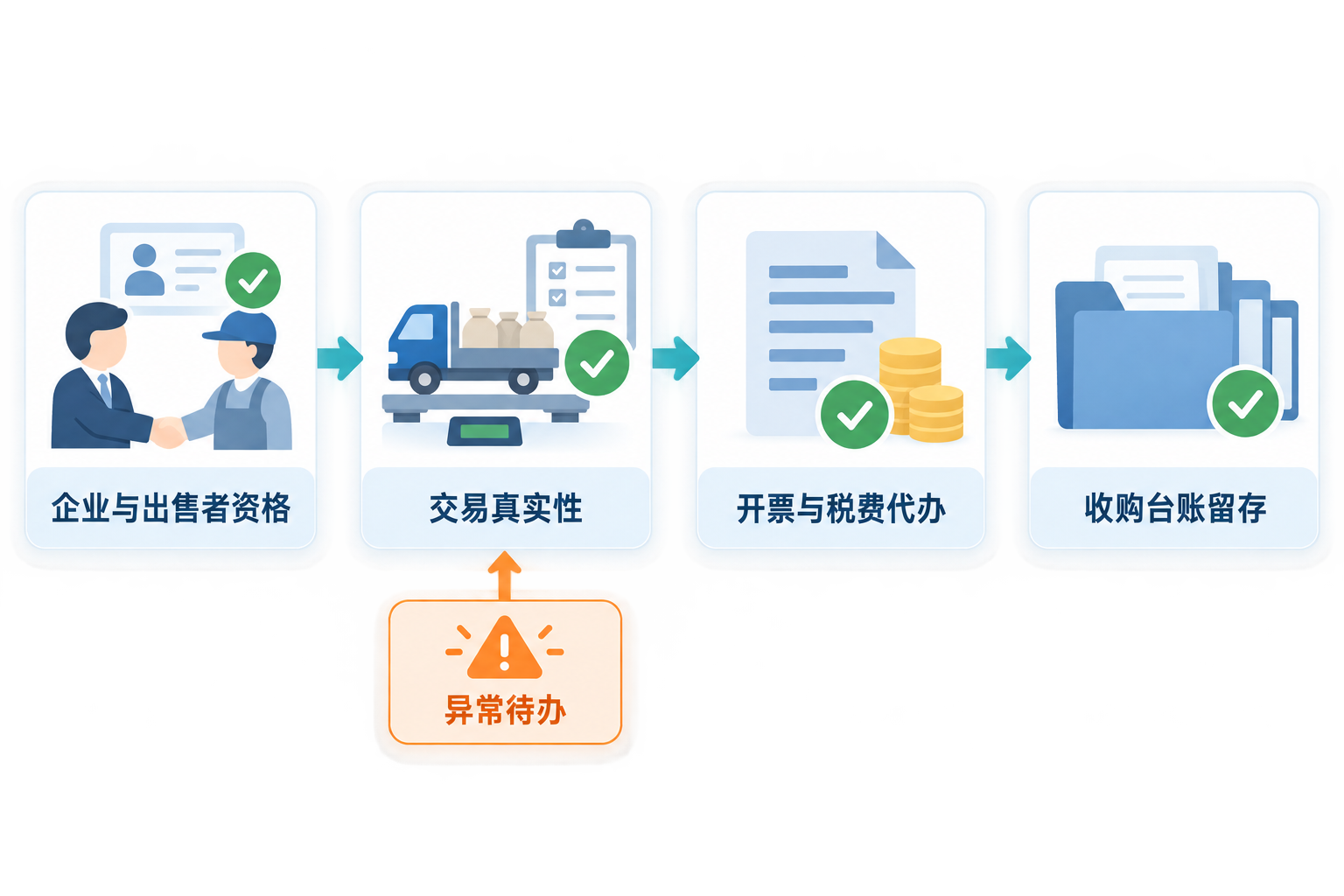
▍1. Gate one: qualifications of the enterprise and the seller
State Taxation AdministrationInterpretation of the Measures for the Implementation of Reverse Invoicingclarifies that the invoicing party should be a unit or individual industrial and commercial household that has the relevant recycling industry qualification and actually engages in resource recycling business, and shall submit application materials to the competent tax authority as required. The invoice recipient is an individual scrap product seller, including an individual who sells scrap products they have used or sells purchased scrap products; when the cumulative sales amount of reverse invoicing over 12 consecutive months exceeds the policy upper limit, the resource recycling enterprise may not continue to reverse invoice for them.
▍2. Gate two: transaction authenticity and goods boundary
Review cannot rely only on an ID card and a weighing slip. Enterprises should link the seller, scrap product category, receipt date, quantity or weight, quality acceptance, settlement basis and payment records to the same transaction, and verify whether it is indeed a scrap product that has lost all or part of its original use value. Image recognition can assist in entering candidate fields, but cannot replace on-site acceptance, identity verification and anomaly judgment.
▍3. Gate three: invoice type, code and tax fee handling
Resource recycling enterprises should reverse issue invoices online marked "scrap product acquisition" through the electronic invoice service platform or the VAT invoice management system, and select the scrap product category code as required. Whether a special invoice can be issued and whether it can be deducted should be judged in light of the VAT calculation method adopted by the enterprise and current rules. Enterprises should also handle VAT and surtax and individual income tax filing matters for sellers as required, and cannot complete only invoicing while omitting tax fee handling.
▍4. Gate four: acquisition ledger and document retention
Policy requires resource recycling enterprises to establish an acquisition ledger and be responsible for the authenticity of recycling business. The ledger should at least be able to link the seller, scrap products, acquisition quantity or weight, settlement, payment, invoices and tax filing materials. "Contract flow, goods flow, capital flow, invoice flow, tax flow" can serve as an internal cross-verification framework, but it is not a slogan replacing statutory conditions; every piece of data should return to the real business and original vouchers.
▍5. The system process must retain manual review and idempotency controls
It is recommended to set up a status chain of "business registration - qualification verification - transaction review - invoicing approval - tax fee handling - ledger archiving". Duplicate requests are intercepted using a unique business identifier, and interrupted interfaces resume from the incomplete step; when identity conflicts, abnormal amounts, unclear goods categories or cumulative sales approaching the boundary occur, they enter manual to-do. Kailing TechnologyReverse Invoicing SolutionIt can connect business materials, approval, issuance results and ledgers according to enterprise authorization and project configuration, but cannot replace the qualification confirmation of the competent tax authority or the enterprise's responsibility for transaction authenticity.
Keywords: reverse invoicing, reverse invoicing review process, resource recycling enterprise, scrap product acquisition, individual seller, tax fee handling, acquisition ledger, Kailing Technology
As a comprehensive business-finance-tax digitalization solution service provider, Kailing Technology provides business-finance-tax management digital transformation products and operational services for various government agencies, institutions, and large, medium, and small enterprises. The product line includes: solutions for sales contract management system, procurement contract management system, fully digitalized Leqi interface project, automatic output invoicing system, reverse invoicing system, invoice issuance for individuals system, employee expense control and reimbursement system, input VAT invoice management system, supply chain collaborative reconciliation system, image AI OCR recognition system, automatic financial bookkeeping system, electronic accounting archives system, etc., comprehensively driving the digitalization process across various fields.
Consultation Hotline: 18513895936 / 010-60974119 Location: Beijing