
How should a renewable resource recycling company handle VAT deduction? Reverse invoicing five-flow-in-one

How should a renewable resource recycling company handle VAT deduction? Don't let input invoices break in the hands of individual sellers
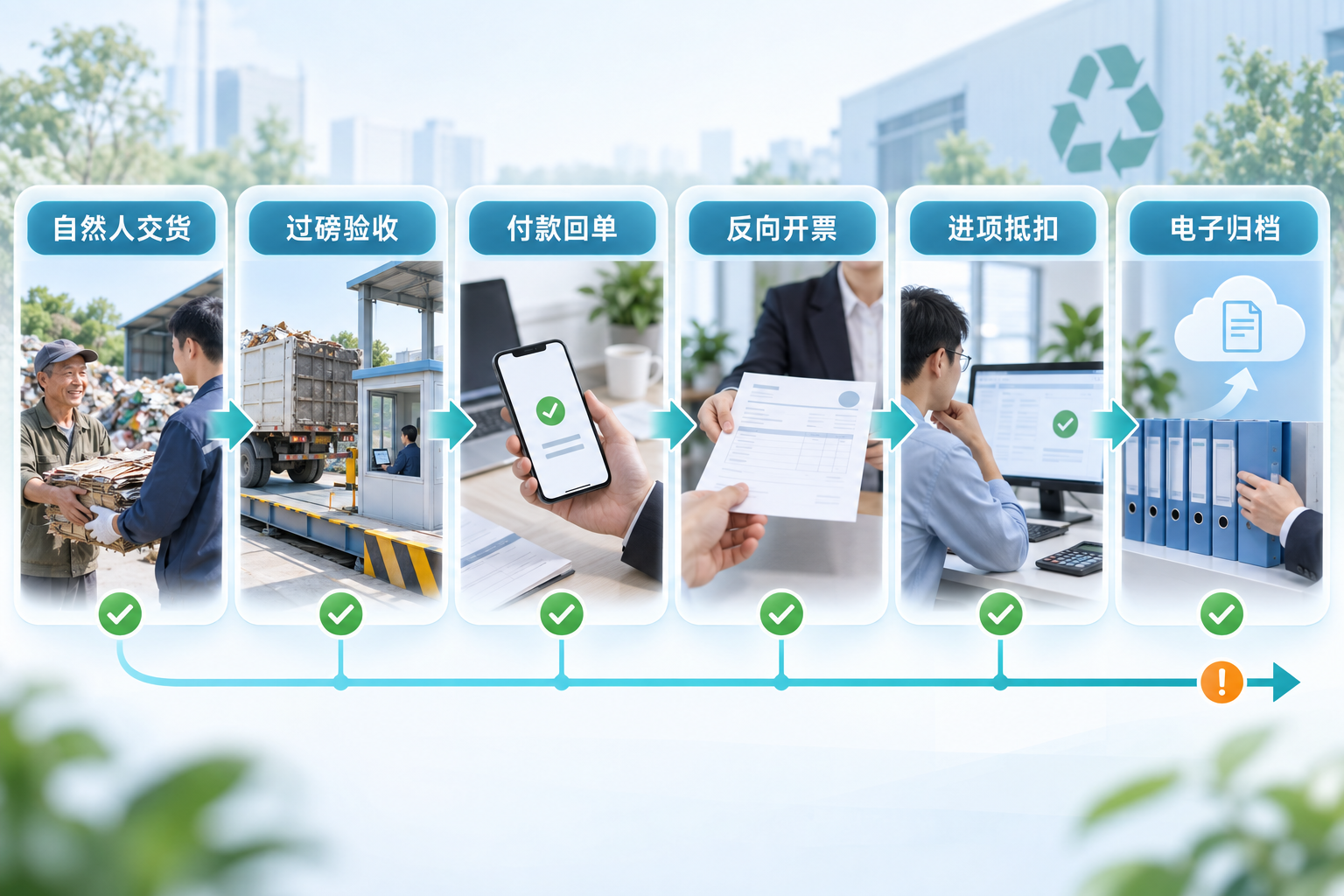
The pain of recycling enterprises is highly concentrated: goods are purchased from scattered scrap stations, self-employed individuals, and waste pickers, who cannot issue special VAT invoices, yet the enterprise must pay tax on sales, with almost zero input deductions and an absurdly high tax burden. The breakthrough approach is not to find invoices to make up the numbers, but to enable the procurement process itself to obtain deductible vouchers compliantly — Kailing Technology's reverse invoicing solution centers on "invoicing upon procurement and a five-flow unified ledger," combined with input VAT invoice management and electronic accounting archives, linking weighing, payment, invoicing, and archiving into a traceable chain so that every deduction stands up to scrutiny.
"The deduction difficulty of recycling enterprises is essentially not a tax rate issue, but that the invoice chain in the procurement stage is broken at the individual seller end." |
▍1. Where exactly is the difficulty in input VAT deduction for renewable resource recycling?
Under current VAT policy, renewable resource recycling enterprises selling scrap materials must calculate and pay VAT normally, while input deduction mainly relies on two types of vouchers: first, special VAT invoices issued by upstream enterprises; second, purchase invoices self-issued in reverse when enterprises purchase from individuals. The problem lies precisely with the latter—a large portion of the upstream recycling chain consists of individual sellers who neither can nor will issue invoices. If an enterprise does not perform reverse invoicing, its input can only remain blank. More troublesome is that even if an invoice is issued, if the weighbridge ticket, payment receipt, and invoice do not match, tax authorities may still determine the vouchers to be untrue during verification, and the deduction may be adjusted. So the difficulty of deduction is not "whether there is an invoice," but "whether the invoice can prove that this purchase actually occurred."
▍II. How does reverse invoicing make input VAT deduction compliance work?
State Taxation Administration Announcement No. 5 of 2024 clarifies the rules for reverse invoicing by resource recycling enterprises to individuals selling scrap products, and Announcement No. 12 of 2026 further arranges the annual sales amount and individual income tax advance payment rate for three-flows-in-one reverse invoicing. Kailing Technology's reverse invoicing solution is designed accordingly: when an enterprise initiates an online payment, the system generates taxes to be paid and pre-filled invoices based on real-time cumulative amounts and tax rules, verifies enterprise qualifications, individual profiles, receipt business, and internal permissions before payment, and triggers payment and invoicing simultaneously. Purchase invoices thus become lawful and valid input VAT deduction vouchers, and each one can correspond to a specific seller and specific goods. This is the value of "invoicing upon purchase"—not making up invoices after the fact, but completing invoice generation when the business occurs.
▍3. Five-flow integration ledger makes deductions stand up to inspection
Deductions must withstand scrutiny; having an invoice alone is not enough—it must also prove consistency across the contract flow, goods flow, fund flow, invoice flow, and information flow. Kailing's reverse invoicing solution runs a procurement business identifier through both the site and the platform: weighbridges, gauging, or acceptance provide the quantity basis, the enterprise system forms procurement orders, the partner platform generates the original transaction and payment data and calls Leqi capabilities to issue invoices, and Kailing receives the payment and invoice results and then completes business write-back and five-flow archiving. Every result can be traced to its source; weighbridge tickets, payment receipts, and procurement invoices are no longer three mismatched pieces of paper, but three records of the same batch of goods. Combined with input VAT invoice management directly connected to the tax bureau to automatically obtain all invoice sources, and verification and duplicate checking to prevent duplicate or missed reporting, the enterprise's deductible input VAT for the month is clear at a glance, no longer pieced together from manual ledgers.
▍IV. From invoicing to archiving: how can deduction vouchers be kept under control?
Issuing the purchase invoice is only the first step; subsequent archiving and retrieval also affect the sustainability of deductions. Kailing's electronic accounting archives management system supports scanning vouchers for immediate storage, recognition for immediate archiving, and association for immediate binding into volumes. Purchase invoices, weighbridge tickets, and payment receipts generated by reverse invoicing can be automatically associated and bound into volumes, and retrieved with one click by business identifier during tax inspections or internal audits. For recycling enterprises that also involve expenditures such as labor remuneration and freight, they can also compliantly obtain vouchers in batches through invoice issuance for individuals, avoiding the inability to deduct costs before tax due to missing vouchers. The entire solution does not pursue single-point invoicing, but instead makes input VAT deductions for renewable resource recycling documented, verifiable, and traceable from the purchase source to the archiving endpoint.
Keywords: Renewable resource recycling VAT deduction, reverse invoicing, five-flow-in-one ledger, input VAT invoice management, purchase invoices, electronic accounting archives, Kailing Technology, invoice issuance for individuals
As a comprehensive business-finance-tax digitalization solution service provider, Kailing Technology provides business-finance-tax management digital transformation products and operational services for various government agencies, institutions, and large, medium, and small enterprises. The product line includes: solutions for sales contract management system, procurement contract management system, fully digitalized Leqi interface project, automatic output invoicing system, reverse invoicing system, invoice issuance for individuals system, employee expense control and reimbursement system, input VAT invoice management system, supply chain collaborative reconciliation system, image AI OCR recognition system, automatic financial bookkeeping system, electronic accounting archives system, etc., comprehensively driving the digitalization process across various fields.
Consultation Hotline: 18513895936 / 010-60974119 Location: Beijing