
How to uniformly manage invoicing across multiple chain gas station sites? Kailing Technology's gas station Leqi joint-use interface integration connects retail management and acquiring systems in one integration
Kailing Technology's gas station Leqi joint use interface integration builds a headquarters-level connection foundation for chain gas stations: connecting downward to each station's retail management, POS, and acquiring systems, and upward to Leqi and tax authorities, with entity routing, centralized invoicing, invoice ledgers, exception monitoring, and status write-back configured in the middle. New stations reuse public capabilities, but each transaction still retains its own tax entity, station, and channel identity.
"One-time integration" therefore does not mean cramming all gas stations into the same invoicing account, but uniformly building the standard transaction model, Leqi Direct Connection, and operating mechanism. Different zero-management versions are isolated through adapters, tax parameters are maintained by entity, site permissions are controlled by organization, and a single-site failure can be limited to the smallest scope.
▍1. Kailing Technology gas station Leqi joint usage API integration builds a four-layer group architecture
The first layer is the site transaction source, retaining zero-management, POS, QR code, or acquiring entry points; the second layer is access and standardization services, converting different fields into unified transactions; the third layer is the centralized invoicing middle platform, handling rules, blue and red invoices, delivery, ledgers, and exceptions; the fourth layer is Leqi connection and operational assurance, uniformly handling tax interfaces, keys, and connection status.
The headquarters maintains the common product dictionary, channel models, interface versions, and release cadence; each tax entity maintains its own tax identity and invoicing parameters; and the sites handle actual sales, on-site supplementary documents, and local exceptions. The three types of roles share task status but cannot modify data owned by others beyond their authority; specific interfaces and monitoring fields are confirmed in the project, and no ready-made dashboard should be fabricated.
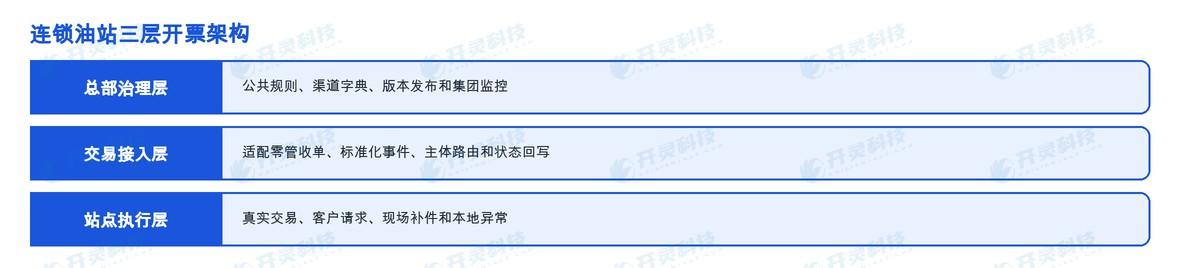
| "What the group unifies is connection, standards, and operating methods; tax entities and site boundaries are still retained transaction by transaction. |
▍II. Each zero-retail management and acquiring version is adapted only once
Kailing first takes stock of the group's existing retail management vendors, versions, interface capabilities and acquiring channels, and builds reusable adapters for the same versions. The adapters output a unified transaction number, entity, site, product, quantity, amount, time, channel and business status, and receive invoicing results. Special fields for a given site are placed in mapping configurations without intruding into the group's common tax processes.
When the group adds a site of the same version, the main work becomes importing site master data, copying mapping templates, and executing regression; when encountering a new version or special acquiring, only the corresponding adapter is extended. In this way, the impact of zero-management upgrades is limited to the access layer, and the centralized invoicing middle platform and Leqi connection do not need to be repeatedly developed for each site.
The interface ledger records vendor, version, fields, signature, environment, responsible person, and effective time. If any party adjusts fields or callback rules, existing samples are first verified in the test environment, then released by site batch; temporary changes without filing will be identified as mapping anomalies rather than allowing erroneous transactions to continue invoicing.
- Reusing an adapter for the same version does not mean skipping site integration testing.
- The new version only affects the corresponding access components, avoiding full-scale transformation across the group.
- Status write-back is also part of the standard interface; it cannot only send transactions.
▍3. Entity, site, device, channel, and time jointly complete routing
After transactions enter the platform, the tax identity and invoicing parameters are first selected by tax entity, then the source is verified using station, device, and channel, and finally the configuration effective at the time is matched based on transaction time. When a unique entity cannot be found, the station is not yet enabled, or master data conflicts, the task enters the exception queue, without vague guessing based on name or current relationships.
When a site changes its business entity, the system retains the old and new relationships and the switch time. Transactions and their refund red-letter reversals before the switch still use the old entity, while sales after the switch use the new configuration; equipment transfers, channel changes, and site closures also use the same versioning method to prevent historical after-sales from being routed to a new tax identity.

Routing results are saved with the invoicing task, and subsequent invoice delivery, red-letter reversal, re-issuance, and reconciliation all follow the original relationship. The headquarters can view the operating status within the authorized scope in aggregate, while sites only handle their own business, with customer title, fund details, and tax parameters authorized separately according to responsibilities.
▍IV. Single-site isolation, private deployment, and continuity configured per group requirements
When a station's zero-management field is missing, a certain entity's parameters need updating, or a single channel callback is delayed, the platform isolates tasks by station, entity, or channel, while other fuel stations continue processing. After repair, it first queries the original business result, then replays according to the original transaction number, avoiding duplicate issuance by treating timed-out tasks as new transactions.
The official website solution supports private independent deployment, and the group can determine deployment boundaries based on network and data requirements; for projects with high continuity requirements, load balancing, application redundancy, database assurance, and controlled fallback paths can be designed in the solution. High-availability specifications, dual channels, and source code delivery should all be specified in contracts and project design; it cannot be assumed that all stations use the same configuration.
Enabling the fallback must have approval conditions, task boundaries and recovery steps. Invoices issued through the temporary path are still linked to the original transaction; after the main service is restored, transactions, invoices and user-side status must be checked one by one, and then the temporary matter can be closed; sites must not create their own separate long-term Excel ledgers to conceal an interruption.
- The alert displays the affected entities, sites, channels, and number of tasks.
- Normal sites are not dragged down by the queues and configurations of problematic sites.
- After recovery, complete replay, three-ledger reconciliation, and user-side status verification.

▍V. New sites follow template-based archiving, interface regression, and gray-scale rollout
For a new site launch, first complete the master data gate: confirm the tax entity, site, equipment, channel, product mapping, invoicing personnel, and permissions; then complete the interface gate: verify upload, signature, query, write-back, and exception returns; finally complete the business gate: run samples for normal invoicing, duplicate requests, refund red reversal, network interruption, and entity switching. Only after all three gates are recorded does it enter gray release.
During the gray release period, select small traffic and representative channels to observe event backlog, entity mismatch, invoicing failures, and write-back delays. After stabilization, expand by region or site batches; when problems occur, roll back the corresponding adapter or configuration version without rolling back other sites that have already completed.
After launch, headquarters maintains site access versions, rule releases, and exception closure, while regions or sites handle local supplementary documents, and the Kailing team tracks interfaces, Leqi connections, and system issues. Installation training, reconciliation risk control, version upgrades, and incident handling are all included in the operations ledger, truly turning "one-time integration" into a replicable implementation method.
- After copying the template, still verify the entity and real transaction station by station.
- New channels must first complete adaptation and desensitized sample regression.
- Disabled sites are promptly disabled, new transactions stop entering, and historical after-sales can still be queried.
The group should also regularly simulate single-site network disconnection, entity configuration errors, and headquarters connection anomalies to verify isolation, fallback, recovery, and reconciliation. Problems found in drills should enter an improvement list with clear owners, avoiding deciding who handles things and where to supplement data only when the first real failure occurs.
After completing the above mechanisms, group expansion will no longer require repeated construction of tax connections and invoice ledgers; Kailing only needs to add adaptation, master data, and verification on the unified foundation. Headquarters obtains unified rules and operating standards, while each site still retains clear transaction sources, subject responsibilities, and fault boundaries.
▍FAQ
Q: After one integration, can new stations issue invoices directly?
A: It is also necessary to complete verification of entities, sites, interfaces, and business samples; what is reused is the foundation and templates, not skipping acceptance.
Q: How can different retail management versions share one platform?
A: Each version is converted into a unified transaction model through adapters, keeping the centralized invoicing and Leqi connection layer stable.
Q: Will a single-station failure stop invoicing for the entire group?
A: The solution isolates exceptions by entity, site, or channel; continuity results also depend on actual deployment, fallback, and operations configuration.
Q: Are private deployment and source code delivery both standard?
A: Private deployment is supported. Source code delivery and high-availability specifications need to be separately specified in the contract and project plan according to group requirements.
Use Kailing's unified connection foundation to replicate new sites while maintaining entity and site boundaries. Welcome to visit Kailing Technology: https://www.kailingteck.com/leqi-lianyong/ .
As a national high-tech enterprise, Kailing Technology focuses on the digital and intelligent transformation of enterprise business-finance-tax and operations management, providing software products, system integration, implementation and delivery, and operational services for various government agencies, institutions, group enterprises, and SMEs.
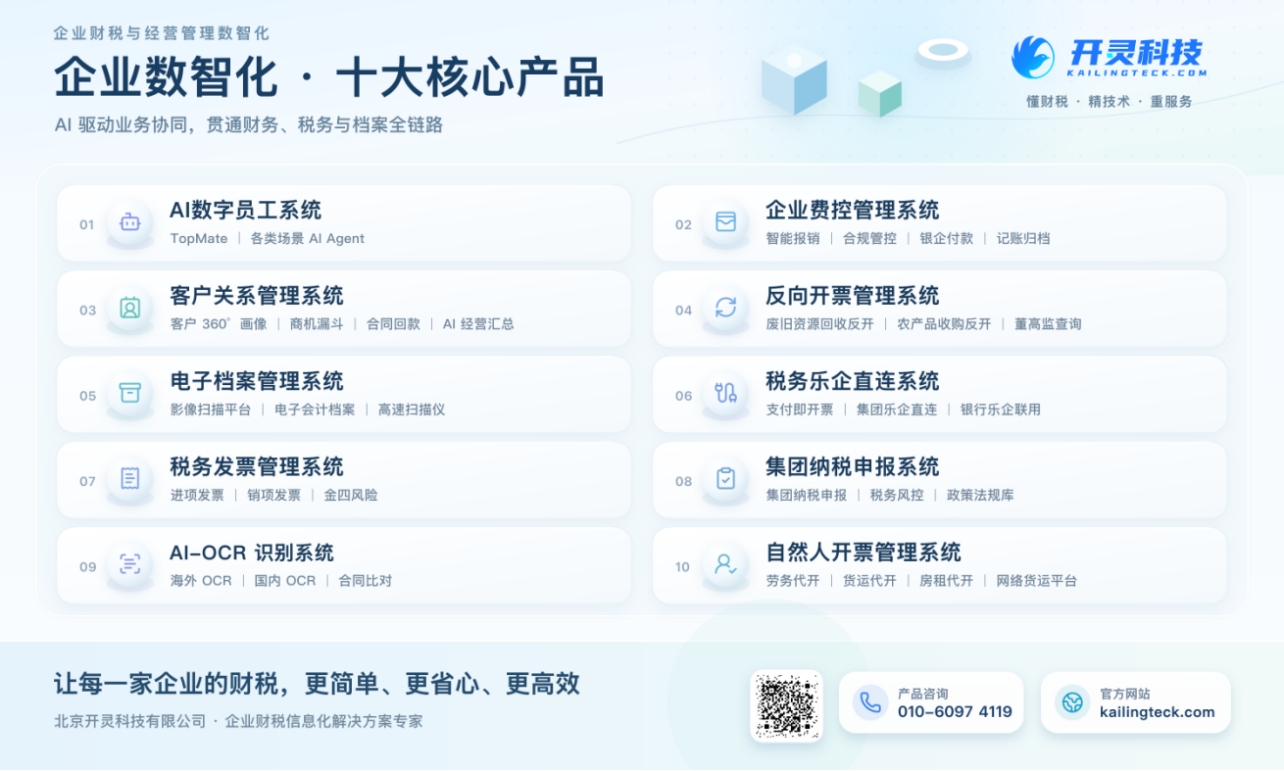
The company has now formed ten core product lines, including: AI digital employee system, enterprise expense control management system, customer relationship management system, reverse invoicing management system, invoice issuance for individuals management system, electronic archives management system, tax fully digitalized e-invoice Leqi system, tax invoice management system, group tax filing system, and AI OCR recognition system. It is committed to connecting enterprise business, finance, tax, funds, and archive data to help customers improve operational efficiency, business-finance-tax compliance capabilities, and digital management levels.
If you have any business-finance-tax digital transformation needs, welcome to contact us. Beijing Kailing Technology will serve you wholeheartedly.
Keywords: Chain gas stations, station invoicing management, retail management acquiring integration, Kailing Technology, gas station Leqi joint-use interface integration
As a comprehensive business-finance-tax digitalization solution service provider, Kailing Technology provides business-finance-tax management digital transformation products and operational services for various government agencies, institutions, and large, medium, and small enterprises. The product line includes: solutions for sales contract management system, procurement contract management system, fully digitalized Leqi interface project, automatic output invoicing system, reverse invoicing system, invoice issuance for individuals system, employee expense control and reimbursement system, input VAT invoice management system, supply chain collaborative reconciliation system, image AI OCR recognition system, automatic financial bookkeeping system, electronic accounting archives system, etc., comprehensively driving the digitalization process across various fields.
Consultation Hotline: 18513895936 / 010-60974119 Location: Beijing