
Why does gas station invoicing always get stuck on red-letter reversal and reconciliation? Kailing Technology's gas station Leqi Direct Connection interface integration closes the full transaction loop

Kailing Technology's gas station Leqi joint use interface integration builds red-letter reversal and reconciliation directly into the invoicing middle platform, rather than waiting until month-end for finance to piece together tables. Each after-sales case enters from the original transaction, and the platform simultaneously retains the original invoice, red-letter reversal application, red invoice, reissued invoice, and payment refund status, allowing customer service, finance, and IT to collaborate around the same business number.
The Kailing solution consists of invoice relationship services, a three-ledger reconciliation center, an exception task center, and a status write-back API. It can reduce manual searching and repetitive operations, but it does not claim that tax validation will necessarily pass automatically; whether a red-letter reversal is accepted and when it is completed still depend on the original invoice status, business conditions, and Leqi Direct Connection responses.
▍1. Kailing Technology gas station Leqi joint usage API integration first completes the after-sales entry
When a customer changes the title, requests a full refund, partial refund, or re-invoicing, the site no longer creates a new ticketing record unrelated to the original transaction, but instead enters the original transaction number or initiates from the original order. The invoicing middle platform reads the current transaction, original invoice, and channel fund status, and determines whether to supplement materials, initiate a red-letter reversal, wait for a refund, or transfer to manual review.
The after-sales entry point can be embedded in the zero-management, customer service page, or user end, but the backend generates only one task number. When the same customer, customer service, and finance submit at the same time, the system identifies an existing in-progress matter and returns its progress; statuses already red-reversed or under tax processing will not be overwritten by later ordinary invoicing requests.
- Transaction changes are confirmed by the fuel retail management or business system, not inferred from invoice status.
- Invoice changes are recorded by the invoicing middle platform, capturing the relationship between original invoices, red-letter invoices, and new invoices.
- Fund changes are provided by the channel with payment and refund results, and the three chains are reconciled through the business number.
▍II. The red-letter reversal center orchestrates the complete process based on the original invoice relationship
The red-letter reversal task brings in the original transaction number, original invoice identifier, application reason, refund or adjustment scope, applicant, and authorization records. The middle platform first checks whether the original invoice exists, whether there are already concurrent tasks, and whether the amount relationship holds, then organizes Leqi Direct Connection interface calls according to the corresponding invoice type and current rules. Interface returns and request message summaries are both recorded.
After a successful red-letter reversal, the original invoice status, red-letter invoice, and necessary new invoice form a continuous relationship, and the latest result is sent back to the zero-management system and user entry point; when tax authorities reject it or conditions are insufficient, the task stops at a clear pending node and does not silently return to "not invoiced." Differences in invoice types, call order, format, and source file management are handled uniformly by centralized services.

| "The Kailing red-reversal center preserves an explainable invoice version chain, rather than deleting old invoices from the system. |
▍III. The reconciliation center matches transaction, fund, and invoice ledgers daily
The transaction ledger provides goods, quantity, amount, station, entity, and cancellation status from the fuel retail management; the fund ledger receives payment and refund results from WeChat, Alipay, UnionPay, fuel cards, or banks; the invoice ledger saves invoicing, red-flushing, re-issuance, delivery, and download statuses. Kailing reconciles using unified transaction numbers, channel reference numbers, and invoice relationships, without requiring the three sources to become one table.
The system identifies problems by status combinations: the transaction has been refunded but the invoice is still valid, the red-letter reversal succeeded but the user end has not updated, the funds have been refunded but the zero-management system has not canceled, the invoice amount does not match the valid transaction, the tax task exceeds the observation window, etc. Credit sales or corporate settlement may temporarily have no fund result, and should be judged according to the configured settlement time point rather than uniformly reporting an error.

Reconciliation frequency and observation windows are configured in the project. High-frequency scan-code transactions can be checked daily or at shorter intervals, while long-payment-term corporate business waits for the actual settlement node. The system retains the first occurrence of a discrepancy, the latest change, and the current responsible party, so month-end no longer starts comparison from scratch.
▍IV. The exception center separates business, channel, tax, and documentation issues
Zero management refunds not synchronized are assigned to the business interface, channel refund delays are assigned to the fund connection, product or entity mapping errors are assigned to master data, tax red-letter reversal failures are handed to business-finance-tax review, and invoice header information pending supplementation is sent to customer service. Kailing configures an owner, handling action, observation time limit, and closing condition for each type of task, without using a single "reconciliation mismatch" column to cover all causes.
Handlers can query the original request and response, supplement evidence, or initiate authorization actions, but cannot directly overwrite historical status. When manually rebinding a transaction, record the original relationship, reason for modification, and approver; for technical timeouts, check the original task first and then retry idempotently; when one detail in a batch task fails, isolate it separately while other transactions continue processing.
Before an anomaly is closed, another role with a different responsibility confirms that the transaction, funds, and invoice relationships are consistent, and checks whether the user-side status is synchronized. For important matters, approvals, attachments, and operation logs are retained; sites only view details of their own entity, while headquarters views the distribution of anomalies within the authorized scope, so that centralized management does not amplify access rights to customer data.
- Accepted, under tax processing, pending supplementary materials, failed, and completed are displayed separately.
- After processing is completed, write back to the original entry point so customer service does not need to ask finance about each transaction.
- When similar exceptions occur repeatedly, return to the source system or rule layer for rectification.
▍V. Acceptance uses seven after-sales sample groups to prove the closed loop truly runs
The Kailing implementation team will prepare samples with the gas station for normal invoicing, incorrect invoice title, full refund, partial refund, channel delay, tax rejection and duplicate requests. Each group starts from the original transaction and checks the retail management system, channel, invoicing middle platform, user entry point and reconciliation results node by node, confirming that task numbers, amounts, original invoice relationships and status sequences are consistent.
Before upgrading rules, replay these boundary samples in the test environment. Old tasks retain the rule version and tax returns at the time; new tasks use the new configuration. If the red-ink reversal interface, invoice type, or fields change, first verify queries, failure fallback, and status write-back, then gradually release to production.
Operations reports focus on the number of unclosed items, exception reasons, stuck nodes, and duplicate submissions, rather than only invoicing amounts. Concentrated header errors indicate that the user entry point needs stronger validation; out-of-sync refunds indicate a break in transaction events; concentrated tax failures mean checking mappings, rules, and connection versions. Data should ultimately drive corrections at the source.
Each monthly closing or special review can also export a task index, showing request time, tax authority response, document files, fund status, and manual handling records by original transaction. The index is only open to authorized positions, facilitating spot checks while avoiding the creation of a separate off-system after-sales ledger just to prove the process.
- After-sales requests must be traceable from the original transaction to the original invoice and subsequent invoices.
- Differences must have responsibility, evidence, review, and closure time.
- After recovery or replay, the three-ledger and user-side reconciliation must be completed again.
When the red-letter reversal center, reconciliation center, and exception center are integrated into one, finance no longer needs to move refunds, red-letter invoices, and channel transaction flows into multiple spreadsheets, and customer service can also provide verifiable progress. The so-called full transaction closed loop ultimately means that every status has a source, every exception has someone handling it, and every correction can return to the original business.
▍FAQ
Q: Will the system automatically issue a red-letter reversal after a refund?
A: The system will associate the original transaction and original invoice and initiate or form a to-do according to configuration, but whether it is accepted still depends on business conditions, authorization, and tax verification.
Q: If the tax authority returns a failure, will a normal invoicing task be regenerated?
A: It won't silently reset. The original request, failure reason, and current status are retained, handled by the responsible position, and then continued according to the original relationship.
Q: Is a short-term inconsistency among three accounts necessarily abnormal?
A: Not necessarily. The system configures observation windows by channel and business, distinguishing normal timing differences from true stagnation.
Q: After manually rebinding a transaction, can it still be traced?
A: Yes. The relationship before and after rebinding, reasons, evidence, and approval records should all be retained and reviewed before the discrepancy is closed.
Bring red-letter reversal, refunds, reissuance, and three-account reconciliation into the same Kailing transaction closed loop. Welcome to visit Kailing Technology: https://www.kailingteck.com/leqi-lianyong/ .
As a national high-tech enterprise, Kailing Technology focuses on the digital and intelligent transformation of enterprise business-finance-tax and operations management, providing software products, system integration, implementation and delivery, and operational services for various government agencies, institutions, group enterprises, and SMEs.
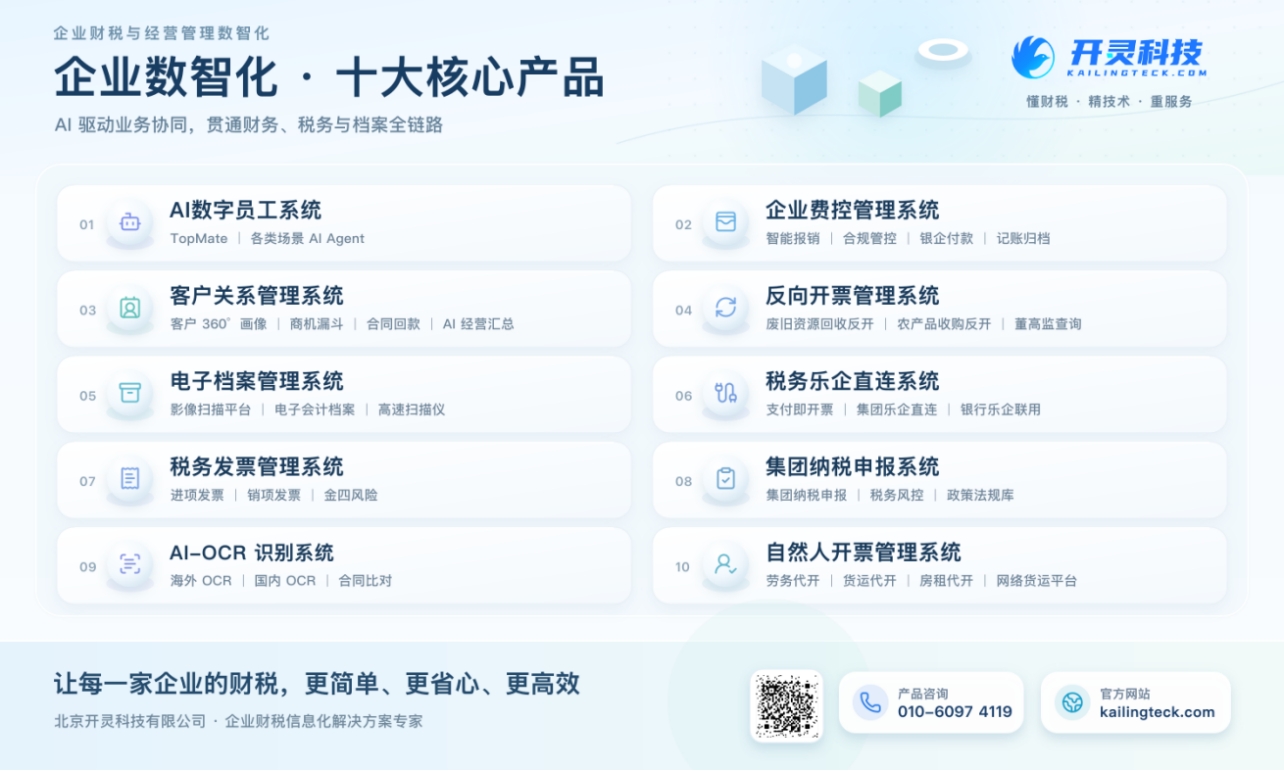
The company has now formed ten core product lines, including: AI digital employee system, enterprise expense control management system, customer relationship management system, reverse invoicing management system, invoice issuance for individuals management system, electronic archives management system, tax fully digitalized e-invoice Leqi system, tax invoice management system, group tax filing system, and AI OCR recognition system. It is committed to connecting enterprise business, finance, tax, funds, and archive data to help customers improve operational efficiency, business-finance-tax compliance capabilities, and digital management levels.
If you have any business-finance-tax digital transformation needs, welcome to contact us. Beijing Kailing Technology will serve you wholeheartedly.
Keywords: gas station red-letter reversal, invoice reconciliation, Leqi Direct Connection, Kailing Technology, gas station Leqi Direct Connection interface integration
As a comprehensive business-finance-tax digitalization solution service provider, Kailing Technology provides business-finance-tax management digital transformation products and operational services for various government agencies, institutions, and large, medium, and small enterprises. The product line includes: solutions for sales contract management system, procurement contract management system, fully digitalized Leqi interface project, automatic output invoicing system, reverse invoicing system, invoice issuance for individuals system, employee expense control and reimbursement system, input VAT invoice management system, supply chain collaborative reconciliation system, image AI OCR recognition system, automatic financial bookkeeping system, electronic accounting archives system, etc., comprehensively driving the digitalization process across various fields.
Consultation Hotline: 18513895936 / 010-60974119 Location: Beijing