
How to unify invoicing across six types of transaction channels? Kailing Technology's gas station Leqi Joint Use interface integration connects WeChat, fuel cards, cash, and corporate transactions
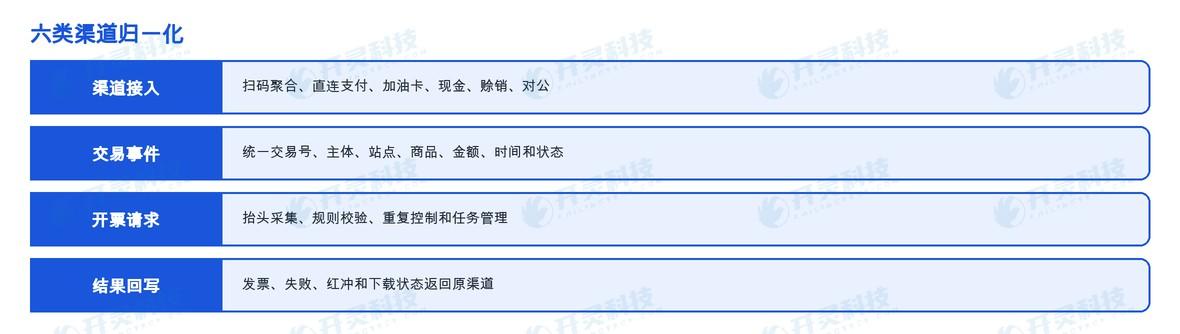
Kailing Technology's gas station Leqi joint use interface integration does not build a separate invoicing system for WeChat, fuel cards, cash, and corporate transactions, but configures channel adapters at the front end and builds a standard transaction center and centralized invoicing middle platform in the middle. Scan-code aggregation, WeChat or Alipay direct connection, fuel cards, cash, credit sales, and corporate settlement all first return to the real sale, then enter the same Leqi link.
During specific implementation, the channel layer retains signatures, callbacks, payment orders, and settlement methods; the transaction center unifies entity, site, product, quantity, amount, and business status; the invoicing middle platform handles title, verification, blue and red invoices, delivery, and write-back. In this way, channel differences are not erased, nor does each channel independently determine whether invoicing is possible.
▍1. Kailing Technology gas station Leqi joint usage API integration first builds six types of channel adapters
WeChat, Alipay, UnionPay, and aggregated payment have different order numbers, signatures, and callback formats. Kailing verifies them separately in the adaptation layer, then converts them into unified channel records; the fuel card adapter distinguishes recharge, consumption, card return, and refund; cash and credit sales obtain confirmed sales from the zero-management system; corporate transactions are linked to customers, settlement lists, and actual transaction details.
The adapter is only responsible for interpreting the source and does not issue invoices directly. Each record must carry the original channel reference number, source time, and status version, and be linked to the global transaction number of Lingguan. When a callback is repeated, the existing result is returned; a late-arriving old status does not overwrite a new status; and when one channel is suspended, it does not block other entry points.
- Official joint-use capabilities cover WeChat, Alipay, and UnionPay, with aggregated channels adapted according to interface conditions.
- For fuel cards, the business approach must first be determined: invoicing at top-up or invoicing at consumption.
- Cash, credit sales, and corporate accounts have no online payment callback, yet are still driven by real transactions.
▍II. The trading center restores channel transaction flows into a single business
The standard transaction center organizes tax entities, sites, oil products or services, quantity, tax-inclusive amount, transaction time, and original business status by global transaction number. Channel type, channel order number, and fund details exist as sub-records; combined payment is still one sale, while corporate aggregation retains each original transaction it contains, and the reconciliation relationship cannot be discarded for the sake of a concise interface.
After fields enter the center, completeness and consistency checks are performed first. If the commodity, amount, entity, or site is unclear, it is returned to the source system for correction; when the same transaction is repeatedly applied for from the payment page, member portal, and customer service portal, the middle platform identifies existing occupation or invoice results. Payment evidence participates in reconciliation, but does not create an "isolated invoice" detached from commodity and quantity.

▍3. Fuel cards, cash, and corporate accounts configure trigger points according to business rules
Fuel cards are not ordinary QR code payments. Depending on actual business needs, you may choose to issue a non-taxable ordinary invoice at the time of top-up with no invoice for subsequent consumption, or issue no invoice at top-up and issue a corresponding invoice for each refueling transaction. During implementation, Kailing configures the selected approach as validation rules for card accounts and consumption transactions to prevent duplicate invoicing of top-ups and consumption.
For cash transactions, after zero management confirms the oil product, quantity, and amount, an invoiceable task is formed; credit sales must wait for business confirmation of the receivable relationship and cannot lose the transaction just because funds have not yet arrived; for corporate accounts, single or consolidated invoicing can be selected according to rules already confirmed by the enterprise, and the consolidated list still retains reconciliation with the original transaction number and amount.
Scan-code aggregation and direct connections with WeChat and Alipay are closer to real time, but must still wait for the actual transaction to complete. If payment succeeds but the fueling transaction is canceled, the middle platform blocks invoicing based on business status; if one transaction is split into multiple payment methods, the invoicing task is still generated around a single business transaction. The six channels thus share the same tax logic while retaining their own settlement rhythms.
| "What Kailing Technology unifies is transaction identity and invoicing rules, not forcing the six channel types to use the same settlement timing. |
▍IV. Centralized invoicing hub handles verification, invoicing, and delivery in one pass
After transactions reach their respective trigger conditions, the invoicing middle platform loads product codes, tax rate relationships, invoice types, headers, and permission configurations by entity, completes pre-validation, and then the Leqi connection layer handles interface calls, pre-assigned codes, dynamic credit limits, key security, and blue/red invoice statuses. Channel integration teams do not need to understand each tax interface separately.
The Results Center writes statuses such as in process, successful, pending supplementary materials, failed, and red-flushed back to the retail management system, post-payment page, member portal, or corporate process, and delivers invoices according to project configuration. Customers querying from different entry points see the same task, and customer service can also view the current node and failure reason based on the original transaction number.
Manual supplementary entry, transaction rebinding, or closing exceptions are all authorized by role and logged. Sites can only handle matters of their own entity and site; headquarters or business-finance-tax positions maintain common rules, and interface and key permissions are managed by dedicated personnel, preventing "channel unification" from becoming unbounded sharing of sensitive data and tax parameters.
- Unify header verification, but the original transaction goods and amounts must not be modified in reverse.
- Unified duplicate control, so applications across entry points recognize only the same business primary key.
- Unify voucher status so red-letter reversals and reissues can still be queried through the original channel.
▍V. Three-account reconciliation and channel operations share one exception center
The Kailing reconciliation center separately receives retail management transactions, channel funds and invoice ledgers, and reconciles them using the global transaction number and channel reference number. The system identifies combinations such as transactions without invoices, invoice amount mismatches, unprocessed refunds, channel success but status not written back, and the same transaction requested through multiple entry points, then dispatches them by business, fund, tax or interface cause.
When adding channels, there is no longer a need to copy the complete invoicing system; only adapters, field mappings, and regression samples need to be completed. Before launch, focus on verifying that combined payments are not split into duplicate invoices, that fuel card top-ups and consumption are not confused, that cash and credit sales remain traceable when there is no online transaction record, and that corporate summaries can trace back to the original transaction.
During the operations period, establish a channel dictionary and version ledger. When an aggregator upgrades fields, a card system adjusts statuses, or a retail management system adds payment types, first replay desensitized transactions in the test environment, then release in batches; when a failure occurs, isolate only the corresponding channel, and after recovery replay by the original business key and recheck invoices, payments, and transactions.
- Channel anomalies have an impact scope, responsible person, and closure conditions.
- For technical retries, query the original task first to avoid duplicate invoicing.
- Keep a longer observation window for corporate and credit sales, avoiding misjudgment based on real-time standards.
After completing this buildout, the front end can still retain the familiar payment and service experience of each channel, while the back end maintains only one set of transaction standards, an invoicing middle platform, and operating mechanisms. Finance views unified results by entity and station, and IT has clear access templates when adding new entry points.
▍FAQ
Q: How are the six categories of channels divided in the solution?
A: This article categorizes by scan-code aggregation, WeChat or Alipay direct connection, fuel cards, cash, credit sales, and corporate settlement; the project will confirm further according to the actual system.
Q: Must a fuel card recharge be invoiced on the spot?
A: Not necessarily. According to actual rules, you can choose to issue a non-taxable ordinary invoice upon recharge or issue invoice by transaction at consumption; the definition must be frozen before launch.
Q: How are invoices issued for cash and credit sales without payment callbacks?
A: Real sales and status are uploaded by the zero-sales management or business system, and after reaching the confirmed trigger conditions, they enter the centralized invoicing middle platform.
Q: Does connecting a new payment channel require changing the Leqi interface?
A: Usually the new channel adapter converts it into existing standard transactions, and the backend reuses unified invoicing and Leqi connection capabilities. The specifics still require joint debugging and acceptance.
Let six types of transaction channels share the Kailing transaction center, invoicing platform, and reconciliation chain. Welcome to visit Kailing Technology: https://www.kailingteck.com/leqi-lianyong/ .
As a national high-tech enterprise, Kailing Technology focuses on the digital and intelligent transformation of enterprise business-finance-tax and operations management, providing software products, system integration, implementation and delivery, and operational services for various government agencies, institutions, group enterprises, and SMEs.
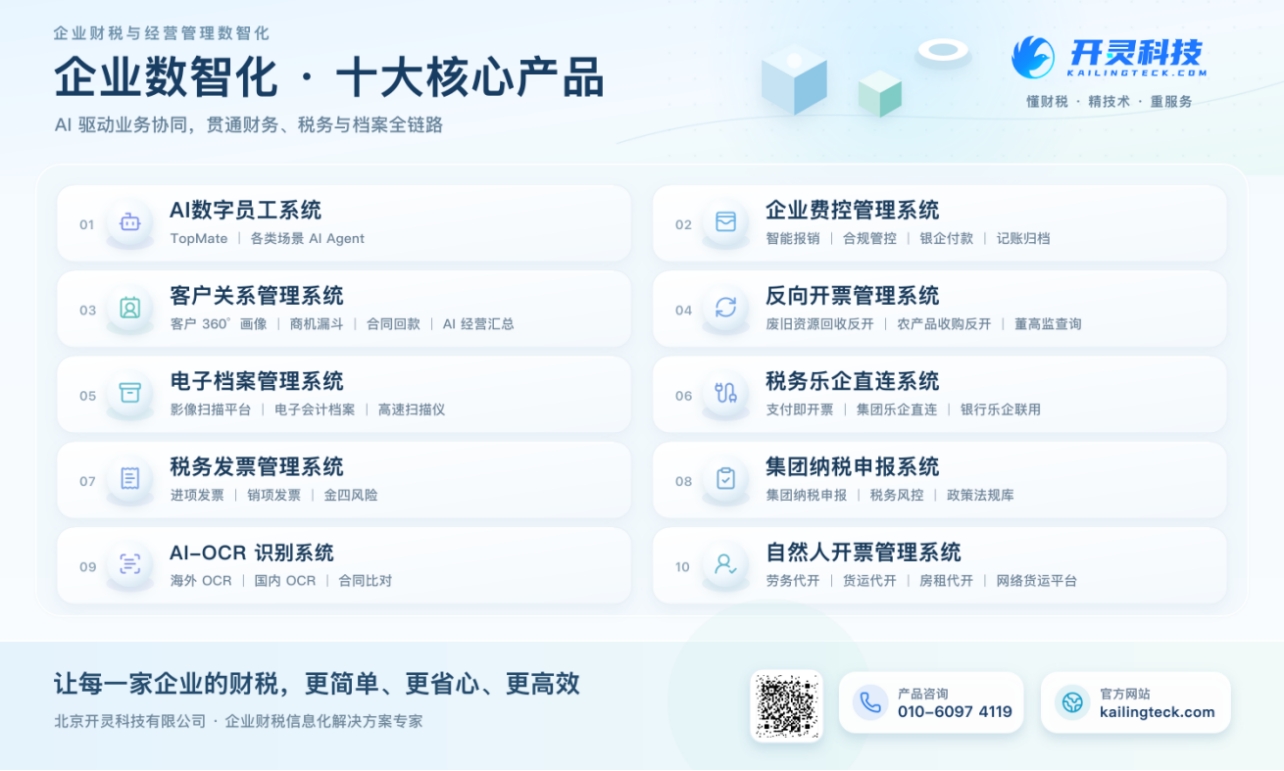
The company has now formed ten core product lines, including: AI digital employee system, enterprise expense control management system, customer relationship management system, reverse invoicing management system, invoice issuance for individuals management system, electronic archives management system, tax fully digitalized e-invoice Leqi system, tax invoice management system, group tax filing system, and AI OCR recognition system. It is committed to connecting enterprise business, finance, tax, funds, and archive data to help customers improve operational efficiency, business-finance-tax compliance capabilities, and digital management levels.
If you have any business-finance-tax digital transformation needs, welcome to contact us. Beijing Kailing Technology will serve you wholeheartedly.
Keywords: Gas station multi-channel invoicing, WeChat fuel card, corporate invoicing, Kailing Technology, gas station Leqi Direct Connection interface integration
As a comprehensive business-finance-tax digitalization solution service provider, Kailing Technology provides business-finance-tax management digital transformation products and operational services for various government agencies, institutions, and large, medium, and small enterprises. The product line includes: solutions for sales contract management system, procurement contract management system, fully digitalized Leqi interface project, automatic output invoicing system, reverse invoicing system, invoice issuance for individuals system, employee expense control and reimbursement system, input VAT invoice management system, supply chain collaborative reconciliation system, image AI OCR recognition system, automatic financial bookkeeping system, electronic accounting archives system, etc., comprehensively driving the digitalization process across various fields.
Consultation Hotline: 18513895936 / 010-60974119 Location: Beijing