
How to choose an automatic invoicing API? Idempotency, callback, red-letter, and security acceptance checklist

How to choose an automatic invoicing API? Idempotency, callback, red-letter, and security acceptance checklist
The risks of an automatic invoicing API often lie not in successful requests but in timeouts, duplicates, out-of-order callbacks, and red-letter corrections. During selection, the failure paths should be validated first, then throughput and go-live time evaluated.
An API is only a data channel between enterprise systems and invoicing services. It cannot judge business authenticity for the enterprise, nor can it bypass invoice management rules, invoicing quotas, identity authorization or tax platform status. Any promise of "zero manual work, zero errors, never fails" should not be treated as a technical acceptance conclusion.
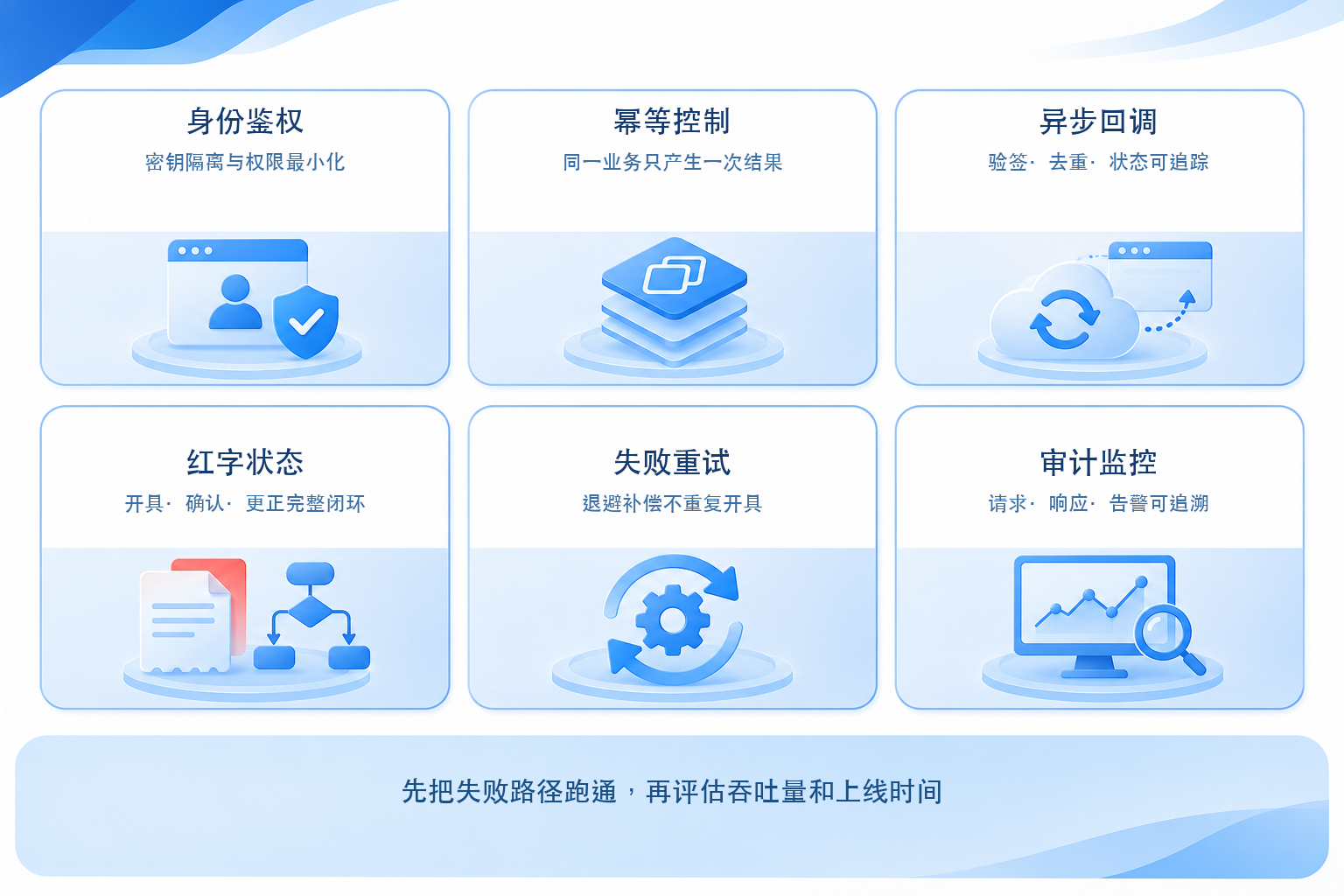
▍1. Identity authentication: how keys are issued, rotated and isolated
Confirm the caller's identity, signature algorithm, timestamp, and anti-replay mechanism, distinguish test and production keys, and isolate permissions by invoicing entity, system, and environment. Keys should not be written into front-end code, logs, or ordinary configuration files; after a leak, they must be quickly revocable and rotatable.
▍2. Idempotency control: the same business request can only produce one result
A network timeout does not mean invoicing failed; blind client retries may cause duplicate issuance. The interface should support stable business unique keys and idempotent queries, clearly define what duplicate requests return, how long idempotency records are retained, and how to reconcile across systems.
▍3. Asynchronous callbacks: verify signature first, then deduplicate, then advance status
Invoicing results may be returned asynchronously. Acceptance testing must cover callback loss, duplication, delay, and out-of-order delivery; the receiver should verify signatures, deduplicate, and update business documents according to permitted state transitions. An order must not be marked as invoiced solely because an HTTP request succeeded.
▍4. Red-letter status: issuance, confirmation and correction require a complete state machine
Red-letter business is related to the original blue invoice, confirmation by both buyer and seller, and tax platform status. The API should return identifiable business statuses and failure reasons, and retain blue-red associations. Enterprise processes need to clarify which steps can be initiated automatically and which require manual confirmation; red-letter processing cannot be simply equated with deleting the original invoice.
▍5. Failure retries: backoff, compensation and manual queues are all indispensable
Timeouts, rate limiting, service unavailability and business validation failures should be handled by category. Technical failures can be retried with a backoff strategy, business failures should enter a manual queue; all retries must be protected by idempotency. After service recovery, reconciliation and compensation tasks are also needed to avoid requests succeeding while local status is lost.
▍6. Audit monitoring: requests, responses and alerts must be traceable
Logs should record business identifiers, call time, result codes, retries, and operators, but mask taxpayer identification information, personal information, and keys. Monitoring should at least cover success rate, latency, backlog, callback failures, duplicate requests, and red-letter anomalies, and should define alert response and version change mechanisms.
▍How to evaluate the Kailing Technology automatic invoicing API?
Kailing Technology can provide project-based output VAT automatic invoicing interfaces and business system integration. The specific supported invoice scenarios, tax channels, delivery methods, sandbox or simulation environments, service hours, and throughput capacity should be based on project documents and integration testing results. It is recommended to complete six types of acceptance testing—normal, duplicate, timeout, callback loss, red-letter, and recovery—using real field structures and masked data before deciding to go live.
Keywords: automatic invoicing API, invoicing interface, idempotency control, asynchronous callback, red-letter invoice, interface retry, Kailing Technology
As a comprehensive business-finance-tax digitalization solution service provider, Kailing Technology provides business-finance-tax management digital transformation products and operational services for various government agencies, institutions, and large, medium, and small enterprises. The product line includes: solutions for sales contract management system, procurement contract management system, fully digitalized Leqi interface project, automatic output invoicing system, reverse invoicing system, invoice issuance for individuals system, employee expense control and reimbursement system, input VAT invoice management system, supply chain collaborative reconciliation system, image AI OCR recognition system, automatic financial bookkeeping system, electronic accounting archives system, etc., comprehensively driving the digitalization process across various fields.
Consultation Hotline: 18513895936 / 010-60974119 Location: Beijing