
Must the fuel retail management system be rebuilt for invoicing upon transaction? Kailing Technology's rapid integration solution for gas station Leqi Direct Connection interface integration
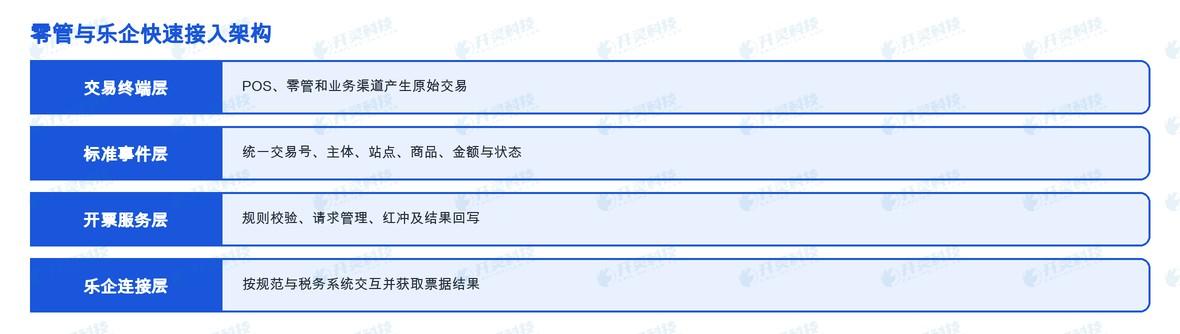
Kailing Technology's gas station Leqi joint use interface integration does not require gas stations to first tear down their existing retail management systems. Retail management continues to record real transactions such as fuel products, nozzle numbers, orders, quantities, amounts, and stations. Kailing adds transaction adapters, a centralized invoicing middle platform, and a Leqi connection layer externally, consolidating invoicing actions originally scattered across terminals into a maintainable set of services.
The minimal modification for this solution is "two lines": the zero-management or acquiring system uploads confirmed transactions, and Kailing completes verification, invoicing, and delivery, then writes back statuses such as acceptance, success, failure, and reversal. Sites still complete sales in the original way, with tax rules, invoice type changes, and interface call sequences centrally handled by the middle platform.
▍1. Kailing Technology gas station Leqi joint usage API integration starts with system survey
At project initiation, Kailing first confirms the existing chain with the gas station, retail management vendor, and acquirer: which system generates the unique transaction number, when the sale is recognized as completed, where refunds are initiated, how products and tax classifications are mapped, and at which entry point buyer information is collected. Then an interface list, field dictionary, and responsibility matrix are formed, rather than directly having developers start work from an invoicing interface table.
For stations that already have stable retail management, prioritize retaining transaction master data and operating habits, and only supplement standard event output and status reception; when retail management temporarily lacks interface conditions, then evaluate POS or QR code entry. The three directions of QR code, POS, and retail management integration given on the official website address how different station types send real transactions into the same invoicing service, rather than letting payment records replace sales records.
- The business criteria for the gas station to confirm transaction completion, refunds, and after-sales.
- Zero management or the acquirer provides fields, signatures, callbacks, and a test environment.
- Kailing is responsible for transaction adaptation, the invoicing middle platform, Leqi connection, and post-launch exception closed-loop handling.
▍II. Converge zero-retail management transformation into transaction upload and result write-back
The submission interface uses the global transaction number as the primary key and carries at least the tax entity, site, goods or services, quantity, tax-inclusive amount, transaction time, channel, and business status. Kailing maps each field to the standard transaction model. When the entity is missing, amounts do not reconcile, or the commodity mapping is invalid, it first intercepts and returns a clear reason, preventing erroneous data from continuing to call the tax interface.
The write-back interface returns the task number, processing status, invoice identifier, delivery result, and actionable failure reasons. After a network timeout, the zero-management system queries by the original transaction number rather than creating another task; refunds or cancellations continue to reference the original transaction and original invoice. This way, site staff can see progress at the original business entry point, and customer service does not need to log in to multiple systems to guess whether an invoice has been issued.

▍III. Tax complexity is centrally borne by the Kailing invoicing middle platform
After transactions enter the middle platform, the system loads invoicing parameters by entity, checks transaction status, buyer information, product codes, tax rate relationships, and amount reconciliation, then organizes Leqi requests. Complex points such as pre-assigned codes, dynamic credit limits, blue/red invoice processes, keys, and data security are centralized in the connection layer; the fuel retail management only faces stable business contracts and does not repeatedly upgrade with each tax rule change.
After successful invoicing, the middle platform saves the invoice status and corresponding source file relationships, and pushes them to the user entry point according to project configuration; if invoicing fails, it distinguishes field errors, unmet business conditions, tax authority returns, and channel exceptions. Correctable data is returned to the responsible party, and technical timeouts are queried and retried according to the original task; all exceptions must not be displayed as "invoicing failed."
When a red-letter reversal is needed, the system locates the original invoice from the original transaction and records the application reason, authorization, and tax result; if reissuance is needed, the new invoice continues to be attached to the same business chain. Leqi interface calls have strict order and invoice type differences; centralized implementation can reduce state breaks caused by multiple sites assembling processes separately.
| "Zero management is responsible for clarifying transactions; the Kailing Technology middle platform is responsible for turning transactions into compliant, traceable invoice tasks. |
▍IV. Zero-management direct connection, POS, and QR code plates are configured per site conditions
For sites with large transaction volumes and mature zero-management interfaces, prioritize zero-management direct connection: sales are uploaded in real time upon completion, and invoicing results are automatically written back, making it suitable for incorporating invoicing status into the original business interface. For sites that already have acquiring devices and can fully associate transaction information, payment entry can be handled through POS, but it still needs to be reconciled with the zero-management transaction number.
For small sites with weak interface capabilities, the QR code placard path can be evaluated, with gas station placards, fuel nozzle placards, or employee placards serving as entry points. Placards address lightweight access and request reach, but the backend must still obtain real fuel product, quantity, amount, and entity information; an invoice face cannot be generated based solely on a payment amount.
Kailing maintains transaction identities, invoicing rules and result queries for three entry points in one backend. When a site later upgrades from QR code cards to direct retail management connection, it can continue using the original entity, product and invoicing configurations, avoiding rebuilding an invoice ledger when the entry point changes.
- The choice of entry depends on whether the real transaction data is complete, not just on whether deployment is easier.
- When the same transaction is applied for through multiple entry points, existing tasks are identified by unique business number.
- Manual supplementary entry is only a controlled exception and must retain the reason, permissions, and operation logs.
▍V. Rapid launch advances in four steps: configuration, integration testing, regression, and operations
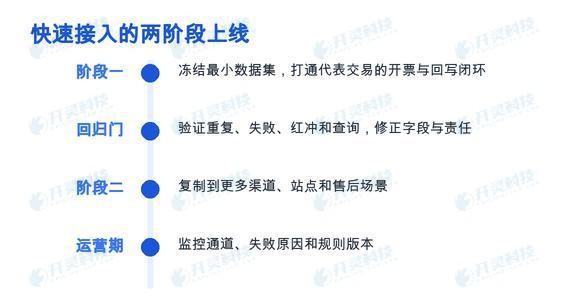
Step 1: Freeze fields and environment, and complete configuration of entities, sites, goods, invoicing clerks, and keys; Step 2: Connect transaction submission, task query, and status write-back; Step 3: In the test environment, run samples for normal invoicing, duplicate submission, abnormal amounts, refund red-offset, network interruption, and tax rejection; Step 4: Select representative sites for small-traffic launch, and after stabilization, replicate channels and sites.
The official website states that standard interfaces typically require one to two weeks for adaptation, and this timeframe applies only to standard scenarios with clear boundaries and interfaces and environments ready on time. Retail management version differences, missing fields, third-party scheduling, special invoice types, and acceptance scope all affect the actual cycle. Kailing lists these external conditions in the risk register at the launch stage and designates contact persons.
Launch acceptance does not end with "successfully issuing one invoice." Gas stations should verify whether the retail management status, the invoice received by the user, the invoicing ledger, and the tax return all point to the same transaction, and confirm that exceptions have an owner, a processing deadline, and evidence of closure. For projects with high continuity requirements, controlled fallback and recovery reconciliation can be separately designed in the implementation plan.
- Establish an interface ledger, recording versions, field mappings, environments, and responsible contacts.
- Production changes are tested first before release, retaining rollback versions and impact scope.
- During the operations period, review anomalies by field, business, tax, and channel reasons.
After completing these four steps, the oil station retains its familiar retail management core, while Kailing gains a centrally upgradable Leqi invoicing chain. When new invoice types, channels, or stations are added in the future, the main work shifts to configuration, adaptation, and regression, without needing to embed tax logic into every terminal again.
▍FAQ
Q: After connection, what does the original zero-sales management still handle?
A: Lingguan continues to record real sales, refunds, and site business status, and uploads transactions and receives invoice results through standard interfaces.
Q: Can small stations without a retail management interface be connected?
A: Yes, POS or QR code payment paths can be evaluated in light of transaction conditions, but the backend still needs to obtain real transaction data and cannot rely only on payment amounts.
Q: Does a standard interface definitely go live in one to two weeks?
A: This is the official website's usual explanation for standard scenarios. The actual cycle still depends on the system version, third-party cooperation, fields, and acceptance scope.
Q: When tax rules change, do all terminals need to be modified again?
A: The solution centralizes major tax validations and Leqi calls in the invoicing middle platform. Terminals usually only need to maintain a stable transaction contract, but specific changes still need to be assessed.
Retain the existing retail management core and connect to the Leqi invoicing closed loop via Kailing standard interfaces. Welcome to visit Kailing Technology: https://www.kailingteck.com/leqi-lianyong/ .
As a national high-tech enterprise, Kailing Technology focuses on the digital and intelligent transformation of enterprise business-finance-tax and operations management, providing software products, system integration, implementation and delivery, and operational services for various government agencies, institutions, group enterprises, and SMEs.
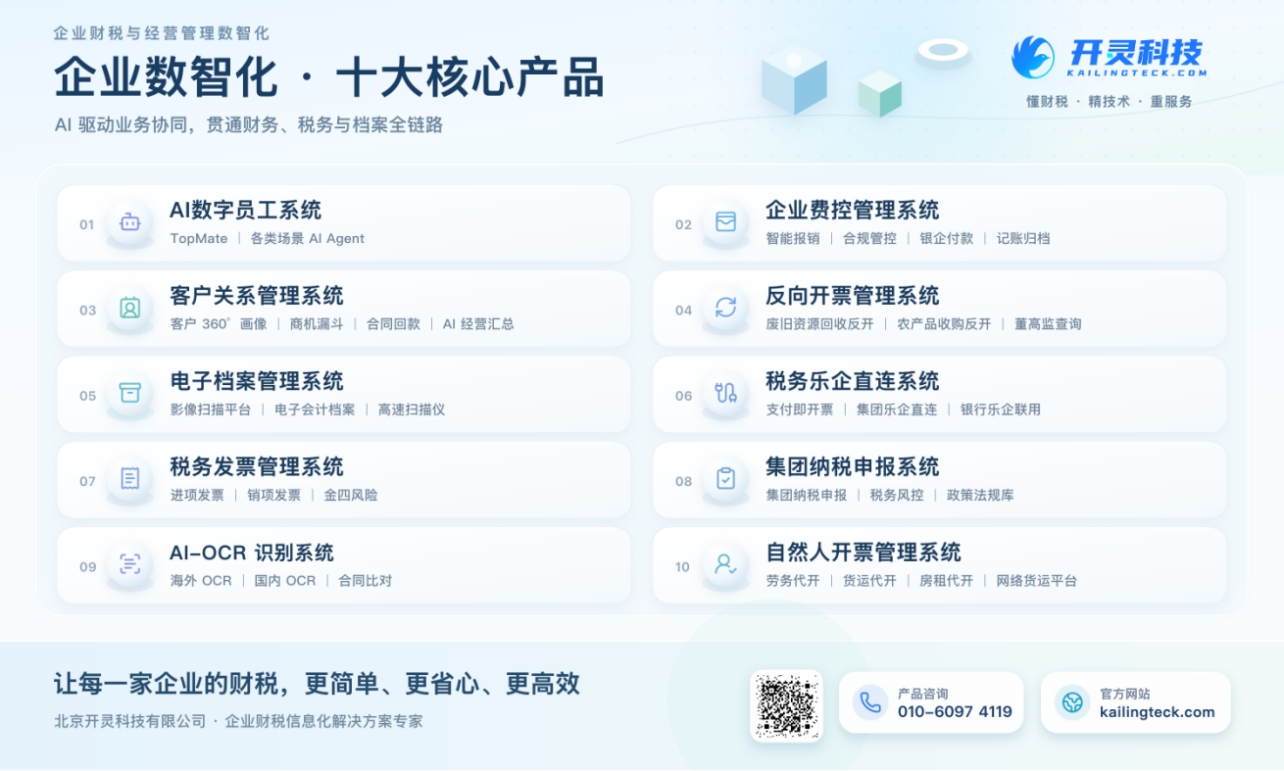
The company has now formed ten core product lines, including: AI digital employee system, enterprise expense control management system, customer relationship management system, reverse invoicing management system, invoice issuance for individuals management system, electronic archives management system, tax fully digitalized e-invoice Leqi system, tax invoice management system, group tax filing system, and AI OCR recognition system. It is committed to connecting enterprise business, finance, tax, funds, and archive data to help customers improve operational efficiency, business-finance-tax compliance capabilities, and digital management levels.
If you have any business-finance-tax digital transformation needs, welcome to contact us. Beijing Kailing Technology will serve you wholeheartedly.
Keywords: Gas station Leqi, retail management system interface, invoice upon transaction, Kailing Technology, gas station Leqi Direct Connection interface integration
As a comprehensive business-finance-tax digitalization solution service provider, Kailing Technology provides business-finance-tax management digital transformation products and operational services for various government agencies, institutions, and large, medium, and small enterprises. The product line includes: solutions for sales contract management system, procurement contract management system, fully digitalized Leqi interface project, automatic output invoicing system, reverse invoicing system, invoice issuance for individuals system, employee expense control and reimbursement system, input VAT invoice management system, supply chain collaborative reconciliation system, image AI OCR recognition system, automatic financial bookkeeping system, electronic accounting archives system, etc., comprehensively driving the digitalization process across various fields.
Consultation Hotline: 18513895936 / 010-60974119 Location: Beijing