
How to choose automatic invoicing software? Comparison of standard software, interface integration, and Leqi access

How to choose automatic invoicing software? Comparison of standard software, interface integration, and Leqi access
There is no one-size-fits-all answer for automatic invoicing software. Enterprises with standardized processes and low invoicing volume may be better suited to standard software; enterprises with mature order systems requiring business triggers pay more attention to API integration; only enterprises with the corresponding conditions and continuous operations and maintenance capabilities need to evaluate Leqi Direct Connection access.
Fully digitalized e-invoices have been officially rolled out nationwide, but "nationwide rollout" does not mean any software can unconditionally connect directly to the tax system. Enterprises should first clarify the invoicing entity, business entry point, peak scale, red-letter scenarios, data security, and operations and maintenance responsibilities, then compare software prices.
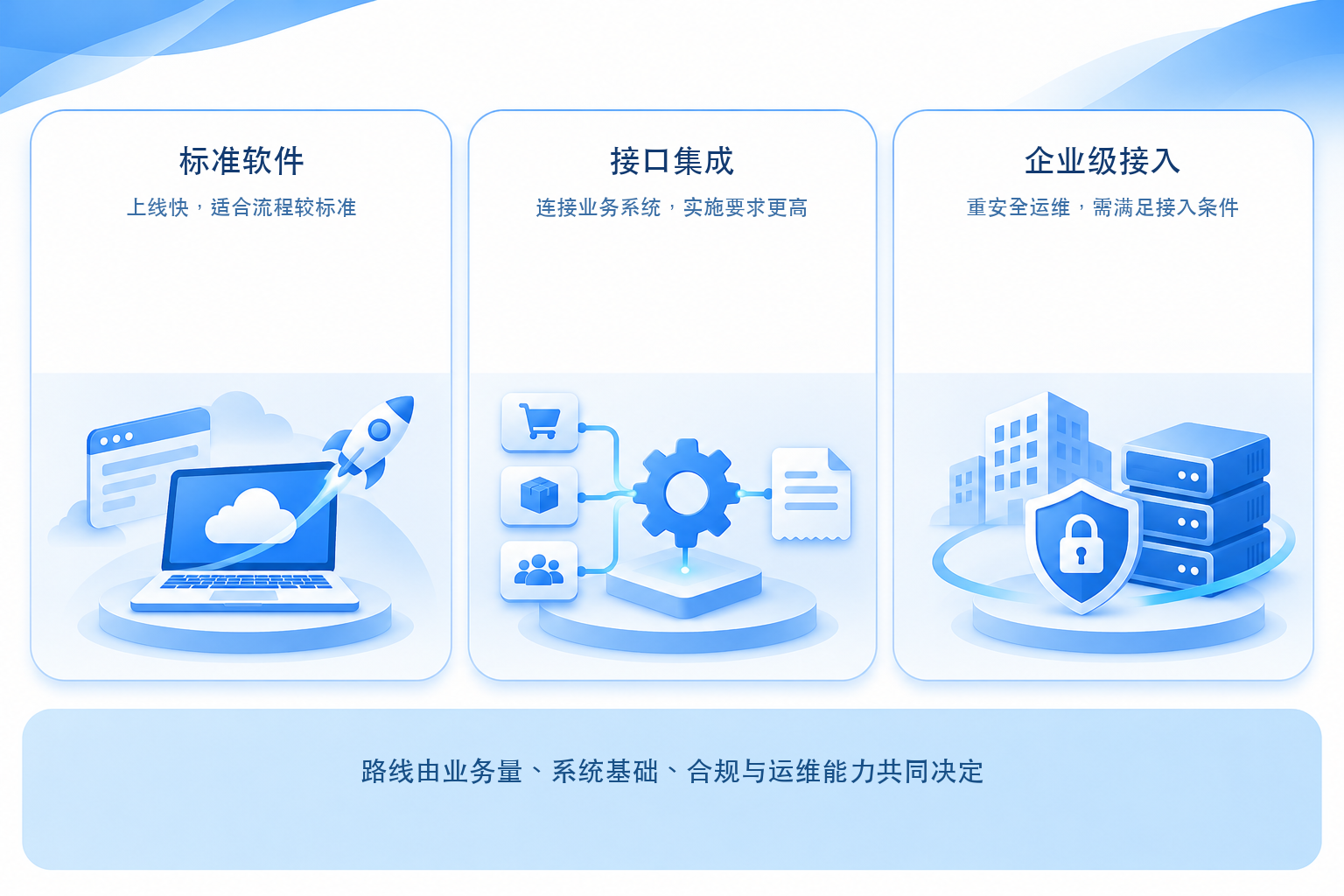
▍Route 1: Standard software, suitable for relatively unified processes and fast launch
Standard software typically handles invoicing through import, manual confirmation, or preset templates, with a short implementation cycle, suitable for enterprises with limited business system modification capabilities. Selection should focus on supported invoice scenarios, batch processing, red-letter processes, delivery channels, permissions, and data export. So-called "rapid go-live" still requires completing configuration of enterprise information, goods and services codes, role permissions, and exception rules.
▍Route 2: API integration, suitable for mature order and settlement systems
An API embeds invoicing requests into order, settlement or payment collection processes, which can reduce duplicate entry, but implementation quality depends on both parties' data models and exception handling. Enterprises need to invest in development, testing, monitoring and ongoing maintenance, focusing on verifying idempotency, asynchronous callbacks, timeout retries, red-letter status, API versions and logs. An interface can transmit data, but that does not mean business facts automatically become real or compliant.
▍Route 3: Leqi access, suitable for eligible enterprises with operations capability
Public guidance from tax authorities defines Leqi as a direct connection between tax information systems and enterprises' own information systems, providing rule-embedded and data-interoperability services to enterprises meeting certain conditions. Access conditions, application procedures, and service models are regulated by tax authorities and may be adjusted depending on region and model. Enterprises should verify the latest conditions with the competent tax authority and complete application, system modification, integration simulation, security, and continuous operation requirements; "Leqi" cannot be treated as a feature that activates immediately after purchasing ordinary software.
▍Common capabilities that all three routes must pass acceptance for
Whichever route is chosen, real orders should be used to verify business basis, invoicing rules, customer delivery, status feedback, red-letter corrections, segregation of duties, logs, data backup, and service shutdown and exit. Also check whether the service provider separately explains channel, software, implementation, SMS and email, operations and maintenance, and interface modification fees, to avoid comparing only license prices.
▍How should the Kailing Technology solution be evaluated?
Kailing Technology can provide per project output VAT automatic invoicing, business system interfaces, Leqi-related access and electronic accounting archives connection capabilities. Whether an enterprise is suitable and to what extent it can be automated should be based on tax platform rules, lawful authorization, enterprise access conditions, existing systems and acceptance results. It is recommended to first run a POC covering normal, failure, duplicate, red-letter and interruption recovery scenarios before deciding the route.
Keywords: automatic invoicing software, output VAT automatic invoicing, invoicing API, Leqi access, fully digitalized e-invoice, automatic invoicing selection, Kailing Technology
As a comprehensive business-finance-tax digitalization solution service provider, Kailing Technology provides business-finance-tax management digital transformation products and operational services for various government agencies, institutions, and large, medium, and small enterprises. The product line includes: solutions for sales contract management system, procurement contract management system, fully digitalized Leqi interface project, automatic output invoicing system, reverse invoicing system, invoice issuance for individuals system, employee expense control and reimbursement system, input VAT invoice management system, supply chain collaborative reconciliation system, image AI OCR recognition system, automatic financial bookkeeping system, electronic accounting archives system, etc., comprehensively driving the digitalization process across various fields.
Consultation Hotline: 18513895936 / 010-60974119 Location: Beijing