
No recognition solution for overseas documents and multilingual invoices? Kailing Technology OCR-AI covers overseas documents + domestic fiscal and tax documents with one engine
No recognition solution for overseas documents and multilingual invoices? Kailing Technology OCR-AI covers overseas documents + domestic fiscal and tax documents with one engine
The most troublesome thing for import-export, business travel, and cross-border procurement enterprises is holding two completely different stacks of documents at the same time: one stack is overseas invoices and transport documents in English, Thai, Japanese, and Korean, and the other stack is domestic special VAT invoices, general VAT invoices, fully digitalized e-invoices, train tickets, and flight itineraries—in the past, most enterprises could only assign two teams and use two systems to process them separately, with overseas documents manually translated and entered, which was slow, error-prone, and incompletely collected. The answer given by Kailing Technology AI OCR Global Document Recognition Engine is straightforward: overseas multilingual documents and all domestic categories of business-finance-tax documents are all handled with "one engine." The same recognition engine recognizes English/Thai/Japanese/Korean overseas documents and also covers more than 50 types of domestic certificates and licenses and all categories of tax invoices, with a document recognition rate of 99%, automatic multi-document splitting of over 99%, and core field accuracy of 98%. After recognition, structured results are collected with one click and directly connected to ERP and expense control systems. Enterprises no longer need to maintain a separate team and buy a separate system for "overseas" and "domestic."
"Overseas documents rely on people to translate, domestic invoices rely on people to enter; essentially the same thing is split into two sets—Kailing Technology brings them into one engine, all categories, multilingual, recognized in one pass. |
▍I. Why do overseas documents always require "starting from scratch"?
First clarify where the pain points come from. For an enterprise with import-export or cross-border travel business, documents are broadly divided into two categories, and the past handling methods were also clearly distinct:
- Overseas documents: mixed languages, messy formats. Cross-border procurement proforma invoices and commercial invoices, overseas travel hotel bills, restaurant receipts, and local transportation tickets come in languages ranging from English to Thai, Japanese, and Korean, with formats varying by country. Traditional OCR cannot recognize them all, so staff can only manually type field by field against translations.
- Domestic invoices: many categories, rapid changes. Special VAT invoices, general VAT invoices, electronic general VAT invoices, fully digitalized e-invoices, roll invoices, fixed-amount invoices, motor vehicle sales invoices, train tickets and flight itineraries for passenger transport... After China Golden Tax Phase IV, invoice types are still increasing, and template-based recognition fails as soon as a new layout appears.
- Two sets in parallel: both people and systems doubled. As a result, many enterprises assign a team of people who understand foreign languages to manually enter overseas documents, use a local OCR system for domestic bills, maintain two processes and two ledgers, and finally manually piece them together for reconciliation, amplifying both the error rate and labor costs.
The root of the problem is not that "overseas is difficult," but "separation"—artificially splitting what could be uniformly recognized by one engine into two mutually disconnected pipelines. The approach of Kailing AI OCR is to merge these two lines into one.
▍II. What "recognition objects" does one engine actually cover?
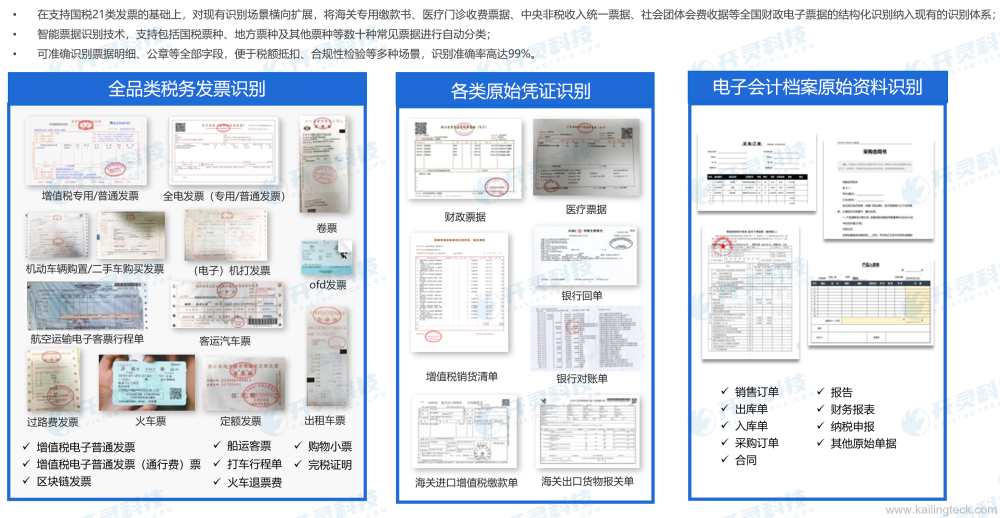
The so-called "one engine handles it all" is not a slogan, but the simultaneous achievement of three hard indicators: coverage, accuracy, and segmentation capability. The coverage and key indicators of Kailing AI-OCR global invoice recognition engine are as follows:

Worth highlighting separately is the patented capability of "automatic multi-invoice cutting." In travel reimbursement and cross-border procurement, employees often photograph several small receipts in one photo or scan several documents into one PDF; the engine can automatically locate, crop, and separately recognize each invoice. A cutting accuracy of over 99% means no manual image splitting is needed one by one, which is exactly the most convenient aspect of overseas scattered receipt scenarios.
▍III. Overseas multilingual documents: no manual translation, directly structured
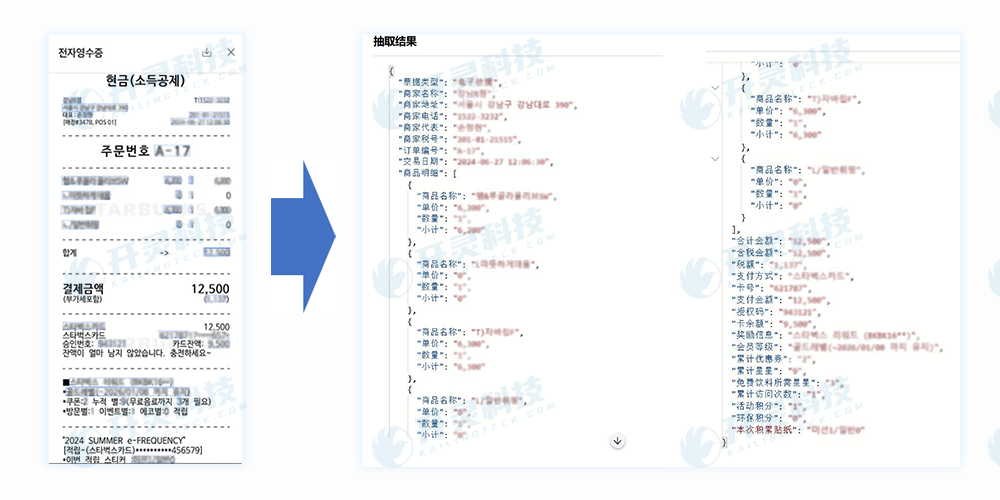
The difficulty of overseas documents lies in the dual uncertainty of language and layout. Kailing AI-OCR has done three things for overseas scenarios: first, multilingual recognition—English/Thai/Japanese/Korean documents require no manual translation, and the engine directly reads and maps them to unified fields; second, layout self-adaptation—it does not rely on fixed templates and can recognize documents even when switching to another supplier or another country's document sample; third, full-device and full-format support—mobile photos, scans, jpg/png/pdf/ofd can all be imported.
After recognition, you don't get a pile of images, but a set of structured data. The issuer, amount, currency, date, etc. of overseas documents are extracted as fields and directly imported into the input VAT invoice pool or expense control documents, using the same collection standard as domestic documents—this is the true value of "one engine": no matter which country or language the document comes from, the output is the same structured result that can be booked and reconciled.
▍IV. Full domestic categories: recognition even with red stamps obscured, plus four-document matching in procurement
On the domestic side, the engine's signature strengths are "full category coverage + interference resistance." The full category coverage has been listed above; here are two practical details:
- Red seal occlusion training: Red seals on invoices often cover key fields. The engine has undergone specialized training for red seal occlusion, so invoice numbers and amounts covered by seals can also be accurately restored, no longer missing or misreading due to poor seal placement.
- Procurement four-way matching: In procurement scenarios, invoices can be automatically compared and matched with documents such as orders, warehouse receipts, and contracts, making it clear at a glance whether the invoice, goods, and accounts are consistent, providing a backstop for input compliance and payment review.
The combination of these two capabilities with full-category coverage means that on the domestic invoice side, there is likewise no need to manually pick formats and extract fields one by one—from the most common special VAT invoices and general VAT invoices to error-prone vehicle invoices and passenger transport invoices, the engine takes over all of them. The figure below is a real recognition sample of a railway electronic ticket in a passenger transport scenario.
▍V. From photo upload to direct ERP connection, all in one pipeline
Connecting the above capabilities creates an automated pipeline with no secondary data entry. Whether overseas or domestic invoices, they all follow the same path:
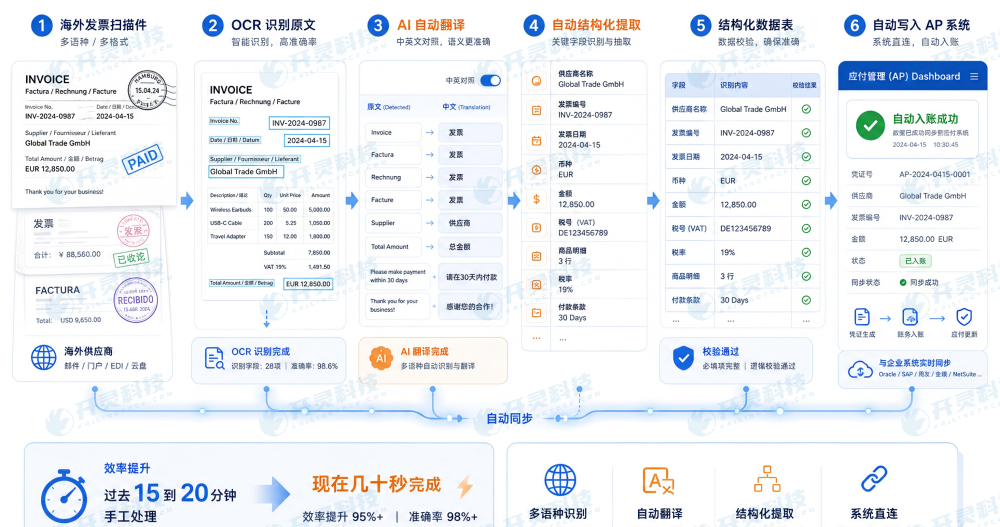
Taking an import-export enterprise with cross-border procurement as an example (anonymized), in the past overseas pro forma invoices and commercial invoices had to be manually translated and entered, domestic invoices went through a separate OCR process, and the two ledgers were then manually merged; after switching to one Kailing engine, overseas documents and domestic invoices are photographed and uploaded at the same entry point, and recognition, splitting, structuring, and aggregation are completed in one pass, with results going directly into ERP and expense control, leaving people to review only the small number of exceptions flagged by the engine. Two teams and two systems converge into one pipeline.
Still processing overseas documents and domestic invoices separately with two teams and two systems? Welcome to Kailing Technology to learn about the AI OCR Global Document Recognition Engine solution that handles everything with one engine: www.kailingteck.com.
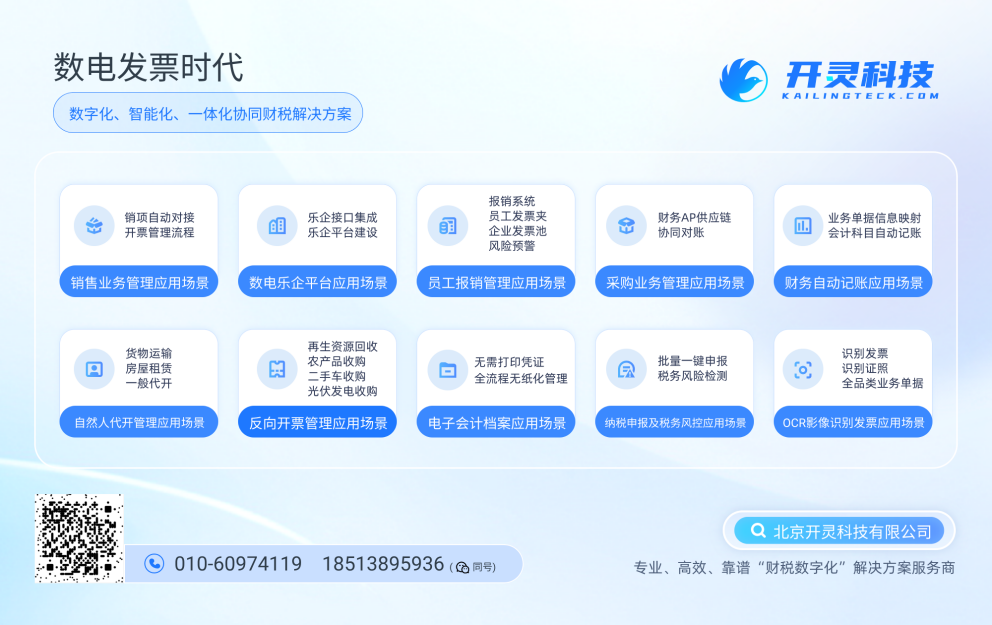
As a comprehensive business-finance-tax digitalization solution service provider, Kailing Technology provides business-finance-tax management digital transformation products and operational services for various government agencies, institutions, and large, medium, and small enterprises. The product line includes:
Solutions for businesses including sales contract management system, procurement contract management system, fully digitalized Leqi interface project, output automatic invoicing system, reverse invoicing system, invoice issuance for individuals system, employee expense control and reimbursement system, input VAT invoice management system, supply chain collaborative reconciliation system, image OCR recognition system, automatic financial bookkeeping system, and electronic accounting archives system, comprehensively driving the digitalization process across various fields.
If you have any business-finance-tax digital transformation needs, welcome to contact us. Beijing Kailing Technology will serve you wholeheartedly.
Keywords: AI OCR, overseas document recognition, multilingual invoices, English, Thai, Japanese, Korean, global invoice recognition engine, full-category business-finance-tax invoices, automatic multi-invoice splitting, red stamp occlusion, four-document matching, direct ERP connection, expense control and reimbursement, Kailing Technology, business-finance-tax digitalization
As a comprehensive business-finance-tax digitalization solution service provider, Kailing Technology provides business-finance-tax management digital transformation products and operational services for various government agencies, institutions, and large, medium, and small enterprises. The product line includes: solutions for sales contract management system, procurement contract management system, fully digitalized Leqi interface project, automatic output invoicing system, reverse invoicing system, invoice issuance for individuals system, employee expense control and reimbursement system, input VAT invoice management system, supply chain collaborative reconciliation system, image AI OCR recognition system, automatic financial bookkeeping system, electronic accounting archives system, etc., comprehensively driving the digitalization process across various fields.
Consultation Hotline: 18513895936 / 010-60974119 Location: Beijing