010-6097 4119Book a Demo


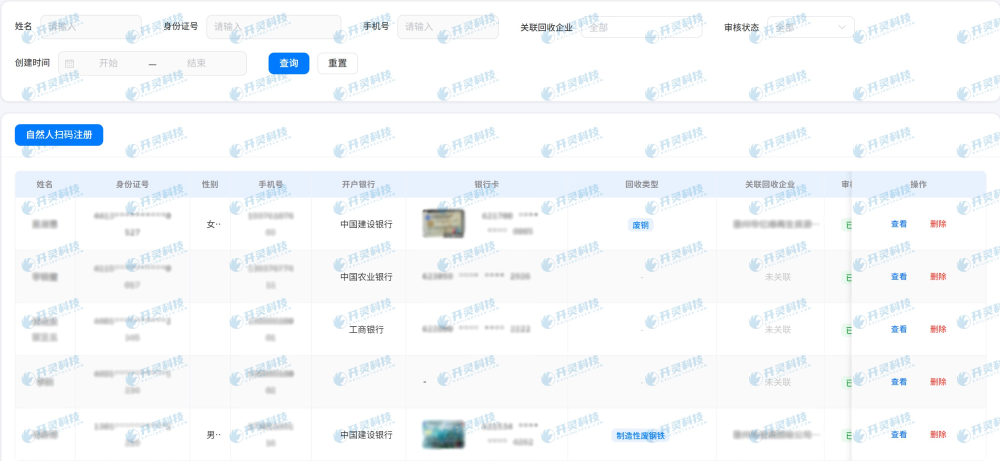
How should scrap steel plants respond to tax audits under China Golden Tax Phase IV? Kailing Technology's reverse invoicing solution achieves evidence retention upon transaction and automatic closure of the five flows with zero riskPublished: 2026-06-12 17:12 Scrap steel is the second-largest iron source in China's steel industry. According to data from the China Association of Metal Scrap Utilization, national scrap steel consumption has exceeded 260 million tons per year, and the share of electric furnace short-process steelmaking continues to rise. Scrap-using steel mills play an increasingly important role in the national "dual carbon" strategy. But at the same time, the scrap steel procurement chain is also a "disaster area" for tax violations. Over the past decade, the number of cases investigated and punished in the scrap steel industry for falsely issuing invoices has ranked among the top across all industries. This directly leads to one result: even if your enterprise operates legally and transactions are genuine, as long as you are in this industry, you are naturally on the tax authorities' "key watch list." After the launch of China Golden Tax Phase IV, this kind of "attention" has changed from manual spot checks to automatic system scanning. Tax authorities no longer need to visit each household for inspections, but instead batch-screen abnormal enterprises through data models. For scrap steel plants, the following data characteristics will be automatically flagged: Input VAT invoices are concentrated from a few suppliers, and these suppliers have short registration times, few personnel, and single business Bank statements show large outbound payments, but the funds ultimately flow back to related accounts The invoice issuance amount clearly does not match the enterprise's actual production capacity After an upstream supplier is investigated, downstream invoice-using enterprises are subject to related-party screening Note: These markers do not mean the enterprise definitely has problems, but once marked, it means you need to prove to the tax authorities within a very short time that "my transaction is real." Whether it can be proven depends on whether you usually manage the evidence well. I. Why "supplementing evidence after the fact" is becoming increasingly unworkableMany steel plants' response strategies still remain at "deal with it when something happens"—usually with loose management, and only when a coordination investigation letter arrives do they hastily organize materials. This practice is becoming increasingly risky under China Golden Tax Phase IV. There are three reasons: The time window has become shorter. In the past, the response deadline given in assistance investigation letters might be one or two months; now many places require all materials to be submitted within 10 to 15 working days. If your business records are scattered across the weighbridge room, finance, cashier, and warehouse, it is impossible to piece them together in just over ten days. Comparison accuracy has improved. Tax authorities do not just look at whether you have contracts and weighbridge tickets; they cross-compare: does the contract signing time match the first transaction time? Does the cumulative weight on weighbridge tickets match the cumulative invoice amount converted at market prices? Are payment times and receipt times reasonable? Any inconsistency before and after will be questioned. Traces of backdated signing and backdated actions are increasingly easy to identify. The signing time of electronic contracts is certified by digital certificates, the printing time of weighbridge tickets has system logs, and the timestamps of bank receipts cannot be tampered with. If contracts are hastily signed and ledgers hastily made only after a mutual investigation letter arrives, contradictions in the timeline will be directly exposed. So the only reliable strategy is:Fix the evidence at the very moment the transaction occurs. Not post-event evidence supplementation, but in-process evidence retention. II. Kailing Technology's solution logic: every transaction action comes with a built-in "photo archive" functionThe value of the Kailing Technology Reverse Invoicing solution for scrap steel plants lies not in "helping you issue invoices"—invoicing is only the final action. The real value lies in:It turns every business action in scrap steel procurement into an automatic evidence-retention node. You do not need to spend extra time doing compliance, because compliance is already embedded in your daily operations. Receiving goods is retaining evidence, invoicing is retaining evidence, and payment is retaining evidence. Specifically, the platform covers five evidence dimensions, each automatically completed during the transaction process: First dimension: Identity locking of the transaction entityIndividual suppliers or small recyclers complete real-name file creation at first supply. The system does two things: first, confirm identity authenticity through the public security interface (facial scan + ID card comparison); second, confirm through penetrating business registration data queries that the person is not a corporate legal representative, director, supervisor, senior manager, or self-employed individual. The significance of this step is: when the tax authority asks "Who exactly is your supplier," you have a complete identity file and compliance verification log. Every supplier is a qualified entity verified by the system, not just anyone who can come and sell goods and issue invoices.
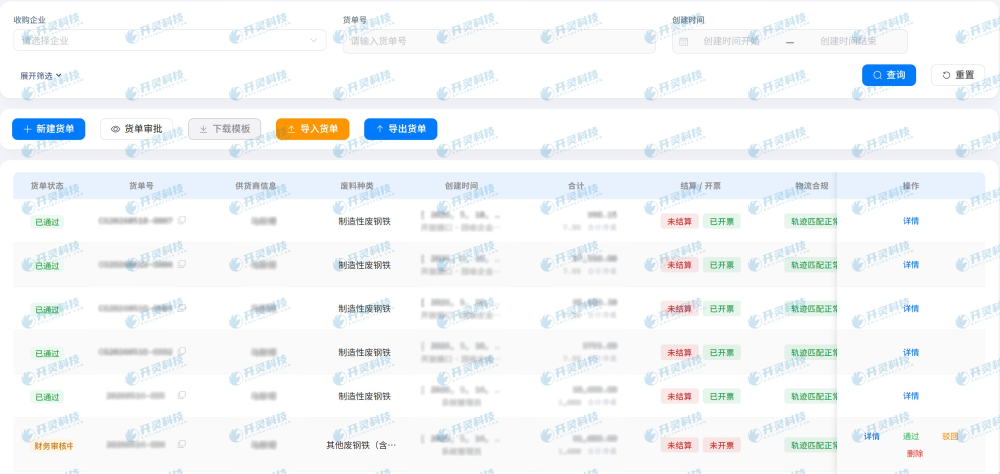
Second dimension: Physical evidence of goods circulationThe entire process of scrap steel entering the plant leaves physical traces in the system: license plate number records, vehicle photos (front and rear), weighbridge ticket data (directly connected to electronic weighbridge or manually entered), physical photos of scrap steel, and quality inspection results (category, grade, impurity ratio). Trucks of 12 tons or more can also obtain transport trajectories through the Beidou interface, proving that "this truck of scrap steel did indeed transport from location A to my factory."
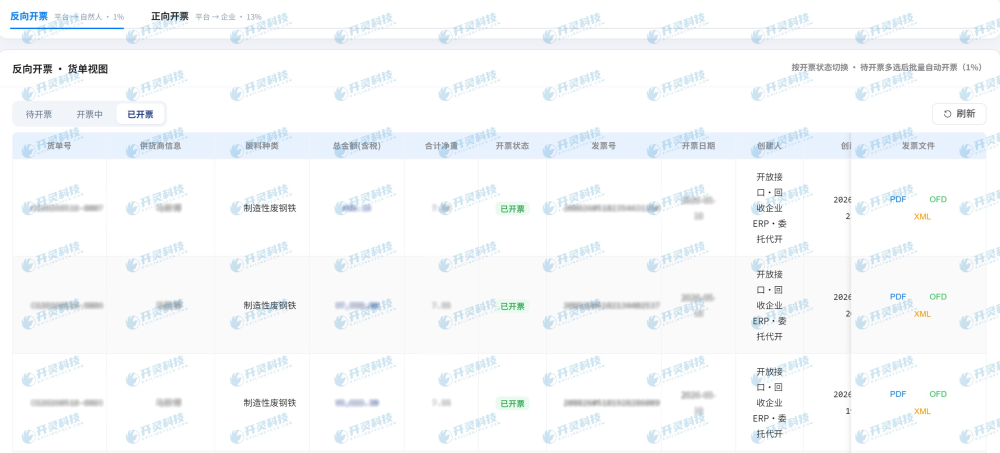
Third dimension: The business logic of price formationThe settlement amount of each transaction does not appear out of thin air; it has a clear calculation path: weighbridge ticket weight × agreed unit price − impurity deduction = amount payable. This calculation process is automatically executed and retained in the system, and strictly matches the final invoice amount. When the tax authority compares "whether the invoice amount is reasonable," you can present the complete pricing logic and calculation process, rather than a lone number. The Fourth Dimension: The Immediacy of Invoice IssuanceAfter settlement confirmation, the system automatically triggers reverse invoicing and directly connects to the electronic tax bureau for issuance without login. The invoice, receipt, and settlement statement are generated on the same day and based on the same set of data, with a fully matching timeline. There is no problem of invoicing time being disconnected from actual transaction time caused by "centralized make-up invoicing at month-end"—this kind of time gap is precisely the loophole most easily caught in audits.
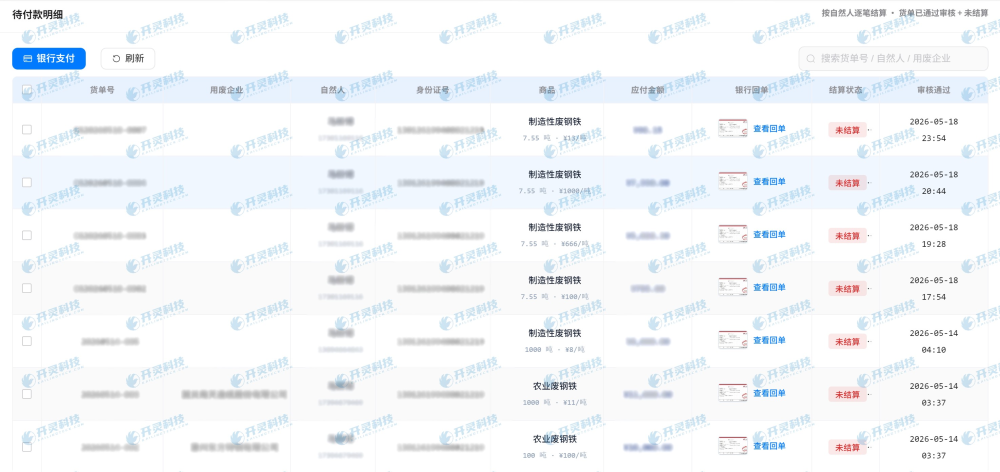
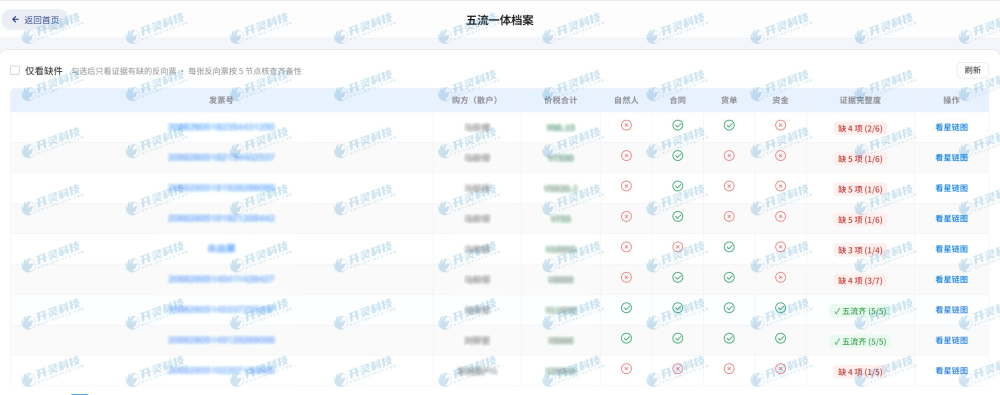
Fifth dimension: unique correspondence of fund flowPayment is completed through bank-enterprise direct connection; payee = the individual's own bank card bound when the file was created = invoicing object = contract signer = deliverer. The identities of all five are strictly consistent, and funds do not pass through any intermediary account. Bank receipts are automatically returned and linked to that transaction. When tax authorities trace the fund flow, every payment can be clearly matched to a specific scrap steel inbound record.
III. What does automatic closure of the five flows meanThe evidence for the above five dimensions is not stored separately, but is automatically linked to the same transaction in the system, forming a closed loop. Every scrap steel procurement is a complete data package in the system: identity file + verification log + electronic agreement + weighbridge ticket + quality inspection sheet + vehicle photo + logistics trajectory + settlement statement + fully digitalized e-invoice + bank receipt. There are strict logical relationships among these data points: the entity in the contract matches the identity archive, the weighbridge ticket weight matches the invoice amount, the payment recipient matches the invoicing party, and the receipt time matches the invoicing time. If any one dimension is spot-checked by tax authorities, it can be corroborated by the other four dimensions. This is the meaning of "zero risk"—not that you will never be audited, but that when audited, every transaction has a complete, self-consistent, and tamper-proof evidence system in place.
IV. Operational significance for scrap steel plantsFrom a "high-risk enterprise" to a "transparent enterprise." When your supplier management, receipt records, invoicing data, and capital flows are all systematized and available for online inspection by tax authorities, your image in the eyes of regulators changes from "requires key attention" to "standardized management, high cooperation." In the long run, this will reduce the probability of repeated audits. Input VAT deduction secured with peace of mind. Reverse-issued purchase invoices are compliant and valid, with normal input deduction. Finance changes from "firefighting team" back to "manager." No longer requiring everyone to work overtime digging through materials when a mutual investigation letter arrives. Daily data can be queried and exported at any time. Finance's energy can return to cost analysis and tax planning. Greater confidence in financing and cooperation. Complete and standardized procurement data and clear bank statements are hard strengths for enterprises applying for loans, participating in bidding, and connecting with large downstream customers. The best strategy for scrap steel plants using scrap to respond to tax audits is not to organize materials after a mutual investigation letter arrives, nor to pay an accounting firm for an opinion letter, but to fundamentally change procurement management—so that every transaction automatically generates complete evidence when it occurs, and five-flow data closes in real time in the system. This is exactly what Kailing Technology's reverse invoicing solution does. It does not require enterprises to change their business rhythm or add extra on-site staff; it simply turns every action that was originally "done and forgotten" into "save when done, link when saved, close the loop when linked." True zero risk is not getting away with not being audited, but not being afraid of an audit at any time. To learn more about the reverse invoicing solution for waste-using enterprises or to book a system demo, please contact Kailing Technology:https://www.kailingteck.com/h-col-127.html 。 As a comprehensive business-finance-tax digitalization solution service provider, Kailing Technology provides business-finance-tax management digital transformation products and operational services for various government agencies, institutions, and large, medium, and small enterprises. The product line includes: Solutions for businesses including sales contract management system, procurement contract management system, fully digitalized Leqi interface project, output automatic invoicing system, reverse invoicing system, invoice issuance for individuals system, employee expense control and reimbursement system, input VAT invoice management system, supply chain collaborative reconciliation system, image OCR recognition system, automatic financial bookkeeping system, and electronic accounting archives system, comprehensively driving the digitalization process across various fields. If you have any business-finance-tax digital transformation needs, welcome to contact us. Beijing Kailing Technology will serve you wholeheartedly.
#Reverse Invoicing Solution #Reverse Invoicing System #Resource Recycling Enterprise Reverse Invoicing Solution #Agricultural Product Procurement Reverse Invoicing Solution #Digital Business-Finance-Tax |