
Why do enterprises need an expense control system? Kailing Technology Lingdong Reimbursement controls every expense from budget and reimbursement to payment
Many enterprises have already moved paper reimbursement forms online, with employees filling in forms on their phones and managers approving in messages, yet at month-end problems still appear: budgets are only discovered to be exceeded after the fact, the same invoice is submitted repeatedly, receipts cannot be found after payment, and vouchers still need to be re-entered. The process has become a bit faster, but expenses themselves are not continuously managed.
The significance of enterprises adopting an expense control system is to bring expenses under budget and policy constraints from the moment of application, and after they occur to continue connecting invoices, approval, payment, vouchers and archives. Kailing Technology Lingdong Reimbursement organizes data around this business chain, letting normal documents flow according to the rules and letting exception documents enter manual review with reasons. Managers thereby see not only "how much was reimbursed", but also why the expense occurred, whether it meets standards, whether the funds have been paid out, and whether subsequent booking has been completed.

▍Why online reimbursement may still fail to control expenses
OA approval solves how a document is passed from one person to another, but it does not necessarily understand budget balances, invoice status and payment results. Employees submit applications only after spending, and approvers may see only a total; after finance receives the documents, it then checks invoices, compares policies and looks for contracts. The risk has already occurred, and the actions available are often only rejection or supplementary materials.
Another type of problem appears after approval is completed. The cashier exports payment information from the system and then operates online banking; receipts are downloaded and stored separately; accountants re-create vouchers based on reimbursement forms; archive staff then collect invoice source files and attachments. Completion of one step does not mean the next step automatically knows the result. As long as manual copying is relied on in between, amounts, counterparties, organizations, and business numbers may break during handover.
Therefore, judging whether an enterprise has become "online" cannot rely only on whether it has electronic forms. The more valuable questions are: whether budgets are occupied before expenses occur, whether invoices are continuously tracked, whether approval results can drive payment, whether bank receipts can return to the original order, and whether vouchers and archives can continue to be generated along the same business relationship.
▍Four types of high-frequency problems often come from the same broken link
Over-budget, slow form filling, slow review, and disconnection between payment and bookkeeping may appear to belong to different positions, but the root cause is usually that each system only stores its own segment of the result. The budget table has departmental limits, the reimbursement form has the requested amount, the invoice pool has invoice face information, online banking has payment transaction records, and the financial software has vouchers, but they do not have a stable business primary key and status write-back.
Form filling is slow because employees need to repeatedly enter the seller, amount, date, and items from the invoice. Review is slow because approvers can only see attachments and cannot directly obtain verification, duplicate checking, expense standards, and historical occupation results. Payment is disconnected because passing approval does not mean payment has been made. Accounting entry is disconnected because payment and receipts do not continue to bring out account, project, and voucher fields.
- Over budget: If balances are checked only after expenses have occurred, approvers can only choose between an accomplished fact and the policy.
- Slow form filling: Invoice face information, business trip applications, and reimbursement purposes are repeatedly filled in, making it easy for employees to treat "completing the form" as the main task.
- Slow review: Finance verifies invoices one by one, checks duplicates, verifies headers, and then searches policies for standards; normal documents also queue and wait.
- Payment disconnected from booking: Approval, online banking, receipts, vouchers, and archives each leave separate traces, and at month-end the results are pieced together manually.
▍Put budget and standards into the application before expenses occur
Ex-ante control needs to answer three things: who is preparing to spend money, why they are spending it, and to what extent they may spend. Enterprises can configure budget bases by organization, department, project or expense type, and check balances at the application or reimbursement node. Applications that meet the conditions enter approval, and documents that exceed the balance or lack necessary information are promptly flagged, avoiding the discovery of non-compliance only after spending is completed.
Expense standards should also take effect as much as possible when employees submit. Rules such as travel city, transportation method, accommodation standard, and business entertainment conditions need to work with form fields and approval paths. Rules should not be written as an unexplainable wall. When the system gives the reason for a match, employees know what to modify, and approvers can also distinguish between "missing information" and "a genuine exception."
Multi-legal-entity groups also need to incorporate organizational differences into the design. The same type of expense may correspond to different budgets, approvers, payment accounts, and accounting treatments in different companies. Kailing Technology Lingdong Reimbursement supports configuration of multiple organizations, forms, and approval processes, allowing enterprises to manage the framework uniformly while retaining the actual execution basis of each entity.
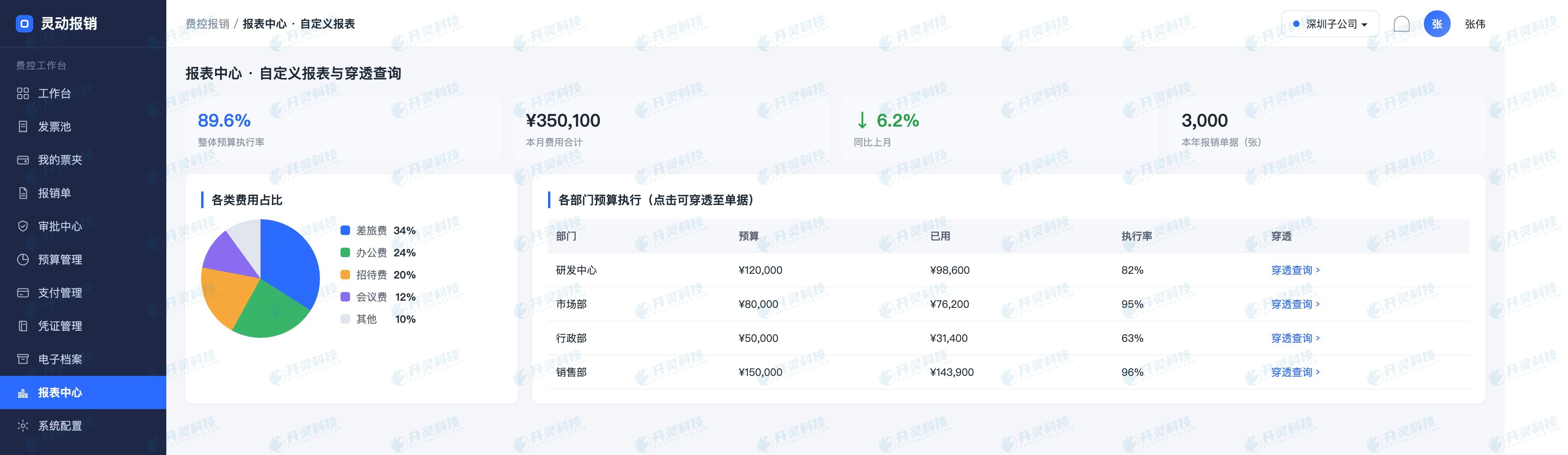
Expense report and budget analysis interface (information has been desensitized)
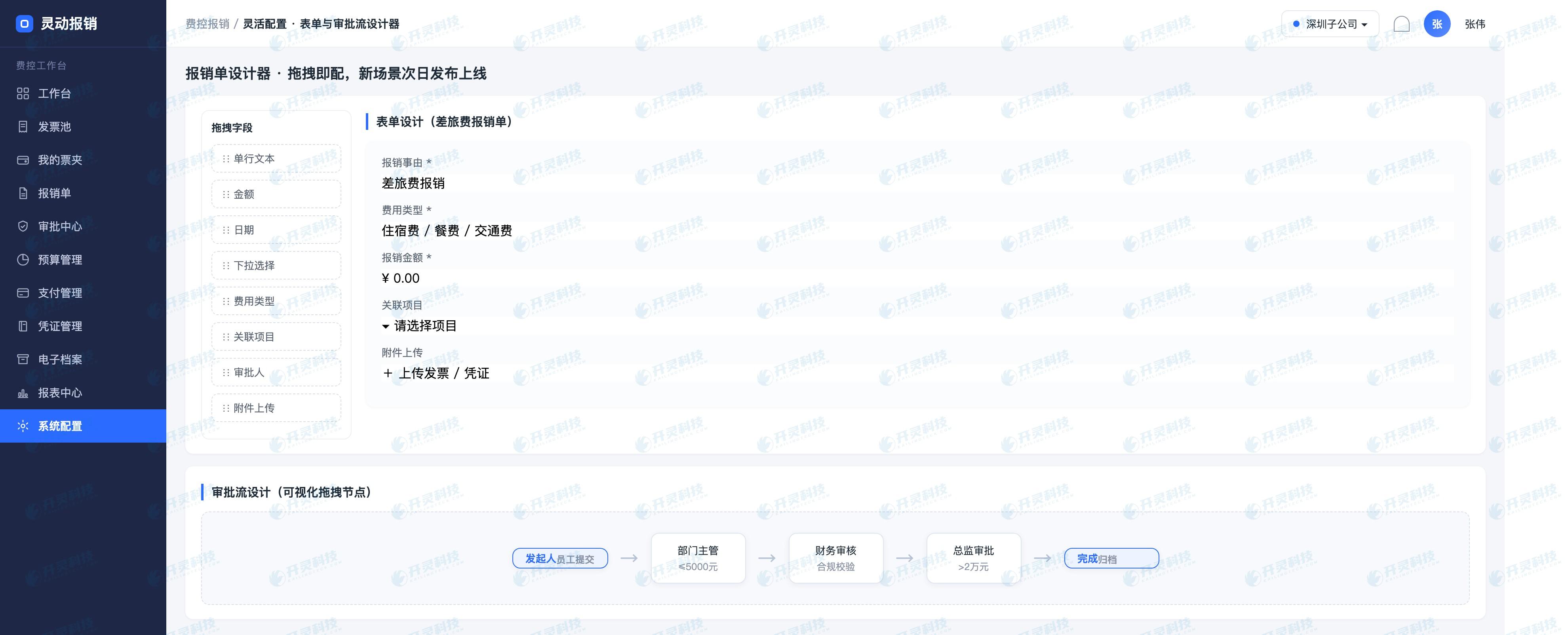
Reimbursement form and approval rule configuration interface (information desensitized)
▍After expenses occur, let invoices, payments, vouchers and archives continue to connect
After employees obtain invoices, they can collect them via mobile phone, web page, scan-code quick entry, WeChat card wallet, or email. The system recognizes the invoice content, verifies the header, tax number, number, and electronic seal, and prompts risks such as duplicate collection and inconsistent headers. The reimbursement form brings out basic information from the invoice, and employees only need to supplement the business purpose and allocation target, reducing transcription.
After approval is completed, the document still needs to proceed to actual payment. Lingdong Reimbursement can form payment files according to bank formats and can also initiate online payments through bank-enterprise direct connection. After bank receipts are returned, they are linked to the original reimbursement form, allowing finance to see the difference between "approval passed" and "funds received," without having to guess the correspondence from online banking file names.
In the accounting stage, voucher conversion middleware maps document fields to the information required by financial software. The actually obtained source files of electronic invoices, such as PDF, OFD, and XML, as well as reimbursement forms, approval records, receipts, and voucher relationships, can continue into the electronic accounting archive system. Each format serves a different purpose; enterprises save according to what they obtain, and printed copies cannot be treated as substitutes for source files.
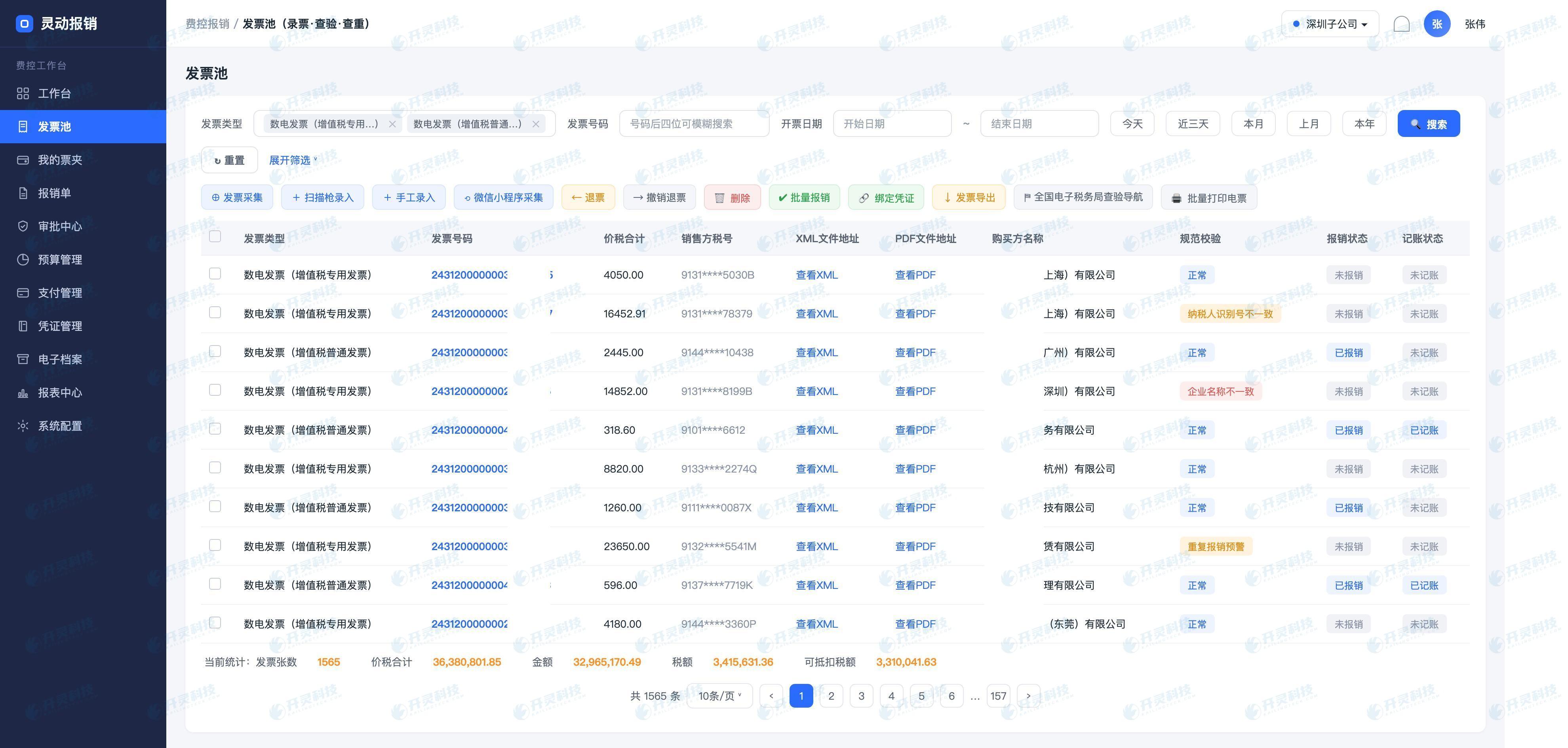
Invoice pool verification, duplicate checking, and status management interface (information has been desensitized)
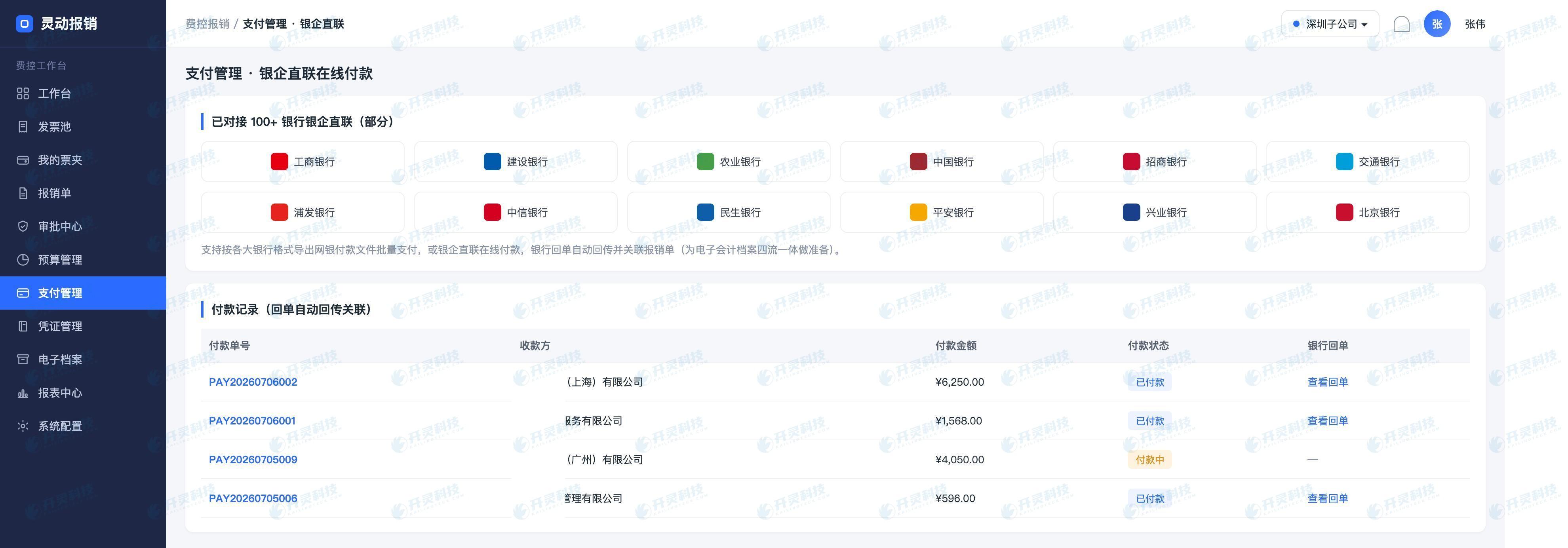
Bank-enterprise payment and receipt association interface (information has been desensitized)
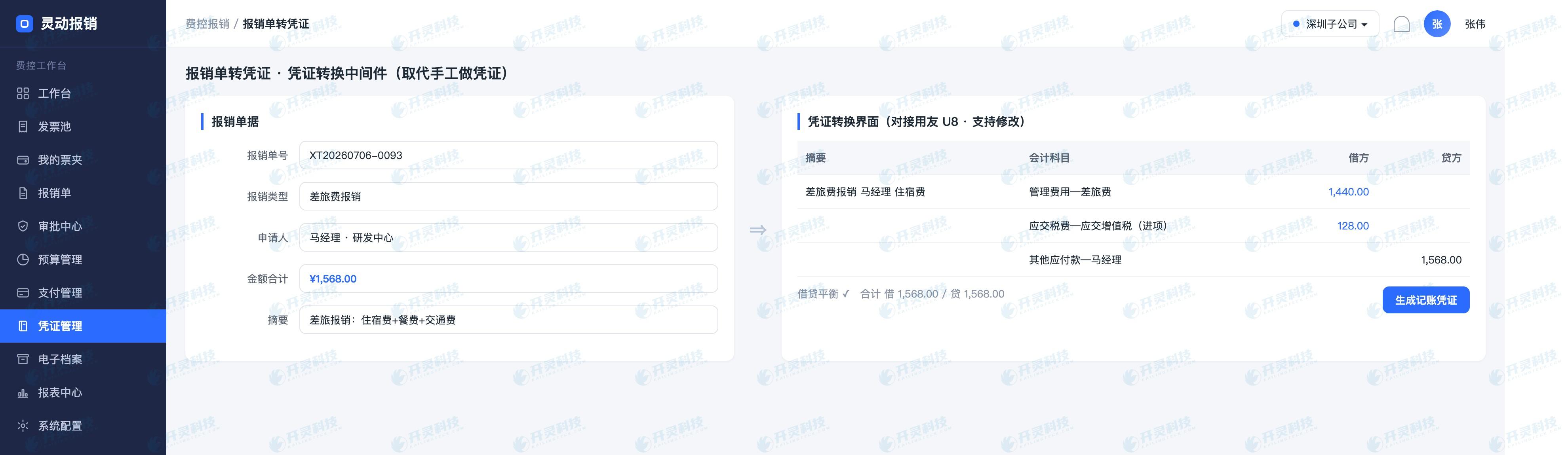
Reimbursement form to voucher interface (information desensitized)
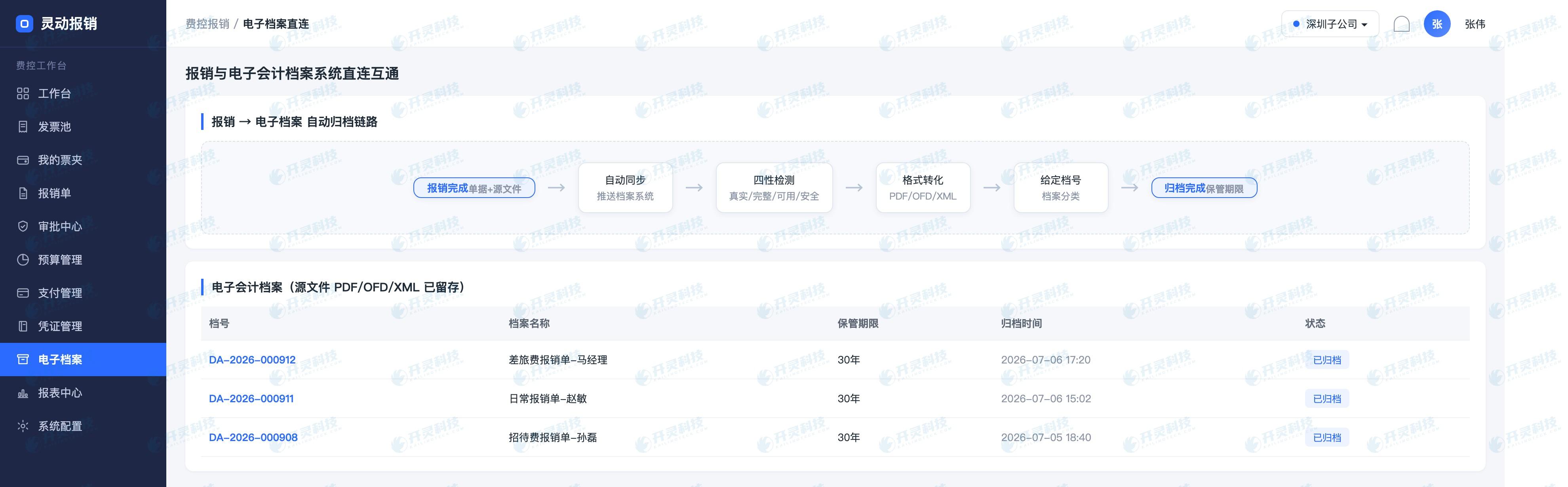
Electronic accounting archive archiving connection interface (information desensitized)
▍How Kailing Technology Lingdong Reimbursement routes exceptions to the right people
The focus of automation is not to make all documents unreviewed, but to reduce repetitive actions by finance on normal documents. Documents with authentic and valid invoices, complete fields, amounts within standards, sufficient budget, and clear associations can continue through the established process; when the header is inconsistent, reimbursement is duplicated, expenses exceed standards, or key attachments are missing, the system hands the specific reasons to the approver.
Manual handling also needs boundaries. Approvers can make judgments based on policies and business explanations, but should not cover up upstream problems by modifying downstream results. For example, duplicate invoices cannot be released merely with a note, inconsistent payees require verification of the contract or delegation relationship, and interface timeouts should first query the original result before deciding whether to retry. How an exception was judged, who handled it, and how it was finally closed should all remain on the original document.
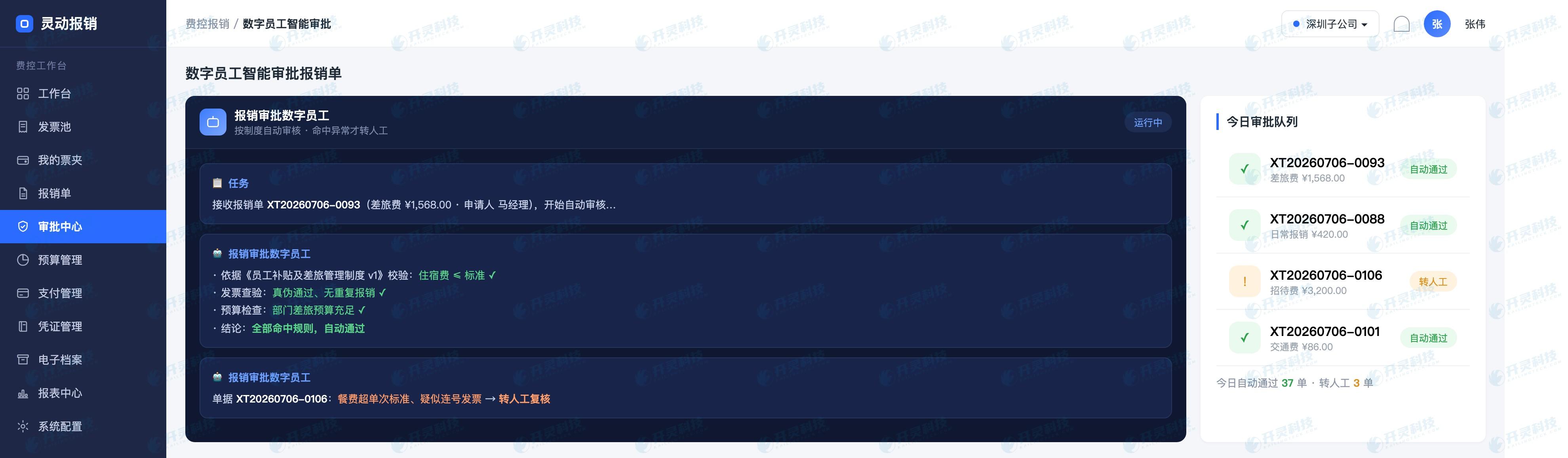
Digital employees assist review and flag abnormal reasons (information desensitized)
▍Five common signals that an enterprise needs an expense control system
Enterprises do not need to wait until the reimbursement scale is particularly large to discuss expense control. As long as expense processing already affects management bases, employee experience or month-end closing, it is worth doing a full-chain check. When two or three of the following signals appear at the same time, it usually indicates that the problem can no longer be solved long-term by adding one more reviewer.
- The budget is always explained only at month-end: At the time the business occurs, the available balance cannot be seen, and departments and finance use different bases.
- Employees repeatedly fill in the same information: Invoices, applications, reimbursements, and payments require repeated manual copying between them.
- Finance spends time on normal documents: Verification, duplicate checking, and policy comparison are not front-loaded, so abnormalities queue together with normal items.
- After approval, it still needs to be reorganized: Payment, bank receipts, vouchers and archiving cannot continue using the original document data.
- Group data is difficult to aggregate and difficult to explain: Headquarters can see the total but cannot drill down to legal entity, department, project, and original invoice.
Before going live, it is best to validate with the enterprise's own real documents rather than only watching a demo. Samples such as normal travel, over-standard accommodation, duplicate invoices, cross-organization expenses and returned payments should all be run through to confirm who generates each status, how it is written back, and whether it can be traced. Only when the system adapts to management rules can expenses truly be controlled.
▍FAQ
Q: If OA approval already exists, is an expense control system still needed?
A: If OA is only responsible for forms and approvals, while budget, invoices, payments, vouchers and archives still rely on manual connection, the expense control system still has value. Whether to build it should be judged by the number of breakpoints and business complexity.
Q: After the expense control system goes live, will the number of approvers decrease?
A: The number of positions may not change immediately, but normal documents can have basic verification completed by rules, and approvers can focus their energy on exceptions, business reasonableness and authorization judgments.
Q: Will budget control affect business efficiency?
A: The key lies in whether the budget granularity, occupation and release nodes, and exception paths match the enterprise's actual situation. Clear rules that can explain the reasons are usually more efficient than repeated post-hoc rejections.
Q: Which interfaces should be looked at first when selecting a system?
A: Prioritize confirming the interfaces that affect the end-to-end closed loop, such as organization and personnel, budget or projects, invoices, bank payments, financial vouchers and electronic archives.
Start with one real expense to verify budget, invoices, payment, and archiving, and learn about Kailing Technology Lingdong Reimbursement: https://www.kailingteck.com/feikong/ .
As a national high-tech enterprise, Kailing Technology focuses on the digital and intelligent transformation of enterprise business-finance-tax and operations management, providing software products, system integration, implementation and delivery, and operational services for various government agencies, institutions, group enterprises, and SMEs.
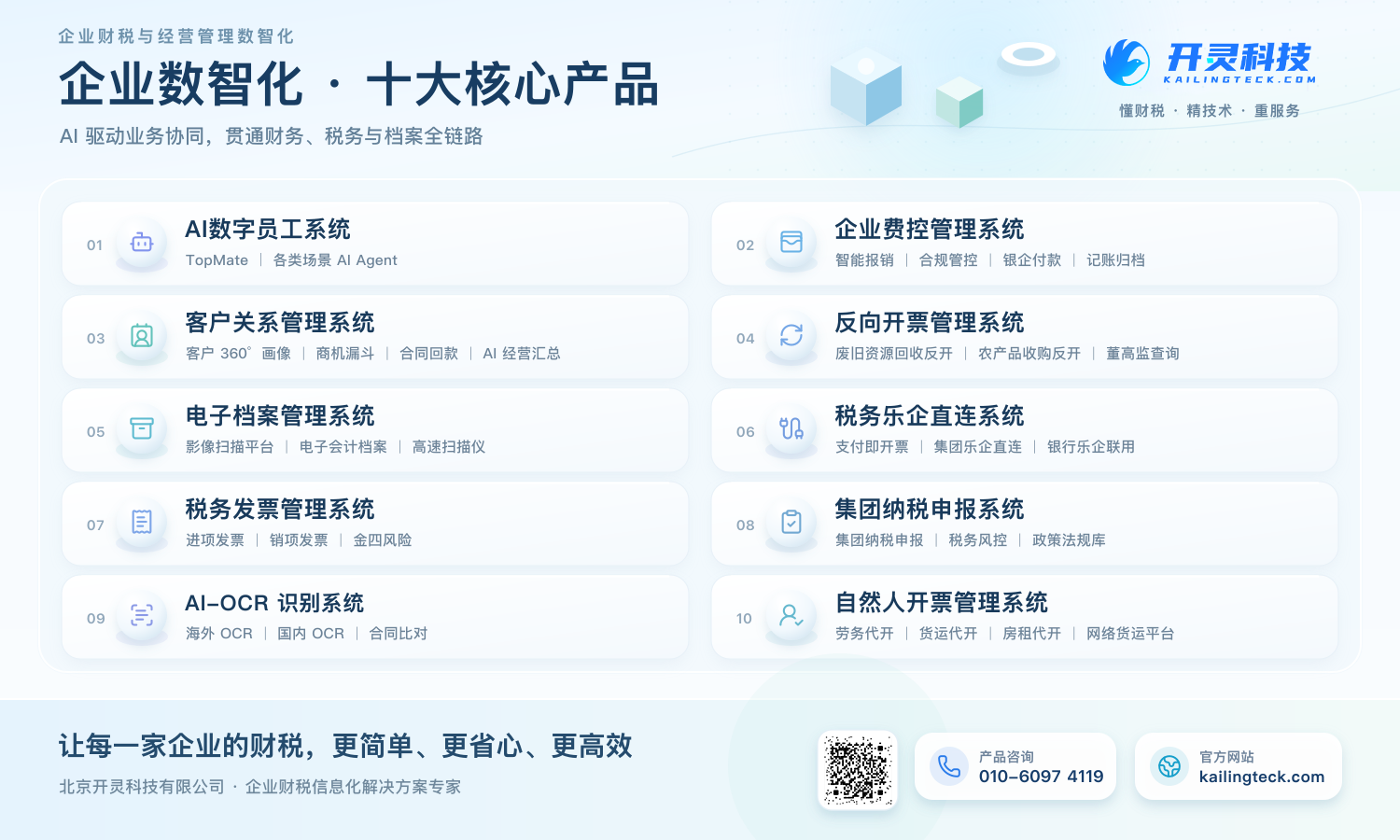
The company has now formed ten core product lines, including: AI digital employee system, enterprise expense control management system, customer relationship management system, reverse invoicing management system, invoice issuance for individuals management system, electronic archives management system, tax fully digitalized e-invoice Leqi system, tax invoice management system, group tax filing system, and AI OCR recognition system. It is committed to connecting enterprise business, finance, tax, funds, and archive data to help customers improve operational efficiency, business-finance-tax compliance capabilities, and digital management levels.
If you have any business-finance-tax digital transformation needs, welcome to contact us. Beijing Kailing Technology will serve you wholeheartedly.
 Keywords: What is the use of an expense control system, enterprise expense management, agile reimbursement, budget control, invoice duplicate checking, bank-enterprise direct connection, electronic accounting archives
As a comprehensive business-finance-tax digitalization solution service provider, Kailing Technology provides business-finance-tax management digital transformation products and operational services for various government agencies, institutions, and large, medium, and small enterprises. The product line includes: solutions for sales contract management system, procurement contract management system, fully digitalized Leqi interface project, automatic output invoicing system, reverse invoicing system, invoice issuance for individuals system, employee expense control and reimbursement system, input VAT invoice management system, supply chain collaborative reconciliation system, image AI OCR recognition system, automatic financial bookkeeping system, electronic accounting archives system, etc., comprehensively driving the digitalization process across various fields.
Consultation Hotline: 18513895936 / 010-60974119 Location: Beijing