
Which businesses does reverse invoicing for resource recycling enterprises apply to? Kailing Technology's reverse invoicing Leqi integration solution first clarifies the entities and boundaries
When a resource recycling enterprise uses Leqi joint usage to handle reverse invoicing, what is connected is not a standalone invoicing button. The payment platform connects to the tax authority's Leqi platform, and the resource recycling enterprise, as a Leqi user entity, connects to the payment platform, completing payment, invoicing, and tax payment within the same online transaction. Kailing Technology's reverse invoicing Leqi joint usage solution is responsible for connecting the enterprise's seller files, goods receipt business, and internal approvals to this chain, so that payment instructions received by the platform correspond to real acquisitions.
State Taxation Administration Announcement No. 5 of 2024 established the basic rules for reverse invoicing by resource recycling enterprises to individuals selling scrap products. The three-flows-in-one reverse invoicing introduced in 2026 does not change the applicable boundaries of enterprises and transactions, but in eligible online payment scenarios synchronizes the invoice flow, person-enterprise relationship, and fund flow. Enterprises should first determine whether the business can be reverse invoiced, and then choose the Leqi joint-use channel; the order cannot be reversed.
▍1. The three roles in Leqi joint usage
The first layer of Leqi Joint Use is the role relationship. Banks, payment institutions, or internet platforms that have completed Leqi access usually assume the roles of direct connection unit and direct connection platform, responsible for connecting to the tax Leqi platform, subscribing to relevant capabilities, and maintaining user units. Resource recycling enterprises have no controlling relationship with the platform and become Leqi user units after being invited by the platform, using tax-related services such as fully digitalized e-invoices in the business and payment environment provided by the platform.
Kailing Technology sits between enterprise business systems and the Leqi joint-use platform. The solution converts individual profiles, goods names, weights, unit prices, receiving notes, and internal approval results into data the platform can accept, while receiving payment, tax payment, invoicing, and failure statuses. This position determines that Kailing can neither replace the payment platform's direct connection qualification nor replace the enterprise's confirmation of business authenticity.
▍II. Reverse invoicing eligibility remains a prerequisite for access
Enterprises need to actually engage in resource recycling business and meet the corresponding licensing, qualification, or filing conditions for hazardous waste collection, scrapped motor vehicle recycling and dismantling, or other renewable resource recycling. Enterprises also need to handle reverse invoicing-related matters with the competent tax authority. Accessing the Leqi joint-use platform will not automatically grant reverse invoicing qualification, nor will it expand the original business scope.
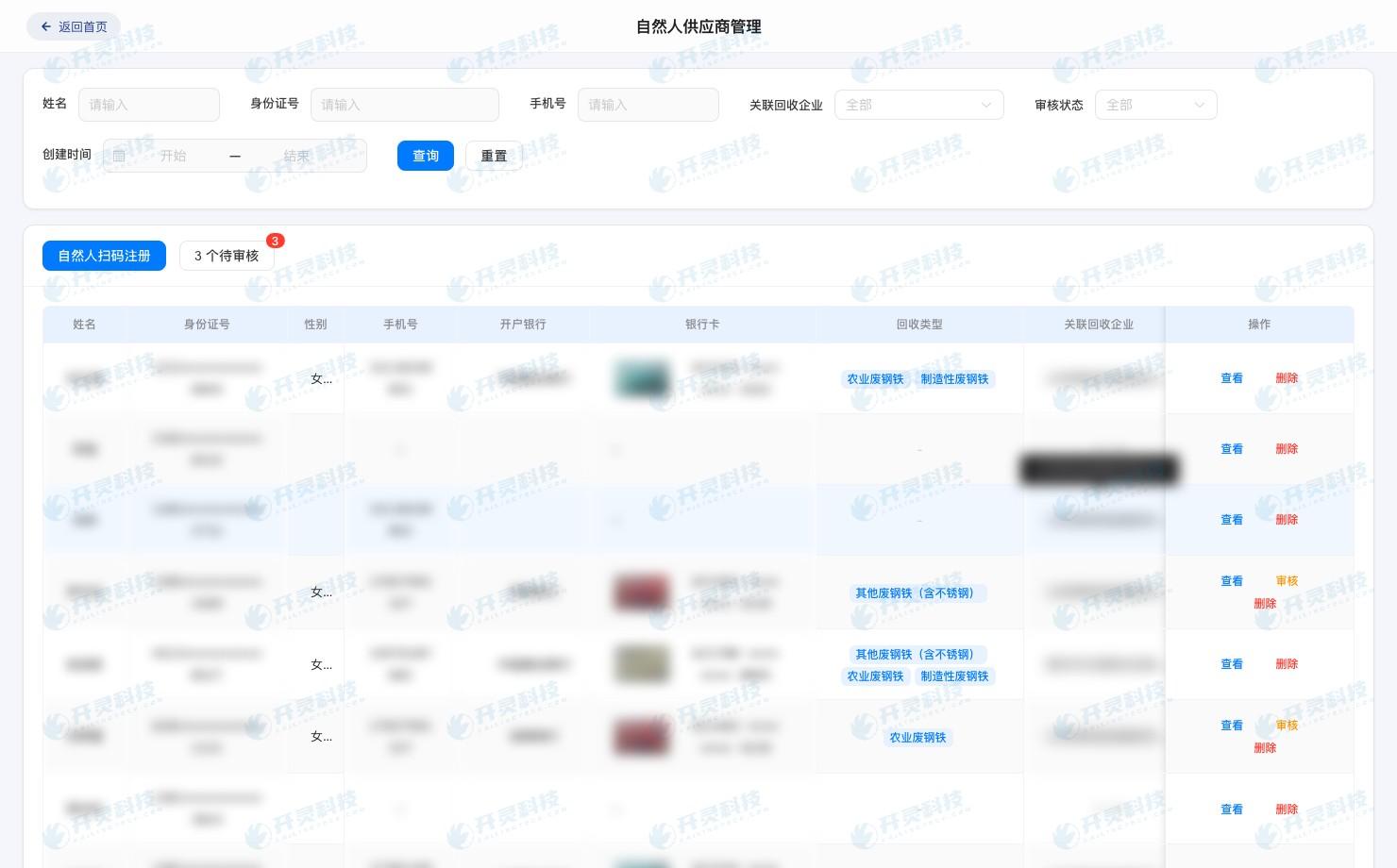
Kailing establishes qualification archives on the enterprise side, recording license type, validity period, applicable goods and maintenance owner. When business personnel create an acquisition order, the system first checks whether the enterprise's current qualifications match the scrap product category; if a license is invalid, materials are missing, or there is a business scope conflict, the business remains in a pending state and no subsequent request is sent to the payment platform.
▍3. Original transactions must be traceable to actual receipt of goods
Leqi Joint Use requires that the original transaction or fund receipt/payment data of the user unit be generated in the direct connection unit's own information system. Resource recycling enterprises therefore need to send confirmed receipt information into the cooperating payment platform, and the platform forms traceable transaction or payment records. It is not permissible to first pay arbitrarily offline and then add invoicing information into the platform; nor to generate reverse invoices based only on a payment application without real receipt of goods.
Kailing binds weighbridge, acceptance, warehousing and business documents to platform orders. When the goods name, quantity, unit price or payee changes, the system retains the original values and adjustment reasons, and passes the final confirmed data to the platform. The same business identifier runs through the goods receipt note, platform transaction, payment, invoice and tax result, and finance can trace the source from any node.
▍IV. Online payment triggers invoicing and tax payment
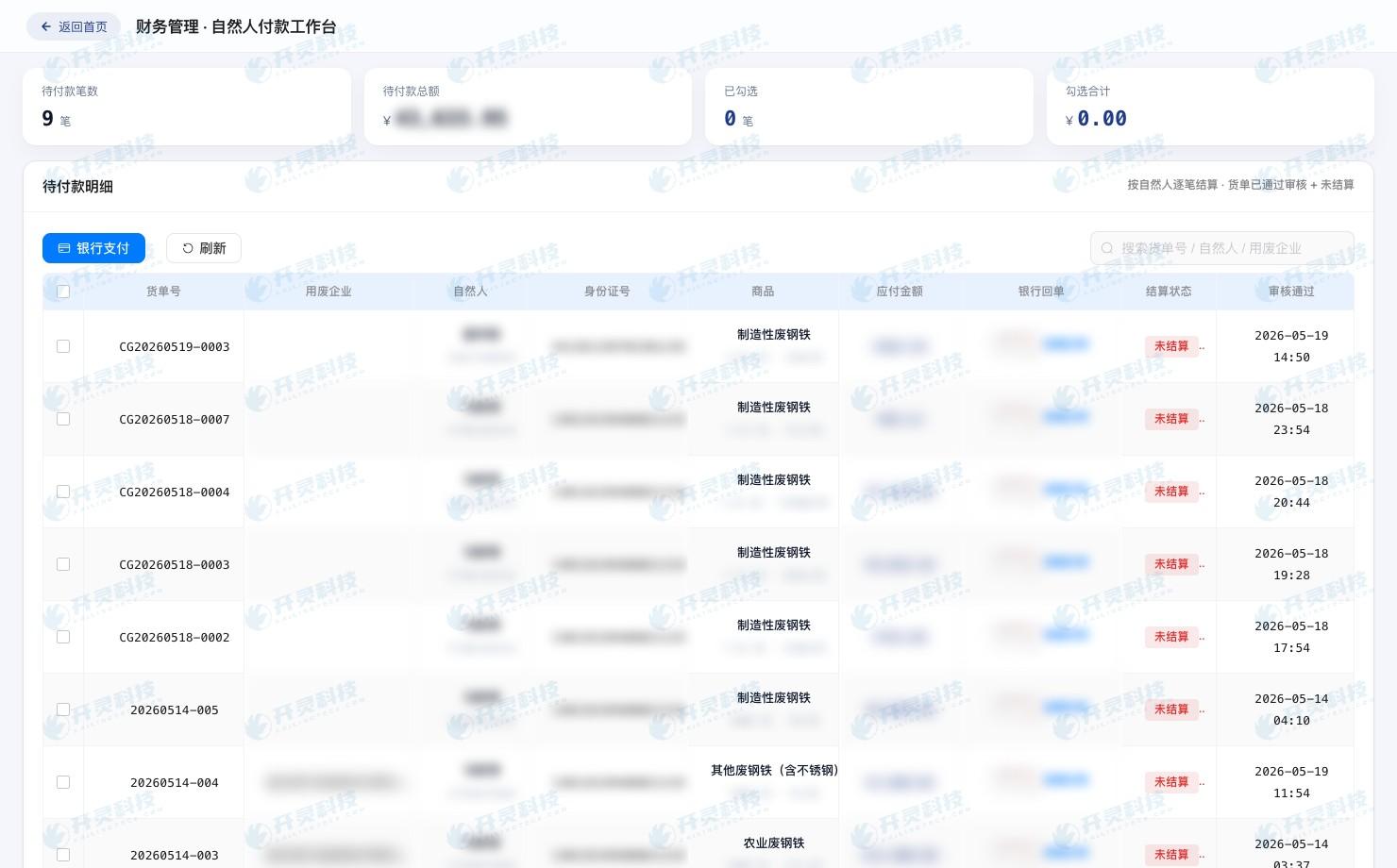
After the functional integration is completed, resource recycling enterprises initiate payment to individual sellers on the cooperative payment platform. The platform calculates the payment amount based on transaction information such as goods name, unit price, and weight, pre-fills the invoice, and generates tax payment information. After the individual seller confirms according to the platform process, tax payment, payment for goods, and invoice issuance are completed in the same online link.
Invoicing success is only a result node. Kailing must also receive the payment transaction, tax status, invoice number, invoice file, and processing time returned by the platform, and write them back to the enterprise's original receipt. Payment failure, incomplete tax payment, blocked invoicing, or interface timeout should each display their own status and reason, and must not all be uniformly marked as "invoicing failed."
▍V. Three-flow linkage and five-flow evidence jointly land on one transaction
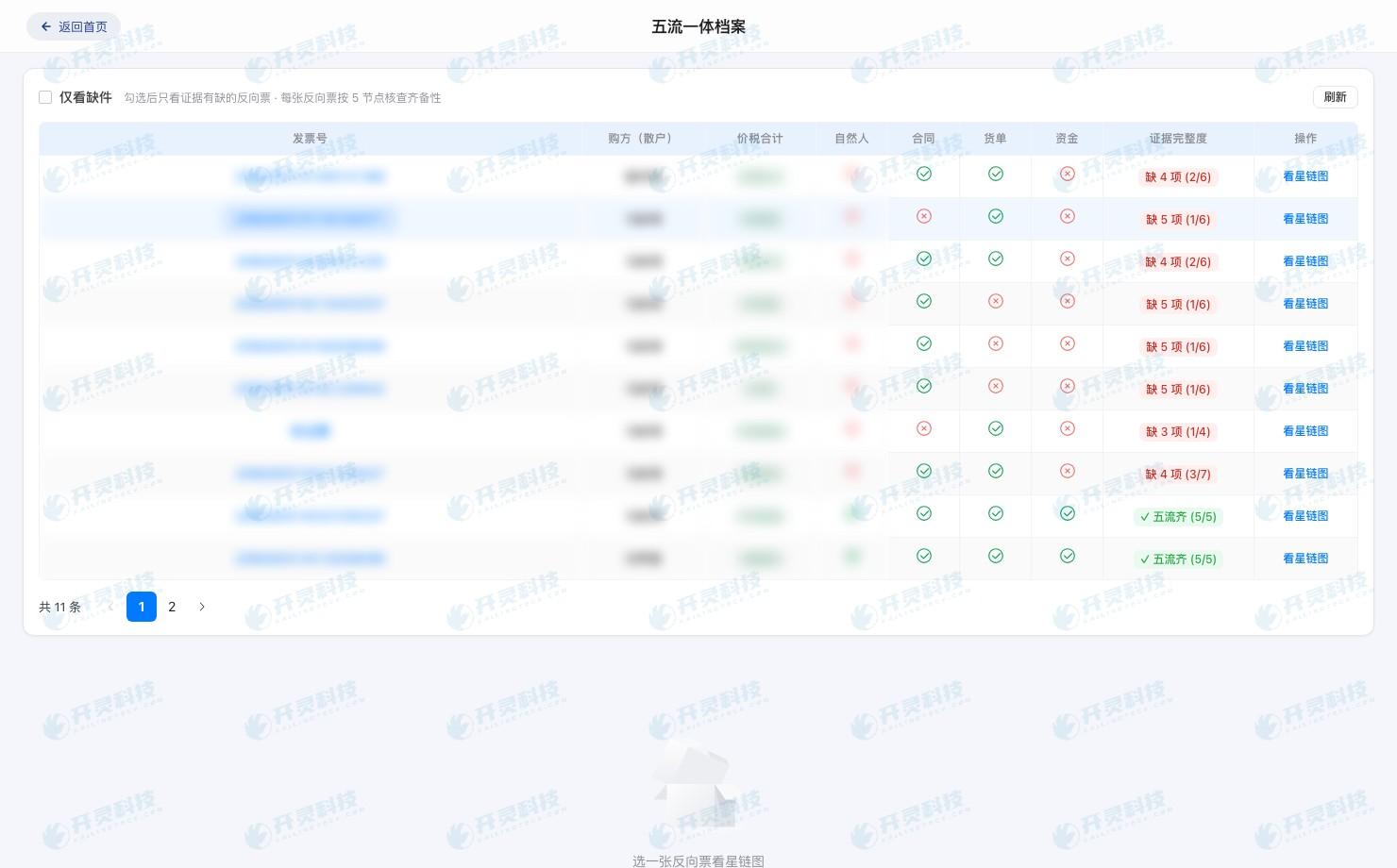
Three flows in one is the operating standard on the tax and payment side, emphasizing that invoices, entity relationships, and funds correspond to each other in the same online processing procedure. Kailing's five flows in one is the enterprise's internal evidence management standard, attributing self-proof materials, contractual agreements, receipt business, tax results, and fund vouchers to the same purchase.
Enterprises do not need to manually copy another ledger for five-flow management. Kailing automatically collects materials from existing archives, contracts, receiving systems and Leqi joint-use return results: the platform's three-flow proof of payment, entity and invoice-tax processing form a closed loop, and the enterprise's five flows further explain where goods come from, under what agreement they are purchased, who accepts them, and how they are subsequently recorded.
▍VI. Different channels must be managed separately
Enterprises may still have reverse invoicing business that is not conducted through Leqi joint use. The system should clearly identify the invoicing channel, separately save the applicable prepayment basis, filing responsibility and business status, and avoid mixing ordinary reverse invoicing records into the three-flow-in-one statistics. When online payment does not go through the cooperative platform, it also cannot be retroactively marked as three-flow-in-one business.
When choosing a platform, enterprises should verify local open capabilities, platform invitation relationships, account activation, interface scope, and exception handling methods. Based on this, Kailing configures the fields, permissions, and callback rules between the business system and the designated platform, so that every reverse invoicing transaction can explain the enterprise qualification, individual seller, scrapped product, payment platform, and tax result.
▍FAQ
Q: After connecting to Leqi connected use, can reverse invoicing be done directly?
A: No. The enterprise still needs to have reverse invoicing qualification and be invited by the payment platform to become a Leqi user unit, completing account and interface integration.
Q: What role do resource recycling enterprises play in Leqi Direct Connection?
A: Usually it is the Leqi user entity; the party bearing direct connection and platform operation responsibility is a confirmed direct connection unit such as a payment platform.
Q: What does Kailing Technology do in the chain?
A: Connect the enterprise receiving and archive systems, cooperative payment platforms, and return results, and complete verification, exception handling, and five-flow archiving.
Q: Will five-flow integration replace the tax three-flow integration?
A: No. The three flows are the platform and tax handling definition, and the five flows are the enterprise evidence management definition; the two support each other around the same business.
Truly connect reverse invoicing eligibility, the Leqi Direct Connection channel, and enterprise purchase business. Welcome to visit Kailing Technology: www.kailingteck.com .
As a national high-tech enterprise, Kailing Technology focuses on the digital and intelligent transformation of enterprise business-finance-tax and operations management, providing software products, system integration, implementation and delivery, and operational services for various government agencies, institutions, group enterprises, and SMEs.
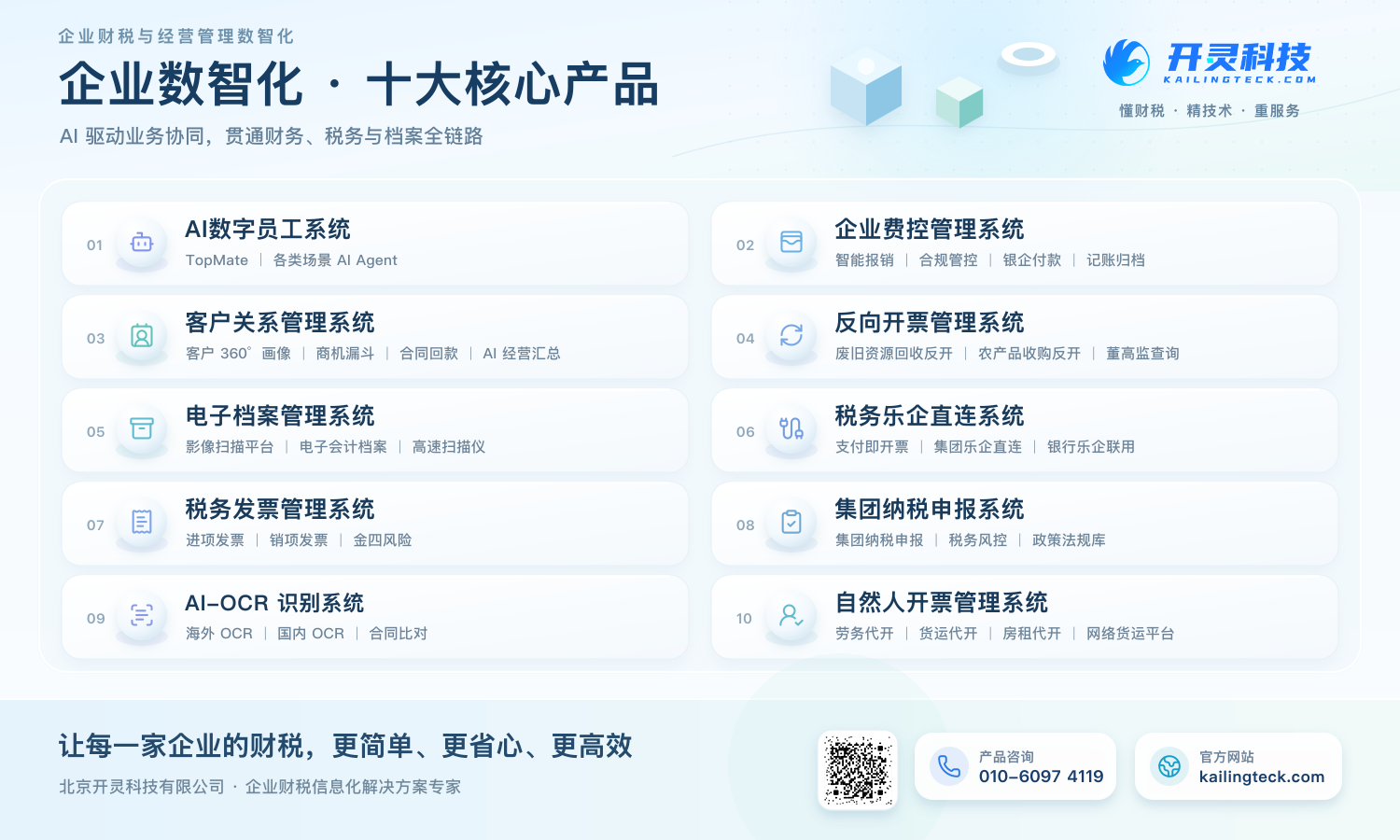
The company has now formed ten core product lines, including: AI digital employee system, enterprise expense control management system, customer relationship management system, reverse invoicing management system, invoice issuance for individuals management system, electronic archives management system, tax fully digitalized e-invoice Leqi system, tax invoice management system, group tax filing system, and AI OCR recognition system. It is committed to connecting enterprise business, finance, tax, funds, and archive data to help customers improve operational efficiency, business-finance-tax compliance capabilities, and digital management levels.
If you have any business-finance-tax digital transformation needs, welcome to contact us. Beijing Kailing Technology will serve you wholeheartedly.
Keywords: Applicable entities for resource recycling reverse invoicing, Leqi user entities, three-flow integration reverse invoicing, five-flow integration reverse invoicing, Kailing Technology reverse invoicing
As a comprehensive business-finance-tax digitalization solution service provider, Kailing Technology provides business-finance-tax management digital transformation products and operational services for various government agencies, institutions, and large, medium, and small enterprises. The product line includes: solutions for sales contract management system, procurement contract management system, fully digitalized Leqi interface project, automatic output invoicing system, reverse invoicing system, invoice issuance for individuals system, employee expense control and reimbursement system, input VAT invoice management system, supply chain collaborative reconciliation system, image AI OCR recognition system, automatic financial bookkeeping system, electronic accounting archives system, etc., comprehensively driving the digitalization process across various fields.
Consultation Hotline: 18513895936 / 010-60974119 Location: Beijing